
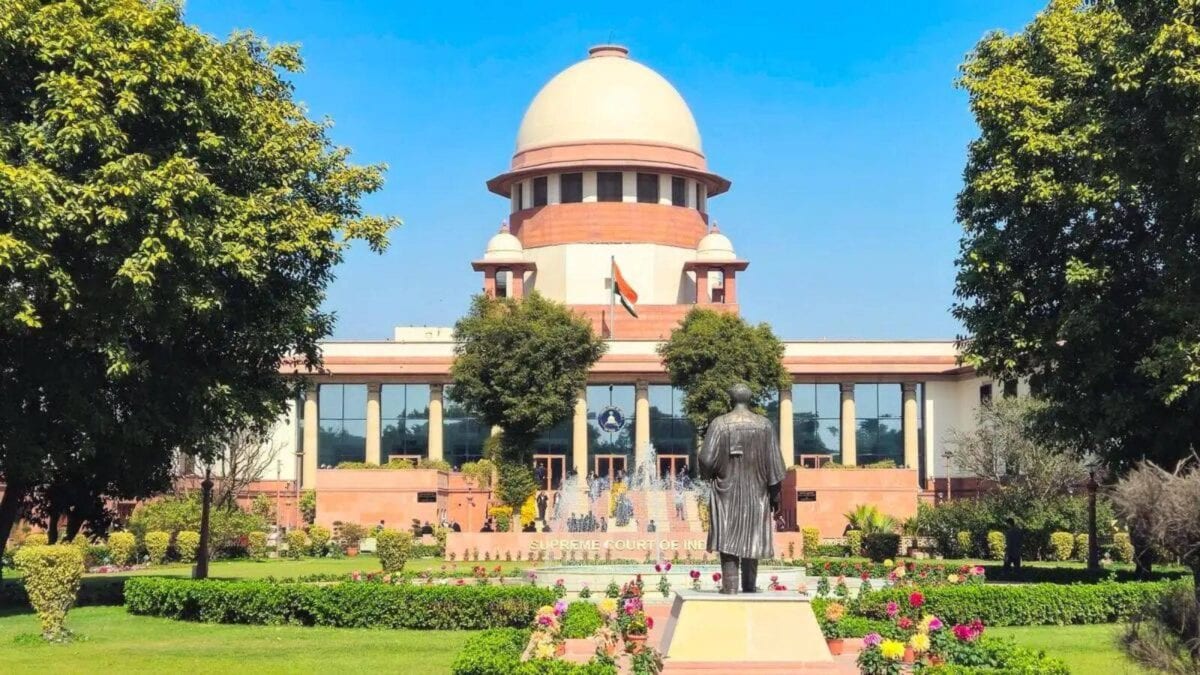
The Supreme Court on Monday said every woman in Delhi-NCR should feel safe walking at 10 PM. The bench stressed that safety measures must move beyond paper to the grassroots level. “You need to work at the grassroots level,” the court said, while questioning the effectiveness of current surveillance systems.
Supreme Court says every woman in Delhi should feel safe walking at 10 pm, using metro or roads, and seeks ground-level action on women’s safety.
The Supreme Court on Monday said its endeavour is to ensure that every woman in Delhi-NCR feels safe while moving through public spaces, stressing that safety cannot remain confined to measures existing only on paper.
“We have to ensure that every woman in NCT Delhi should feel safe whether walking at 10 PM or by metro or road," the court said during the hearing of the Delhi-NCR rape suo motu case.
The matter was being heard by a bench headed by Justice JB Pardiwala.
During the hearing, the court also questioned the effectiveness of surveillance infrastructure, asking, “How would a CCTV prevent a crime if there’s no continuous monitoring, and how would the crime be prevented if there’s no war room."
The Supreme Court also emphasised the need for action at the grassroots level, making clear that merely placing measures and directions on paper would not be sufficient.
“You need to work at the grassroots level. We are in a country like India where putting all this on paper will not work," the court said.
It further indicated that authorities should not hesitate to adopt strict measures when required, even if such steps invite objections.
“If you have to be strict, don’t hesitate. There will be people raising hue and cry about Article 21," the court said.
The latest hearing follows the Supreme Court’s September 28 decision to take suo motu cognisance of a series of recent rape and sexual assault incidents in Delhi-NCR.
The court had questioned whether law-enforcement and civil authorities had been able to establish effective mechanisms to prevent such crimes, particularly in public spaces.
The court had made clear that the proceedings were not intended to determine the guilt of individual accused persons.
Instead, the focus was on broader institutional failures and whether the State and its agencies had established effective preventive, monitoring and response mechanisms to protect women and children.
The last hearing referred to the alleged gang rape of a 17-year-old girl at Aastha Kunj Park, the alleged gang rape and murder of a teenage girl in Swaroop Nagar, and the alleged sexual assault of a minor girl on a moving sleeper bus that travelled more than 47 km from Greater Noida to Delhi without being intercepted.
The court said the bus incident brought back painful memories of the 2012 Nirbhaya case.
The bench had also noted previous complaints by students of Lady Shri Ram College for Women regarding recurrent sexual harassment around Aastha Kunj Park.
It said those complaints had not resulted in adequate patrolling and vigilance before another alleged attack.
The court had warned that parks, roads, buses, metro stations, subways and footbridges cannot become high-risk zones because of inadequate lighting, poor surveillance, lax patrolling or other preventable administrative deficiencies.
Court Demands Ground-Level Assessment Of Safety Measures
The Supreme Court had sought a comprehensive status report covering safety arrangements in parks, roads, public transport facilities, markets, educational institutions and other places frequented by women and children.
Authorities were specifically asked whether these mechanisms remained effective during late evenings and early mornings, when visibility and public footfall could be lower.
The court also sought details on the use of the National Database on Sexual Offenders for antecedent verification and identification of repeat or habitual sexual offenders.
It asked how often the database had been used in Delhi investigations during the preceding five years and whether the information was being converted into lawful preventive action.
It similarly sought details about the Investigation Tracking System for Sexual Offences, including who monitors investigations, how frequently cases are reviewed and what happens when investigations are delayed.
The court also sought the status of Mission Shakti, Emergency Response Support System 112, Women Helpline 181, the Safe City Project, Women Help Desks and One Stop Centres.
For the Safe City Project, it specifically sought details about CCTV coverage, command-and-control infrastructure, smart lighting, emergency response systems and the functioning of installed equipment.