
The Election Commission of India faces a credibility crisis after two commissioners recorded 14 objections over 10 months regarding decisions made without their knowledge. On September 29, the Supreme Court agreed to hear a petition questioning if Chief Election Commissioner Gyanesh Kumar took key actions without the other commissioners' concurrence.
For months, the Election Commission of India (ECI) has fought Opposition allegations of "vote chori" and rejected claims that its Special Intensive Revision (SIR) of electoral rolls placed an unconstitutional burden on vulnerable citizens. On September 23, a report in The Indian Express brought the credibility battle to Nirvachan Sadan itself. Two of the three election commissioners, Sukhbir Singh Sandhu and Vivek Joshi, reportedly recorded objections at least 14 times over 10 months to decisions and orders they said were taken without their knowledge, asking who had authorised them. The ECI, on its part, through two press notes, said that all decisions related to the SIR were unanimous, though it did not respond to some of the other allegations in the newsreport.
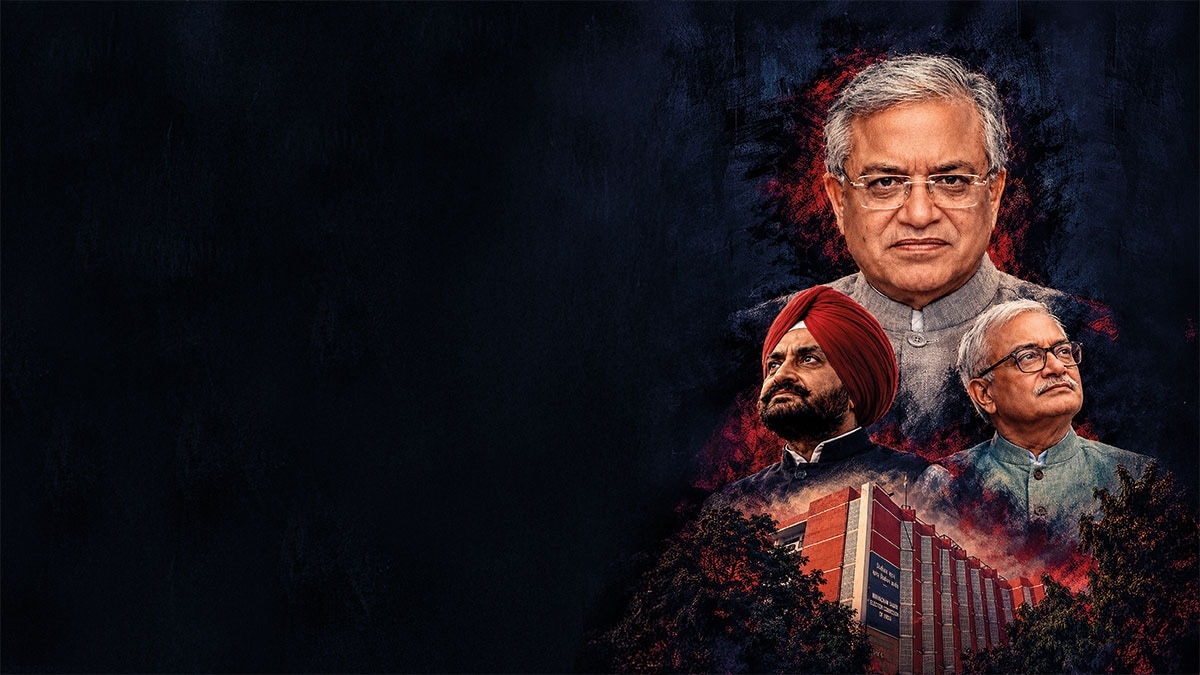
The controversy has now reached the Supreme Court. On September 29, the apex court agreed to hear, in the following week, a petition asking whether Chief Election Commissioner (CEC) Gyanesh Kumar took key decisions without the concurrence of the other two election commissioners (ECs). The plea seeks production and preservation of the ECI's records since October 2025, potentially putting its internal decision-making and claims of unanimity under judicial scrutiny. The ECI must not merely be independent but must also be seen to be independent, Supreme Court Justice Dipankar Datta said on September 23, voicing a difference of opinion with Justice Satish Chandra Sharma over a challenge to the 2023 law governing the appointment of ECs.The three men at the centre of the storm are career bureaucrats who came to Nirvachan Sadan from other arms of government. Kumar, a 1988-batch IAS officer of the Kerala cadre and an IIT Kanpur alumnus, headed the Jammu and Kashmir division of the home ministry when Article 370 was revoked in 2019, and also served as Union secretary, cooperation. Sandhu, an officer of the same batch from the Uttarakhand cadre, is a doctor by training who went on to become Uttarakhand's chief secretary and chairman of the National Highways Authority of India. Joshi, a Haryana-cadre officer and IIT Roorkee alumnus with a doctorate from Geneva, was registrar general and census commissioner from 2019 to 2022 and later Haryana's chief secretary.Taken together, the internal dissent recorded by the two ECs, the court battle over the process for appointing ECs and the commission's own defensive responses point to a deepening credibility crisis within the ECI on several key fronts. A HOUSE DIVIDED? Chief Election Commissioner Gyanesh Kumar (centre) with ECs Sukhbir Singh Sandhu and Vivek Joshi at Nirvachan Sadan, New Delhi (Graphics by Tanmoy Chakraborty) CRISIS 1 : The SIR's burden of proofThe first concern is the SIR itself, and whether a long-overdue clean-up of rolls has become a tool for shifting the burden of proving eligibility onto voters, leaving millions at risk of disenfranchisement. The exercise began on June 24, 2025, when the ECI ordered an intensive revision of Bihar's electoral rolls, the first since 2003, five months before the state election. Every elector had to submit a fresh enumeration form; those who could not be mapped to the 2003 roll had to produce one of 11 documents that initially excluded Aadhaar, voter ID and ration cards. Critics called it a citizenship test by the back door. The SC later added Aadhaar as the 12th document, but specified it could serve as proof of identity, not of citizenship. On May 27 this year, it upheld the ECI's authority to conduct the SIR.In West Bengal, nearly six months before polls in April this year, the ECI set in motion a process to link each elector to the previous intensive-revision roll. Those it could not link were marked "unmapped"; those it could link but with anomalies detected were flagged for "logical discrepancies". Around 13.6 million voters received such notices. The discrepancy categories grew from four to 11, including an age gap of under 15 years between a voter and a parent, more than six children linked to one parent, variations in how a parent's name was spelt, and women mapped to their father in an older roll but to their husband in the current one. None of these filters, apparently, was defined in the public SIR orders.As a result, in the 15 months since the SIR swept across much of the country, an unprecedented number of voters have been removed from the electoral rolls. Bihar saw 6.86 million names removed and 2.15 million added. That left the state's electorate roughly 4.7 million -- about 6 per cent -- smaller. Uttar Pradesh's January draft omitted 28.9 million voters, nearly a fifth of the electorate. The state's final roll, in April, still had about 20.4 million fewer electors than its pre-SIR list of 154.4 million -- counting claims as well as first-time registrants. Across Phase II's 12 states and Union territories, the combined final rolls shrank by more than 10 per cent: over 51.8 million out of 510 million. In the 20 states and UTs that have published their final rolls till now, including seven from the ongoing Phase III, net deletions have exceeded 60 million. Several big states in Phase III, such as Maharashtra, Karnataka, Andhra Pradesh, Telangana, Punjab, Haryana and Delhi, have yet to publish their final rolls. Spanning 16 states and three UTs, they had deleted over 61.6 million names from the draft rolls. Cumulative deletions at the draft stage stand at 133.9 million. This is provisional: the final figures depend on claimsobjections and first-time registrations. As a ballpark, of the reductions in Phase II, 6.3 million names, or over 12 per cent, were deleted after objections, while another 6.7 million electors, or nearly 13 per cent, were listed as dead.Former EC Ashok Lavasa argues that the SIR exercise reverses the commission's traditional responsibility. "It is conceptually flawed," he says. "It turns the system upside down by shifting the burden of proving eligibility from the ECI to the voter. For 75 years, it was the ECI's duty to go to citizens and include them in the electoral roll. The SIR appears to have changed the priority from inclusion to exclusion."There is no consolidated national count of challenges. In Bihar, the ECI claimed there were no appeals. In Bengal, citing a "trust deficit" between the commission and the state government, the apex court in February invoked its discretionary powers under Article 142 and handed around six million pending cases to judicial officers. Of these, 1.61 million appeals were reportedly filed in the ECI's name, seeking the deletion of voters whom judicial officers had already cleared. Sandhu asked who had authorised the appeals "on behalf of ECI", recording that neither he nor Joshi had been informed. The apex court is now scheduled to hear, on October 5, petitions over unresolved voter appeals in the Bengal SIR, just a day before bypolls in the state.The ECI defends the SIR on three grounds. The rolls had not been intensively revised for more than two decades and had accumulated dead, migrated and duplicate entries, an issue parties across the political spectrum had raised. ECI sources point to considerable disinformation on the number of people left out of the rolls. Of the 133.9 million individuals who do not figure in draft rolls, they say 131.3 million -- or 98 per cent -- fall into four categories: dead, absent, shifted or duplicate. That leaves some 2.6 million excluded for other reasons, such as documentation. The ECI also claims no name is deleted without notice and a hearing, and that the exercise has so far survived judicial scrutiny. Individual errors must be corrected, sources acknowledge, but they cannot by themselves establish that the entire system was designed to exclude legitimate voters. Accused of callousness over deletions and objections, the ECI met on September 26 and softened the process. Booth-level officers will ordinarily visit flagged voters and upload their documents; online hearings are preferred; adult family members may represent voters; help desks will assist vulnerable groups; and deadlines for filing claims have been extended in Delhi and Maharashtra. CRISIS 2 : The Form 6 overreachThe sharpest legal dispute, and the one that attracts profiling charges, concerns Form 6. Prescribed by Rule 13 of the Registration of Electors Rules, 1960, it allows a new voter to seek inclusion in an electoral roll. Under Section 28 of the 1950 Act, it can be amended only by the central government after consulting the ECI and notifying the change in the Official Gazette, after which the amendment must be laid before both Houses for 30 sitting days. That was how Form 6 was last amended, in 2022. By July 12 this year, however, the online Form 6 on ECINet carried a new section between Parts J and K asking whether the applicant, a parent or a grandparent figured in the roll of the previous SIR, along with the constituency, polling booth and serial number. The field was not marked mandatory, yet the form could not be submitted without it. Curiously, however, the downloadable version of the form had no such section.Joshi had reportedly warned in May that a form prescribed under the 1960 Rules could not be altered through an SIR instruction. On August 13, Sandhu called the change "unauthorised and illegal" and demanded its removal. ECI sources insist the statutory paper form was untouched and the online change merely integrated two existing requirements into a single digital process, sparing applicants a second e-signature. Besides, the additional declaration form was added as an annexure to Form 6 during the Bihar SIR and, on May 27, the SC upheld the legality of SIR and its documentation framework. Critics counter that, in upholding the SIR framework, the SC never decided whether the ECI could make an additional requirement effectively compulsory through software. "Asking an applicant whether their parents or grandparents figured in an earlier SIR roll is not a procedural or formatting change; it is a substantive addition to the registration requirement," says jurist and five-term MP Abhishek Manu Singhvi.Lineage data matters because of the timing. The Census, delayed since 2021, is under way, with house-listing this year and population enumeration, including caste, slated to begin on March 1, 2027. The constitutional freeze on redrawing constituencies and reallocating Lok Sabha seats among states, extended by the 84th Amendment in 2001, ends with the first Census after 2026. The one-third quota for women in legislatures, passed in 2023, takes effect post delimitation. Delimitation is based on Census population, not electoral rolls. But the Opposition fears that rolls re-verified via family lineage -- with flagged and deleted voters concentrated in particular communities and regions -- could give the State a profile of the electorate and shape how new constituencies are drawn and reserved, and who is counted as a voter in them. The ECI dismisses this as conjecture. The problem? The filters generating that profile were never made public. ECI sources say mapping was introduced to reduce the burden of producing documents. Since many Indians may not have the required papers, they can instead establish a family link to an earlier electoral roll and be included in the new roll without submitting those documents. "Mapping is not mandatory," says an ECI source. CRISIS 3 : Control by softwareThe third crisis runs through ECINet, the commission's integrated, one-stop digital platform. Launched on January 22, it merged more than 40 ECI apps and portals into a single platform, with its electoral roll module handling name addition, deletion and correction. But the law vests those powers in the Electoral Registration Officer (ERO) of each constituency, not in ECI headquarters. In a note of dissent, Joshi warned of a "gradual centralisation of the electoral roll database" and proposed an independent technical audit to certify that only statutory officers had credentials to alter entries. Sandhu recorded that state officials lacked "proper and complete access" to the portal and argued that Seema Khanna, director general, IT, had no legal authority to restrict statutory officers. On September 24, the Maharashtra Chief Electoral Officer asked the ECI to modify ECINet so that EROs could exercise their statutory discretion to resolve logical discrepancies, exempt vulnerable voters from hearings and accept a wider range of documents. The request echoed the objections raised by the two ECs that centrally controlled software was constraining powers legally vested in field-level officers."Technology cannot rewrite a statute," asserts S.Y. Quraishi, former CEC. "A computer program cannot overrule a statutory officer." In Goa, 97 voters flagged for logical discrepancies were found eligible by EROs after hearings and document checks. Rule 21 of the 1960 Rules allows an ERO to include names omitted through error, while Rule 22 requires such decisions to be incorporated before the final roll is published. An ECI deputy election commissioner also recorded that the IT system could not obstruct that authority. Yet between February 11 and 17, the Goa Chief Electoral Officer's office sent eight requests for a software facility to implement the decisions. It was not enabled before the final roll was published on February 21. The 97 voters remained excluded despite rulings in their favour and had to apply afresh through Form 6. The ECI now says 88 have since done so, six are currently out of India and three have Portuguese passports. According to the ECI, Goa exposed a limitation in one software workflow, not central control. "If the allegation that somebody sitting in the central IT division could alter the electoral roll at will was correct, the 97 Goa cases could simply have been changed centrally," says an ECI source. Only field officers with individual credentials can perform statutory functions, while headquarters handles cybersecurity, a critical task after the 6.8 million attempts to breach the system on counting day during this year's assembly elections. Critics, however, say that a system that can prevent a statutory officer from acting is itself a form of control.Other reports point to further institutional friction. The annual Special Summary Revision (SSR), which updates the rolls and enrols new voters, has not resumed for 2025-26 despite Joshi pressing for it. The ECI says there is no legal requirement to conduct an SSR alongside an SIR because both are undertaken under Section 21(3) of the Representation of the People Act, 1950. It says 27.3 million voters aged 18-28 have been added since the SIR began. CRISIS 4 : Who is the boss at ECI?All the dissent points to the larger contest over who runs the commission. A July 28 order by senior deputy election commissioner Maneesh Garg reportedly removed deputy election commissioner Sanjay Kumar from supervising the IT division headed by Seema Khanna. Sandhu and Joshi wrote separately to cabinet secretary T.V. Somanathan and jointly set aside the order the next day. The ECI says the redistribution was never implemented.The law is clear about where authority lies. The CEC is first among equals. Section 18 of the 2023 Act says the commission's business should, as far as possible, be transacted unanimously; where members differ, the majority prevails, and even the allocation of business can be altered only unanimously. Former CEC O.P. Rawat says that cuts both ways. "Together, they [the ECs] constitute a majority of the commission. If they disagree with the Chief Election Commissioner, they can overrule him. It happened to me when I was Chief Election Commissioner," he says. But he faults both sides for writing to outside authorities before sitting down together to resolve their differences.The ECI's first response, on September 23, was largely defensive: written observations are routine in a multi-member body, and every major decision had ultimately been unanimous. A second note, after the full commission met on September 26, said the Bihar order and the October 2025 and May 2026 schedules had all been approved by the three commissioners. Yet it also conceded ground. A committee headed by a senior deputy election commissioner, with an independent IIT or IIIT expert, will examine whether ECINet complies with election law. Field officers are to be given the flexibility to exercise their statutory powers; new IT modules must be vetted by a committee of officers; agendas will be circulated in advance and minutes issued; and the commissioners' directions must be "meticulously complied with". Psephologist Yogendra Yadav, a petitioner against the SIR, calls it "an ultimate admission of guilt" and a "ceasefire agreement". "Now it's not just the CEC. All three election commissioners stand exposed," he says. CRISIS 5 : Who selects the umpiresBeneath both disputes lies a structural suspicion. For seven decades, Parliament did not enact any law governing ECI appointments, leaving the executive to choose the commissioners. In March 2023, after questioning the appointment of Arun Goel as EC a day after he took voluntary retirement, a constitution bench in Anoop Baranwal vs Union of India ruled that, until Parliament legislated, appointments would be made by a committee comprising the prime minister, the leader of the Opposition and the Chief Justice of India.Parliament legislated within months. The 2023 law replaced the CJI with a Union Cabinet minister nominated by the prime minister, giving the government two representatives on the three-member selection panel, alongside the leader of the Opposition. A search committee headed by the law minister draws up the shortlist, while eligibility is restricted to those who have held posts equivalent to secretary to the Government of India, effectively limiting the field to serving or retired bureaucrats. A provision in the original bill that would have placed the commissioners' pay and status on a par with the cabinet secretary rather than a Supreme Court judge was dropped following protests. Security of tenure remains uneven. Under Article 324(5), the CEC can be removed only in the same manner and on the same grounds as a Supreme Court judge, while an EC can be removed on the CEC's recommendation.The new law was tested almost at once. In March 2024, Kumar and Sandhu were appointed days after Goel resigned; Adhir Ranjan Chowdhury, the Opposition member on the panel, said the shortlist reached him only minutes before the meeting. The Supreme Court declined to stay the appointments ahead of the Lok Sabha election but not before questioning the undue haste. In February 2025, Kumar was elevated as CEC the same night the selection committee met, over a written dissent from Rahul Gandhi. The challenge to the law remains unresolved. The controversy has brought into focus not just who appoints ECs, but also how much institutional independence the system gives them once they are appointed.A government-controlled selection process and unequal protection make dissent inside the ECI rare and costly. History offers examples. In 2009, CEC N. Gopalaswami recommended the removal of EC Navin Chawla over allegations of partisan conduct; the recommendation was rejected and Chawla later became CEC. In 2019, EC Ashok Lavasa dissented from the ECI's decisions on Model Code complaints involving Narendra Modi and Amit Shah. He resigned in August 2020, despite being next in line to become CEC. Goel resigned in March 2024, days before the Lok Sabha election schedule was announced, without giving a public reason. The irony of the present crisis is that both dissenters, Sandhu and Joshi, were appointed under the 2023 law. It is a reminder that the problem is less the individuals than a system that leaves neutrality to the office-bearers' conscience. CRISIS 6 : An uneven playing fieldThe other major concern is how unevenly the umpire treats the players. Between August 2023 and January 2024, the INDIA bloc wrote at least eight times seeking a meeting with the full commission on EVMs and VVPAT counting, but was referred to FAQs on the ECI website. Yet on June 2, 2024, a day before the Lok Sabha counting, a BJP delegation led by Nirmala Sitharaman met the full commission.The same asymmetry marked the "vote chori" row. On August 7, 2025, Rahul Gandhi presented data alleging 100,250 suspect entries in the Mahadevapura segment of Bengaluru Central. On August 17, at his first press conference as CEC, Kumar said the Congress leader should file an affidavit within seven days or apologise to the nation. Days later, BJP MP Anurag Thakur made similar claims about "fake" and "doubtful" voters in Rae Bareli, Wayanad, Diamond Harbour, Kannauj and other Opposition-held seats. He was not asked for an affidavit. When Rahul Gandhi's November 2025 "H Files" alleged around 2.5 million suspect entries in Haryana, the state CEO replied that more than 416,000 claims had been processed without appeal and that 86,790 polling agents had raised no objection.Access to evidence has also narrowed. In December 2024, after litigation seeking Haryana election records, the Centre, after consulting the ECI, amended Rule 93(2)(a) of the Conduct of Elections Rules, narrowing public access to CCTV and webcasting recordings. In May 2025, the ECI directed that such recordings be destroyed 45 days after results if no election petition was filed, and refused Rahul Gandhi's demand for Maharashtra footage after 5 pm, citing the risk of voter profiling. Jairam Ramesh's challenge to the amendment remains pending in the Supreme Court.Party-split rulings have added to perceptions of bias, with critics pointing to the ECI's decisions in favour of the factions aligned with the BJP: Eknath Shinde's Shiv Sena in February 2023 and Ajit Pawar's Nationalist Congress Party in February 2024. Both decisions remain under challenge. The Trinamool Congress (TMC) is the latest test. Ahead of West Bengal by-elections, the ECI froze the name and symbol of the TMC through an interim order and assigned the rival factions the names Democratic Trinamool Congress and Mamata All India Trinamool Congress. The Supreme Court subsequently asked the ECI to resolve the dispute expeditiously; on September 28, it gave the ECI three months to decide the issue, after allowing the factions four weeks to complete their submissions. RESTORING CREDIBILITYPolitical pressure had been building even before the internal notes surfaced. In March, 193 MPs moved a notice seeking the CEC's removal; it was rejected in April. Rahul Gandhi has since accused the BJP, RSS and the ECI of "treason" and demanded Kumar's resignation, as has Akhilesh Yadav. The Congress Working Committee has also called for the resignations of Prime Minister Narendra Modi and home minister Amit Shah over alleged "vote chori", Kumar's removal as CEC, a suspension of the SIR and the restoration of the deleted names. The Cockroach Janta Party has called for Kumar to be prosecuted, the SIR to be frozen and the 2023 law governing the appointment of ECs to be repealed.Legal demands and challenges have followed. On September 24, TMC MP Mahua Moitra sought an FIR against Kumar. A public interest litigation filed by advocate Shailendra Mani Tripathi asks the apex court to set aside decisions and software changes made without the full commission's concurrence or contrary to its majority under Section 18, and seeks criminal action against Kumar, Garg and Khanna. Two petitions before the Bombay High Court seek cancellation of 14 SIR orders issued by the CEC. Even NDA allies -- Lok Janshakti Party's Chirag Paswan, Telugu Desam's Lavu Srikrishna Devarayalu and Rashtriya Lok Morcha's Upendra Kushwaha -- have asked the ECI to clear the air, though the parties subsequently reiterated their confidence in its actions.The ECI's challenge is no longer merely legal, it is also one of credibility. The poll body now has to address not only internal dissent but also the concerns raised by voters, political parties and the courts over how it exercises its powers. Only then can it demonstrate that the country's electoral umpire is not merely independent but visibly so.- Ends