
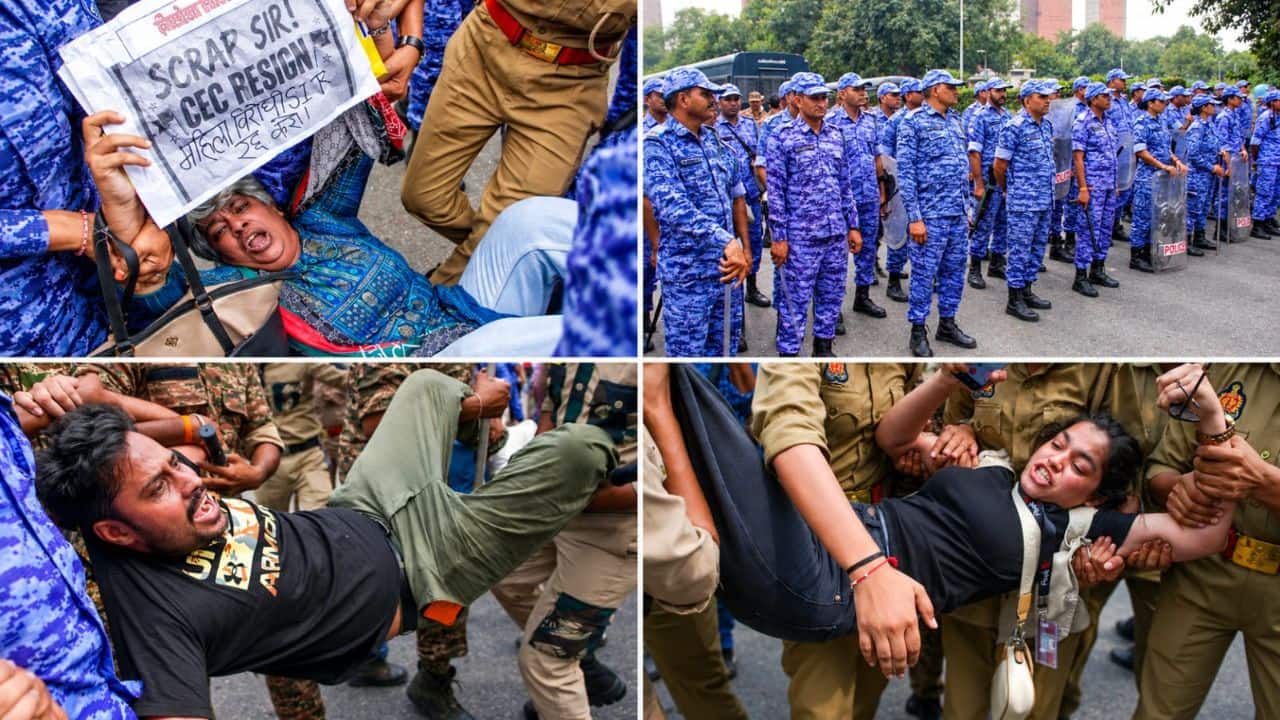
Delhi Police continued detaining protesters on Sunday despite a Supreme Court order protecting peaceful assembly. Around 100 people got taken away in buses as demonstrations against Chief Election Commissioner Gyanesh Kumar resumed. The court said authorities must follow the law, yet many people still faced police action across Delhi.
NEET PG Counselling 2026: Check MCC Round 1 schedule, Registration dates here
Delhi Police continued detaining protesters on Sunday, hours after the Supreme Court ordered that people assembling peacefully must not be detained except in accordance with the law. Around 100 people were reportedly taken away in two buses as demonstrations against Chief Election Commissioner Gyanesh Kumar resumed. The fresh police action came amid renewed scrutiny of restrictions imposed across the capital.
According to a Hindustan Times report, around 100 protesters were put into two buses and taken away from the area. The report also described a man being pulled out of a burger outlet on suspicion of participating in the protest. In a video of the encounter, he told the police that he had merely been standing there and refused to accompany them. The officers eventually let him go.
Several empty buses intended to transport detainees were also spotted near RK Ashram Marg Metro station as crowds grew, according to the Hindustan Times report. HT also reported detentions in Connaught Place, including that of student activist Neha Bora, who had reached the area with other demonstrators.
During a special sitting on Sunday, Justices Joymalya Bagchi and V Mohana directed that nobody be detained except in accordance with the procedure established by law, particularly when peaceful, unarmed people assemble outside areas covered by prohibitory orders under Section 163 of the Bharatiya Nagarik Suraksha Sanhita (BNSS).
The bench directed the authorities to allow free movement, subject to traffic regulations, and review barricades without delay. Delhi Metro and railway services were to operate normally unless specific lawful restrictions were necessary to maintain public order. Internet access was to remain uninterrupted, subject to the powers available under the law.
Sunday's hearing followed Saturday's operation to prevent CJP supporters from reaching Jantar Mantar. Delhi Police denied permission for the demonstration, saying the organisers had not submitted their application at least 10 days in advance and citing security concerns.
More than 7,000 people were detained on Saturday, while the CJP claimed that the number of detentions exceeded 15,000.
Entry and exit restrictions were imposed at 45 Metro stations on Saturday before the gates reopened later that night. Train services and mobile internet were also disrupted. Solicitor General Tushar Mehta told the Supreme Court on Sunday that Metro trains had continued operating on their normal Saturday schedule despite restrictions on access to stations.
By Sunday, 20 FIRs had been registered in connection with the protests, including cases involving allegations of assault on police personnel and obstruction of public servants. Four men claiming links to a right-wing group were arrested in a separate case concerning alleged attacks on protesters.
CJP founder Abhijeet Dipke and leaders Saurav Das and Ashutosh Ranka were released on Sunday after being produced before an Executive Magistrate. Delhi Police said they had been preventively arrested under Sections 126 and 170 of the BNSS and had furnished surety bonds of Rs 50,000 each, undertaking to maintain peace and good behaviour for one year.
The CJP has vowed to continue its campaign demanding Gyanesh Kumar's resignation, while opposition parties are preparing another mobilisation for October 12.
The protests centre on the Election Commission's Special Intensive Revision (SIR) of electoral rolls. The CJP and opposition parties allege that the exercise has led to the wrongful removal of eligible voters and could benefit the BJP. The Election Commission has denied allegations of partisan bias.
A September 23 investigation by The Indian Express found that Election Commissioners Sukhbir Singh Sandhu and Vivek Joshi had recorded objections at least 14 times over 10 months to decisions involving voter registrations, deletions and internal procedures. The Commission described the differing views as part of its decision-making process and maintained that its decisions were unanimous.
Stay informed on all the latest news, real-time breaking news updates, and follow all the important headlines in india news and world news on Zee News.