
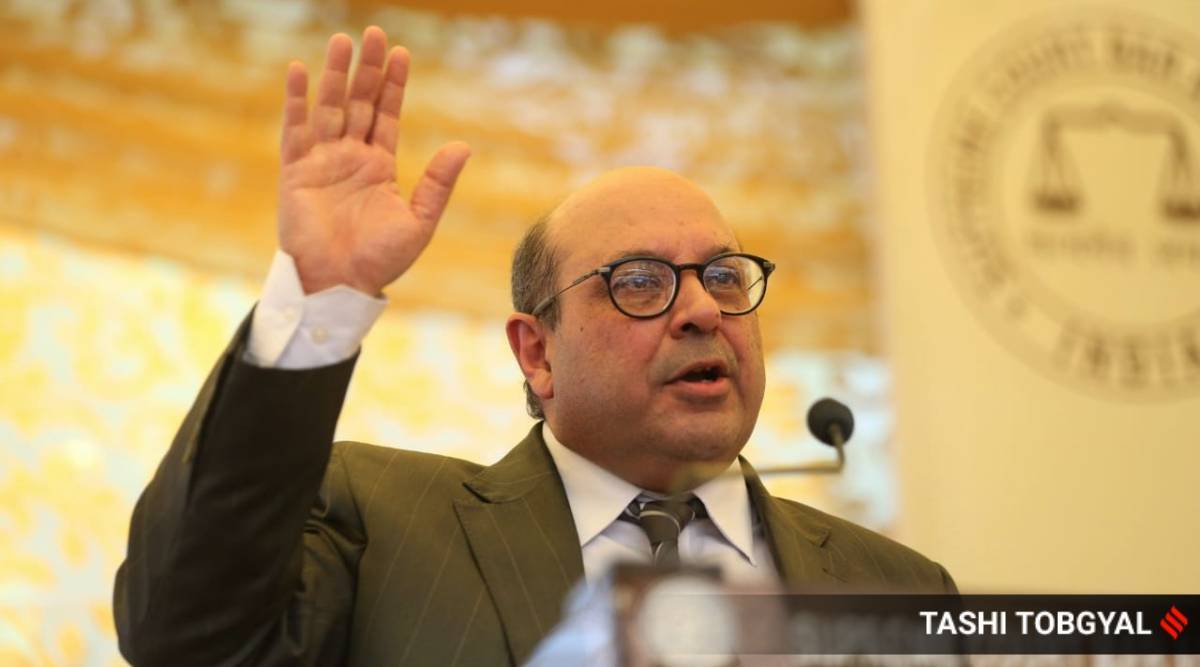
Former Supreme Court judge Justice Rohinton Fali Nariman said, "We cannot have an Election Commission that malfunctions." Speaking at Rajkot last Sunday, he highlighted that 90 lakh voters got disenfranchised during West Bengal polls. He urged the Supreme Court to intervene, noting the right to vote is in great peril.
Former Supreme Court judge Justice Rohinton Fali Nariman has called for the Supreme Court's intervention in issues related to Special Intensive Revision (SIR), saying, "We cannot have an Election Commission that malfunctions". The senior jurist referred to The Indian Express investigation about the Election Commission and said the "right to vote", which is at the "heart of our democracy", is in "great peril". The Express investigation, dated September 23, showed that the question of who makes it to the voters' list and who is left out was being raised within the Commission itself.
The former Supreme Court judge, who has also served as Solicitor General of India, spoke at the Late CA MJ Rindani Centenary Memorial Oration at Rajkot last Sunday on the subject, "Constitution and the Common Man."
Referring to the SIR in West Bengal ahead of the Assembly polls earlier this year, Justice Nariman said, "All of you have seen that in the West Bengal election, 90 lakh voters -- it's an astounding figure -- were disenfranchised. Now 90 lakh voters getting disenfranchised didn't somehow move the Supreme Court enough to stay this, so that these 90 lakh voters were out when the Bengal election took place. Out of those who were disenfranchised, some 22 lakh voters actually filed appeals; the others have all seemed to have accepted -- they must be poor people, they must be people who don't have the wherewithal or the access to justice that the others had." "And of these 22 lakh voters, some one lakh voter appeals were decided, 93 per cent in favour of the voter. So can you imagine, this was a completely illegal knocking out of the common man, of the citizen of India, in order that a government obtains what it wants, and the result, as you saw in West Bengal, was something that upset the government of the day and brought in the government of the state," he said.
Saying that "very, very disturbing things are happening in our country today", the jurist said, "Equally disturbing is the fact that we discover now, thanks to The Indian Express, that the two gentlemen on either side of the Chief Election Commissioner voiced objections to whatever was going on 14 times, and somehow or the other they didn't press their right under the new Act, Section 18, to say that look, between the three of us, it's the majority vote that counts. So the two of us prevail over you, Chief Election Commissioner. They didn't do that. They were also appointees of the present government."
"So what do we have today? And as of right, as of today itself, today's newspaper tells us that there is some patch-up between these three gentlemen, to the nation's great detriment, where they have come out with some common statement saying, yes, some of the objections you people took seem to be correct, we revert to the old Form 6, and so on and so forth," Justice Nariman said. "So the first issue I wish to flag today is that the common man today under our Constitution, and at, if I may say so, the heart of our Constitution, the heart of our democracy, which is the right to vote, is at great peril. And I hope that the apex court, an institution to which I once belonged, steps in immediately and rectifies these things. You cannot have an Election Commission which functions or malfunctions like this. It's something amazing," he said.
On appointment of Chief Election Election Commissioner
The senior jurist referred to the petition challenging the 2023 law on the appointment of the Chief Election Commissioner. A two-judge bench recently gave a split verdict on the petition and said that it should be referred to a five-judge Constitution bench. "And the sooner the Constitution Bench decides that you have to have somebody like a Prime Minister, Leader of Opposition, coupled with the Chief Justice or his nominee, who then picks up the best name in order to see that votes actually translate into what they're supposed to translate into happens, the sooner that happens, the better," he said.
The panel that appoints the Chief Election Commissioner now has the Prime Minister, the Leader of the Opposition and a Union Cabinet minister appointed by the Prime Minister. The main opposition Congress has opposed this, saying the current system gives undue advantage to the government.
The Election Commission, Justice Nariman said, originally consisted only of the Chief Election Commissioner. "He was to be appointed by the government of the day, subject to a law made by Parliament. This is very important. And later, laws added two more commissioners, so that we have three commissioners as of date. This Chief Election Commissioner had a fixed tenure of 5 years, could not be removed save by impeachment in the same manner as a Supreme Court judge, which meant that you required a two-thirds majority in both houses, present and voting, in order to get rid of him. So it becomes difficult to get rid of, but the difficulty is, if the appointment is in the hands of the government of the day, then this removal procedure doesn't add very much to independence or impartiality. This is the first conundrum that we face," he said.
"Second, the two commissioners who are with him are also appointed by the government of the day, and they can only be removed with his concurrence, with the Chief Election Commissioner's concurrence," he said. "Recently, we had in Anoop Baranwal's case in 2023, the Supreme Court looking into the fact that so many years have passed since the Constitution came into force and Parliament making no law whatsoever under Article 324 for appointment of the Chief Election Commissioner and the other Election Commissioners. So the court suggested, why don't we take a leaf out of Section 4A of the Delhi Special Police Establishment Act, which appoints the Director of the CBI, and for that Director you require to have a collegium consisting of the Prime Minister of India, Leader of the Opposition, and the Chief Justice of India? So the court suggested that pro tem, until Parliament makes a law, we will have these three people who will select somebody who is independent and impartial.
"Now what does Parliament do? It's amazing. Parliament immediately enacts in 2023 itself, an Act for the appointment of all these people, and instead of these three functionaries, the Prime Minister has his own minister as number two, and then as Leader of the Opposition, so that again you are back to square one," he said. "Now the unfortunate part is that all this came before the court very recently. Two learned judges differ, and the ultimate thing is now that it's gone before a bench probably of five judges in order to find out whether this is good law, not good law. But meanwhile, these appointments continue only in the hands of the government of the day," the jurist said.