
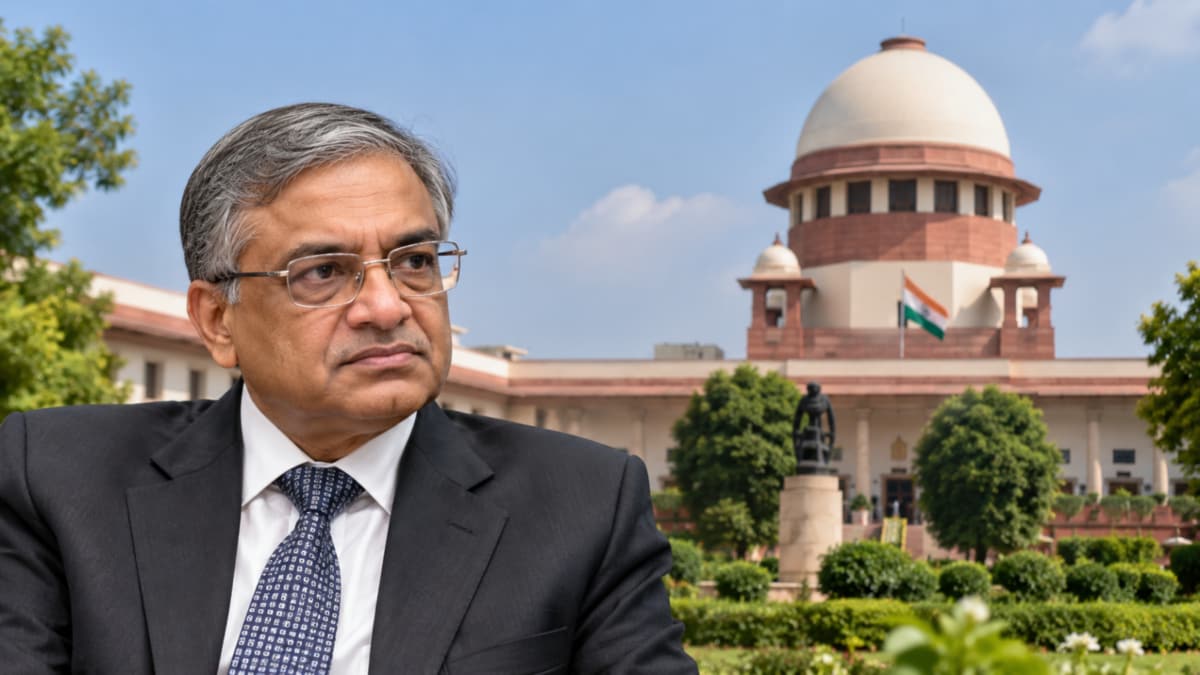
The Supreme Court on Monday issued notice to the Election Commission and Chief Election Commissioner Gyanesh Kumar regarding a plea for his suspension. The court did not remove him from office. The petition claims the poll panel took decisions unilaterally, ignoring the collective nature of the constitutional body’s official work.
SC has issued notice to the Election Commission, Kumar and the two other Election Commissioners on a petition alleging several decisions of the poll panel were taken unilaterally.
The Supreme Court on Monday stopped short of granting one of the most extraordinary interim prayers it has faced in recent years: a plea seeking the immediate suspension of Chief Election Commissioner Gyanesh Kumar.
A bench headed by Chief Justice of India Surya Kant, along with Justices Joymalya Bagchi and V Mohana, issued notice to the Election Commission of India, Kumar and the two other Election Commissioners on a petition alleging that several decisions of the poll panel were taken unilaterally. The court, however, did not pass an interim order removing or suspending the CEC from functioning.
But can the head of a constitutional body be temporarily kept out of office by a court while allegations about the functioning of that body are being examined?
Why Is Suspending A CEC Unusual?
The office of the Chief Election Commissioner is protected by the Constitution precisely because the Election Commission is expected to function independently of the executive.
Article 324 vests the “superintendence, direction and control" of elections in the Election Commission, rather than expressly in the CEC as an individual. It also provides that where other Election Commissioners are appointed, the CEC acts as the Chairman of the Commission. Most importantly, Article 324(5) says a CEC cannot be removed except in the same manner and on the same grounds as a Supreme Court judge.
This protection makes the demand for an interim suspension particularly extraordinary.
The petitioner, represented by senior advocate Vikas Singh, is not merely alleging that Kumar made an incorrect decision. The central contention is that powers constitutionally entrusted to the multi-member Election Commission were allegedly exercised as though they belonged to the CEC individually.
The plea has pointed to alleged differences between Kumar and Election Commissioners Sukhbir Singh Sandhu and Vivek Joshi, including objections reportedly recorded over several decisions relating to electoral rolls and the Special Intensive Revision (SIR). An Indian Express report had said the two commissioners raised objections at least 14 times over 10 months. The Election Commission, however, has maintained that its final decisions were unanimous.
What The Law Says About Collective Decision-Making
Section 18 of the Chief Election Commissioner and Other Election Commissioners Act, 2023 says the Commission should transact its business as far as possible unanimously. If the CEC and other Election Commissioners differ, the matter is to be decided by the majority.
The petition argues that this provision reinforces the constitutional character of the ECI as a collegial institution. In other words, the argument is that where the law places a power in the Election Commission, the CEC cannot convert that collective power into an individual one merely because he is its Chairman.
The plea has therefore sought a writ of quo warranto – asking the court to require Kumar to show the legal authority under which he allegedly exercised powers vested in the Commission as a whole.
Singh made an unusually forceful pitch for immediate judicial intervention. He argued that the credibility of the Election Commission itself was at stake, saying, “Every citizen of the country is feeling that Election Commission’s credibility is at stake."
He went further, arguing that the ECI and its commissioners have become more powerful than other constitutional authorities and telling the court, “A PM doesn’t have this protection, not even judges."
Seeking immediate relief, Singh told the bench, “I am wanting an interim order today to suspend the Chief Election Commissioner." He warned, “If no interim order is passed the country will burn."
The remarks underline the petitioner’s case that this is not an ordinary service or administrative dispute, but a question concerning public confidence in the institution that conducts India’s elections.
Why The Supreme Court Refused Immediate Suspension
The bench’s response was notably cautious. The CJI indicated that the Election Commission would be expected to respond to the allegations and make its position clear. The court observed that the commissioners are expected to take decisions unanimously and, where there is no unanimity, the law provides for a majority decision.
But the bench also flagged a basic evidentiary problem. “Today, you are going only on a news report," the CJI told the petitioners.
Can Supreme Court Suspend A CEC?
The Constitution lays down an exceptionally stringent removal mechanism for the CEC. A court cannot simply treat an allegation against the office-holder as equivalent to removal.
But the petition is attempting to draw a distinction between removal and interim restraint. The petitioners are asking the court to temporarily prevent Kumar from exercising the disputed powers while the legality of his functioning is examined. They are also challenging decisions allegedly taken without the participation required under the constitutional and statutory framework.
Whether such an interim restraint can be granted, without effectively undermining the constitutional protection attached to the CEC’s office, is itself a major legal question.
The case also has an important institutional backdrop. The Supreme Court had earlier dealt with the question of whether a CEC could exercise greater authority than other Election Commissioners in the context of the tenure of former CEC TN Seshan. The court ultimately underscored the collective character of a multi-member Election Commission and the principle of majority decision-making. That history gives the present dispute added significance.
For now, the Supreme Court has chosen scrutiny over suspension. It has sought the Election Commission’s response rather than immediately removing its head from the decision-making process.