
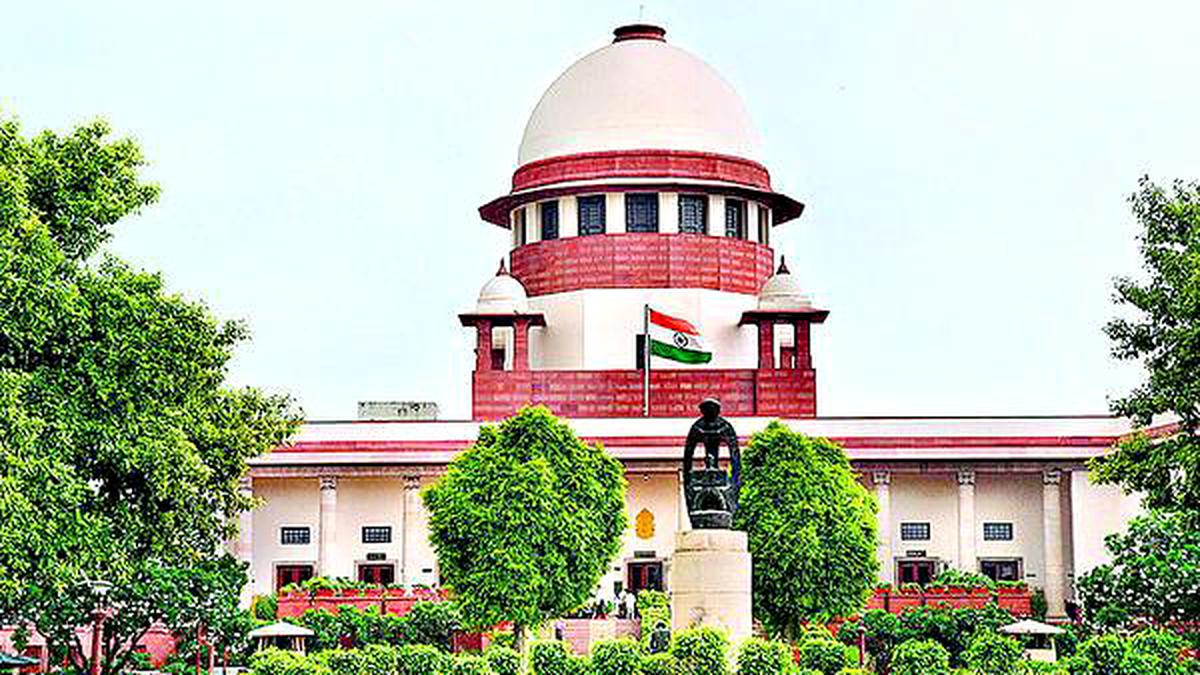
The Supreme Court on October 6, 2026, asked if party symbols should go to those who committed the "constitutional sin" of defection. The Bench heard arguments on the Election Commission’s decision to give the Shiv Sena symbol to the Shinde faction. Judges questioned if legislative strength is enough for allotment.
The Supreme Court on Tuesday (October 6, 2026) orally asked whether the "sentiment of the symbol" operates for persons who have committed the "constitutional sin" of defection, as it heard arguments on whether the Election Commission of India was right to rely primarily on legislative strength to allot the symbol to the Shinde faction.
The observation was made by a Bench comprising Chief Justice Surya Kant and Justices Joymalya Bagchi and V. Mohana during the hearing on a batch of pleas arising from the split in Shiv Sena, including challenges to the Election Commission of India’s decision recognising the Eknath Shinde-led faction as the real party and allotting it the bow-and-arrow election symbol.
The Bench was hearing arguments by senior advocate Neeraj Kishan Kaul, appearing for the Shinde faction. Mr. Kaul, referring to various apex court judgments, defended the ECI’s reliance on the legislative majority test, saying that the test remained legally valid and relevant in determining which faction constituted the political party under the Election Symbols (Reservation and Allotment) Order.
Justice Bagchi questioned how the party symbol should operate in a situation where members facing disqualification proceedings subsequently lose their membership.
“The liberty remains with the political party. And what it says is, if disqualified members go away, the remaining members get a different symbol. Now, you were just about to read Sadiq Ali (judgment).
"Will the sentiment of the symbol operate for persons who have committed the constitutional sin, or will it operate for the persons who complained of the constitutional sin?” Justice Bagchi asked.
He also raised concerns over determining grassroots support merely by counting organisational members, saying such a process could be difficult in the “muddled situation” of Indian politics.
Mr. Kaul, referring to a judgment, said that it did not hold that disqualification necessarily operated retrospectively.
He said the ruling had dealt with a specific situation in which a split was considered before the Speaker decided disqualification petitions, and the court had directed that disqualification be examined on the facts existing when the petitions were filed.
He also relied on the Constitution Bench judgment in the Subhash Desai case, contending that it did not bar the use of the legislative majority test.
Mr. Kaul said that while deciding disqualification petitions under Paragraph 2(1)(a) of the Tenth Schedule, the Speaker may first have to determine which faction constitutes the political party when rival factions emerge.
He said that the Speaker should examine the party constitution and rules governing its leadership, and, where rival versions of the constitution were produced, consider the version submitted to the Election Commission of India before the factions emerged.
“The legislative majority test” could nevertheless be applied where a constitutional authority, after examining all relevant factors, found it appropriate, Mr. Kaul said.
“The senior advocate said the symbol should go to the faction that establishes that it is the real political party. If neither faction could establish that claim, a different question would arise,” he said.
Justice Bagchi questioned whether an organisational test would necessarily reflect actual grassroots support where the party constitution itself did not provide for a clearly democratic organisational structure. The hearing remained inconclusive and will continue on Wednesday (October 7, 2026).
Earlier, the Bench had asked whether the Election Commission of India had adequately considered the possibility of denying the reserved bow-and-arrow symbol to both factions and requiring them to contest elections on separate symbols.
It had also questioned whether legislative strength could be regarded as a “safe test” when disqualification proceedings were pending against the very MLAs whose numbers formed the basis of that majority.
Mr. Kaul has maintained that 40 MLAs supporting Shinde faction accounted for 76% of the votes polled in favour of the 55 Shiv Sena MLAs who won seats in the 2019 Maharashtra Assembly elections.
He also cited Lok Sabha figures, saying 13 MPs supporting Shinde accounted for 73% of the votes polled in favour of the party’s 18 elected MPs.
He had said that the pendency of disqualification proceedings, by itself, could not prevent the Election Commission of India from deciding the party-symbol dispute under Paragraph 15.
He also pointed out that the 2019 Maharashtra Assembly had since been dissolved and a new House constituted after the 2024 elections.
The lead plea, filed by Sunil Prabhu of the Uddhav Thackeray faction, challenges the Maharashtra Assembly Speaker’s January 10, 2024 decision declining to disqualify MLAs of the Shinde faction under the Tenth Schedule of the Constitution.
A connected plea filed by Uddhav Thackeray challenges the ECI’s decision recognising the Shinde faction as the official Shiv Sena and allotting it the party symbol.