
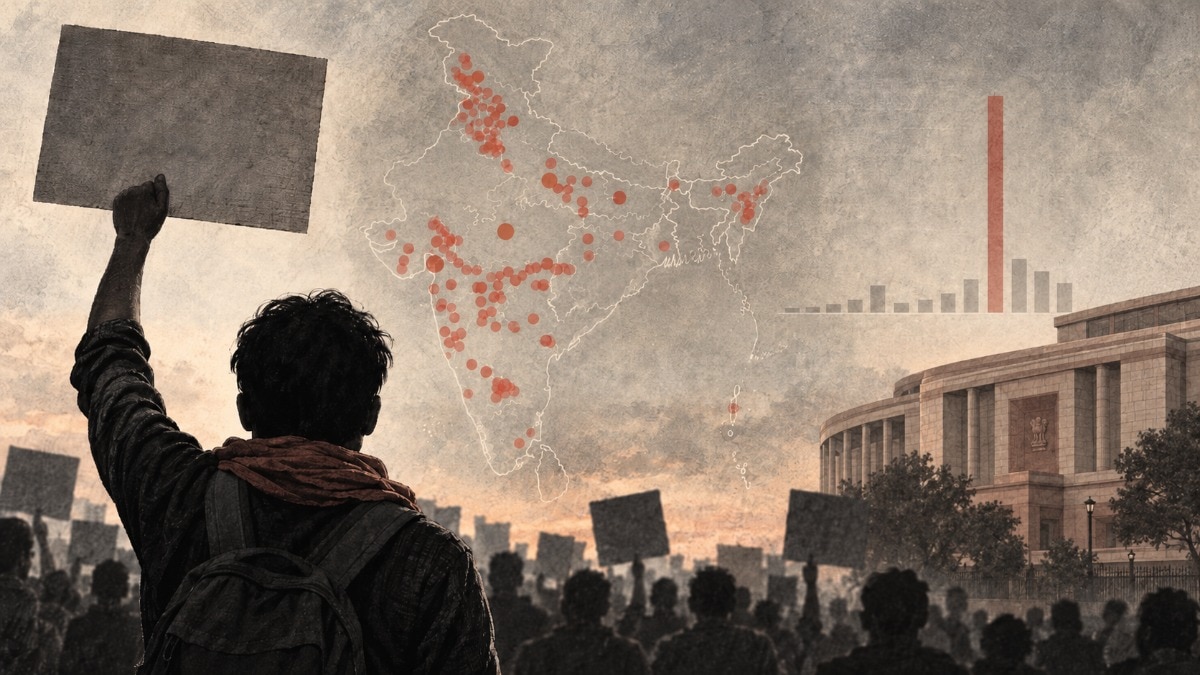
Indians protested against the Election Commission 278 times in 10 days leading to October 2. People are "finally fed up," one protester said. They want Chief Election Commissioner Gyanesh Kumar to resign over voter list changes. Student unions now plan a joint protest in Delhi on Saturday, October 10.
She came to the rally in Mumbai with her family and friends. She would not give her name, for fear of retribution. But she was clear about why she was there. People are "finally fed up," the 35-year-old woman told a reporter. "You cannot take away my name from the voting list."
She was far from alone. In the 10 days to October 2, Indians protested the Election Commission 278 times in 26 of the country's 28 states. That is about 23 times the usual pace, according to an India Today analysis of data from the non-profit Armed Conflict Location and Event Data.
And the biggest test may be days away. On Saturday, October 10, student unions and the Cockroach Janta Party, the youth movement whose protests forced out the education minister in July, plan a joint protest in Delhi, according to ACLED.
At stake are Chief Election Commissioner Gyanesh Kumar's job and the trust voters place in the body that runs India's elections. Protesters want him to resign over the Special Intensive Revision, a nationwide re-check of the voter list. Opposition parties allege it has wiped eligible voters off the rolls. The commission says it removes duplicate and ineligible entries.
WHAT TWO COMMISSIONERS OBJECTED TO
Many of the protests followed an investigation. Two of the three election commissioners objected on record at least 14 times in 10 months to decisions taken under Kumar, including adding and deleting voters, it found.
The commission said "differing views" were part of its decision-making and that its decisions were unanimous. On October 5, the Supreme Court declined to suspend Kumar and asked the commission and the government to answer the petitions against him.
ONE MONDAY, TWO IN THREE PROTESTS
The protests came in a burst.
Two in every three came on a single day, Monday, September 28, when ACLED recorded 187. Congress or one of its wings took part in all but one. Three days earlier, on Friday, September 25, opposition parties held nationwide protests.
They spread from Jammu and Kashmir to Puducherry. Among states, only Rajasthan and Sikkim recorded none, and Rajasthan's gap is partly a quirk of record-keeping: a Congress march in Jaipur on September 28, over what the party called "vote theft", was logged as a march to the state's chief electoral officer, without naming the commission.
PEACEFUL, EXCEPT DELHI
More than nine in 10 protests passed off peacefully, the data shows.
The capital was different. Police stepped in at half of Delhi's protests, dispersing, detaining or otherwise stopping them, according to the data. Delhi Police "have forcibly broken up several peaceful protests," Pearl Pandya, ACLED's South Asia analyst, wrote. The Leader of the Opposition, Rahul Gandhi, was detained on two days running.
This is, above all, as the data suggests, an opposition campaign. Congress or its affiliates took part in more than eight in 10 protests. The Cockroach Janta Party, which filled the streets in July, appears in only two so far.
"The election commission is a puppet in the hands of the government," Mallikarjun Kharge, the Congress president, said on October 6. The Bharatiya Janata Party sees it differently. "After failing multiple times, Congress leaders have decided to establish anarchy in the country and attack institutions," its spokesperson, Sambit Patra, said the same day.
BIG, BUT NOT YET JULY
ACLED put the count at "nearly 300 protests" in 10 days on October 7 and called it nearly half of the previous 1.5 years' count. Based on data released so far, which runs to October 2, India Today's count comes to about two-fifths.
Set against July, this wave is smaller. The protests over exam-paper leaks that forced out Education Minister Dharmendra Pradhan came at twice the daily pace in their last 10 days. July's count covers protests the Cockroach Janta Party led.
The count will also rise as reports come in. ACLED keeps adding protests to past days: its count for one week in July later rose from 412 to 475, an India Today comparison found. Figures for the most recent days are probably incomplete.
WHAT THE COMMISSION IS DOING
The commission had not answered the calls for Kumar to go as of October 2. It has told state election officers to compare today's rolls with those from before the revision and to visit, house to house, people who dropped off, according to its October 1 letter. The drive is meant to take about a month.
On October 6, it said it had turned down a meeting with 240 MPs at Parliament House Annexe as "unusual," because such meetings are held at its own office. It offered to send its senior-most officer to take their memorandum instead, it said; the MPs declined.
Saturday's protest will show whether the street can keep up the pressure. A count of protests cannot show what the woman in Mumbai came for: whose names are still on the list.
Methodology: DIU analysed protests in India recorded by ACLED from September 23 to October 2, the latest data available. We count a protest if ACLED's description mentions the Election Commission, its chief, or the voter-list revision; this may miss at least one march. The usual pace is the daily average over the previous 18 months. Counts by state show how far the protests spread, not how intense they were.