
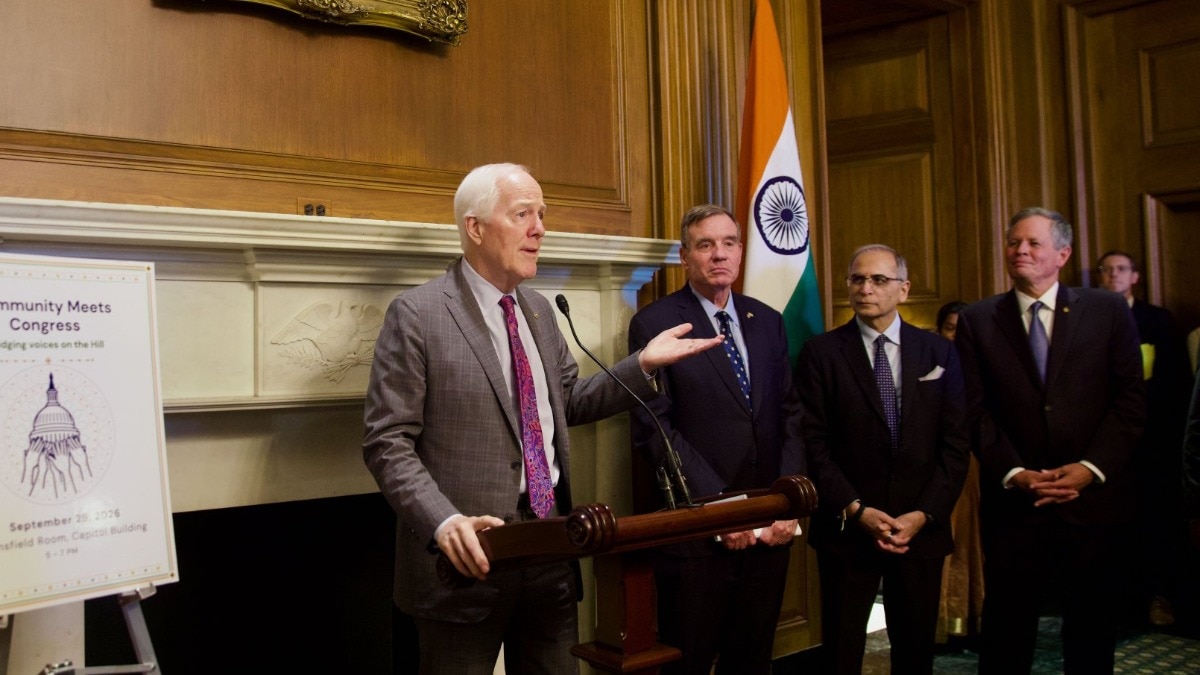
Bipartisan Senate support on the Hill points to renewed India-US momentum. Senators reaffirmed the strategic importance of the relationship during a recent gathering. Republican Senator John Cornyn said, "We are like-minded in so many ways." Both parties now work to resolve trade differences as high-level engagement grows between the nations.
The India-US relationship may have gone through some difficult weeks, but the latest signals from Washington and New Delhi point toward renewed high-level engagement -- from Prime Minister Narendra Modi's phone call with President Donald Trump to fresh trade negotiations and a planned visit by Secretary of State Marco Rubio to India.
That was the backdrop to an exclusive bipartisan gathering of the Senate India Caucus on Capitol Hill, where senior Republican and Democratic senators reaffirmed the strategic importance of the relationship and stressed the need to work through recent differences.
The gathering brought together senators, Indian-American community leaders and prominent members of the diaspora, with both sides of the political aisle making the case for sustained engagement with New Delhi.
Republican Senator John Cornyn, co-chair of the Senate India Caucus, acknowledged that there had been "misunderstandings or rough spots in the road," but described the relationship between the two countries as a "genuine friendship".
"We are like-minded in so many ways," Cornyn said, stressing the importance of continued US-India cooperation.
National security, he said, remains a central pillar of the relationship. He also pointed to China, saying Washington is closely interested in how India and China manage their relationship.
The comments came hours before after Modi and Trump phone call, in a conversation that focused on trade, defense, energy and critical technologies. The two leaders reaffirmed their commitment to advancing the India-US Comprehensive Global Strategic Partnership and agreed to remain closely engaged.
Democratic Senator Mark Warner, the other co-chair of the India Caucus, described the relationship in even broader terms.
"This is one of the absolute most critical relationships in the world," Warner said. "I think, frankly, for the next 20-plus years, it will be the most critical relationship."
Warner acknowledged the importance of the US-China competition but said the India partnership cannot be viewed solely through the China lens.
"We've obviously spent a lot of time focused on competition with China, but in terms of values and common interests, it is extraordinarily important that we continue to develop the relationship between the United States and India," he said.
Warner also singled out the Indian-American community as one of the relationship's biggest assets, describing the diaspora as "incredibly strong" and saying it "punches way above its weight in all categories."
The bipartisan message comes as the two governments intensify efforts to resolve trade differences.
Commerce and Industry Minister Piyush Goyal is currently in the United States for a week-long visit, from September 29 to October 5, combining participation in the US-hosted G20 Trade Ministers' Meeting in Milwaukee with bilateral discussions aimed at advancing the proposed India-US Bilateral Trade Agreement and an interim deal.
Goyal has already met US Trade Representative Jamieson Greer on the sidelines of the G20 meeting. The two sides are seeking to move forward on an agreement that New Delhi has described as needing to be balanced and mutually beneficial.
The trade negotiations are taking place against a complicated backdrop, including disagreements over US tariff measures linked to India's purchases of Russian oil. But the latest diplomatic contacts have continued across multiple tracks.
Republican Senator Steve Daines, who also addressed the Capitol Hill gathering, stressed that trust would be critical to navigating those differences.
"Any relationship like this is built on trust, and that is why we remain committed to building a trustful relationship between the United States and India," Daines said.
Daines recalled his visit to New Delhi in February, saying he and his wife stayed at the residence of US Ambassador to India Sergio Gor and had an opportunity to hear Indian concerns directly.
He said those discussions were followed by efforts in Washington to reduce friction between the two countries.
"We were able to come back to Washington and work with leaders like Senator Warner and Senator Cornyn to bring this to the beginning of closure here on a good trade deal and reduce some of the friction that we've had," Daines said.
The next major diplomatic engagement is already taking shape.
US Secretary of State Marco Rubio is expected to travel to India in October, with India Today reporting that the visit is likely to take place in the third week of the month. Rubio and External Affairs Minister S Jaishankar met on the sidelines of the UN General Assembly in New York last week and reaffirmed the importance of the US-India strategic partnership in the Indo-Pacific.
The sequence of events -- the Modi-Trump conversation, Goyal's Washington visit and trade talks, the upcoming Rubio visit and continued congressional engagement -- provides a broader picture of a relationship being actively managed at the highest levels despite disagreements.
For the Senate India Caucus, the message was bipartisan and direct: differences may create friction, but lawmakers from both parties continue to see India as an important long-term strategic partner.
And with trade, defense, critical technologies, energy and the Indo-Pacific all increasingly intertwined, the relationship is moving into a phase where the ability of Washington and New Delhi to manage disagreements may be as important as the areas on which they agree.