
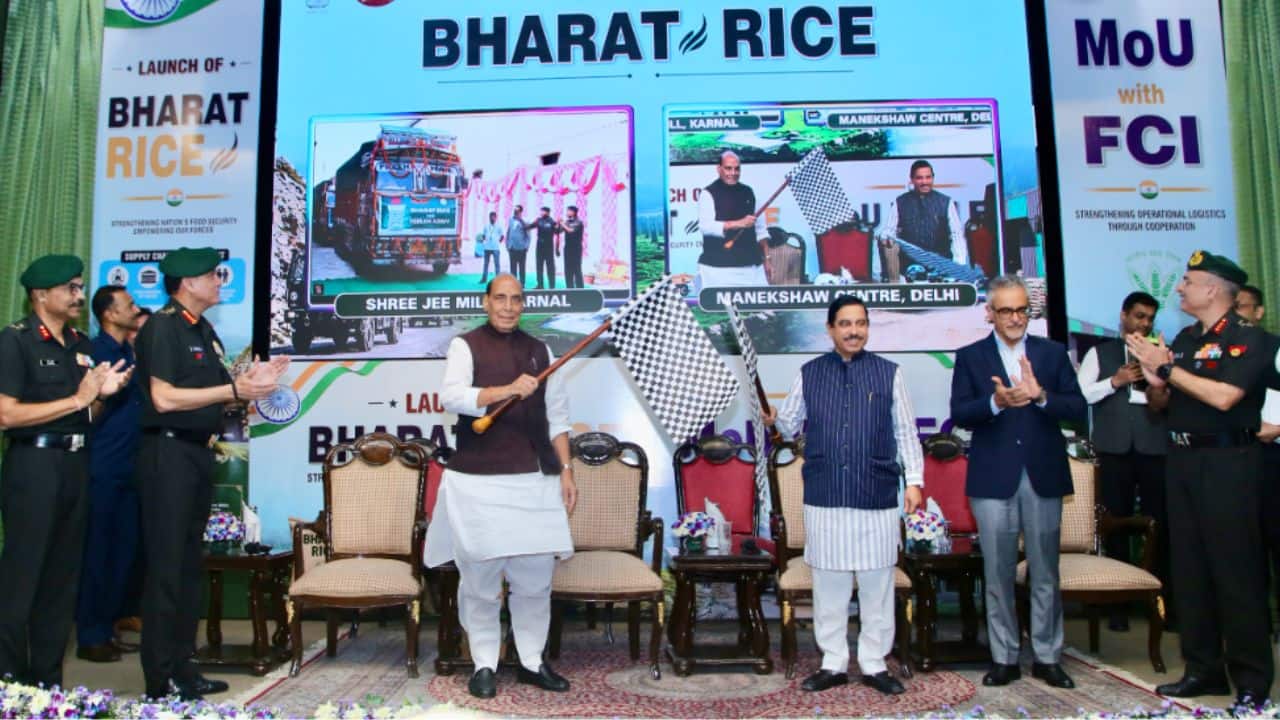
The Indian Army on Monday launched Bharat Rice to improve the quality of rice supplied to defence personnel. Defence Minister Rajnath Singh said, “This superior-quality rice will be provided in accordance with standard specifications.” The initiative ensures better rations for soldiers in remote areas like Ladakh and the Northeast.
Market Mastery
Webinar by Vishal Malkan
Find the weak links
in your portfolio by Vishal Malkan
The Indian Army on Monday launched Bharat Rice, a new initiative to improve the quality of rice supplied to defence personnel.
According to a media statement by the Ministry of Defence, deliveries of the superior quality rice is being planned directly to Army Supply Depots, including those in remote areas of Ladakh and the Northeast.
The initiative was launched in New Delhi in the presence of Defence Minister Rajnath Singh and Consumer Affairs, Food and Public Distribution Minister Pralhad Joshi.
What is Bharat Rice?
Spearheaded by the Directorate General of Supplies and Transport, Bharat Rice aims to improve ration quality based on sustained feedback from Army personnel. The rice will be milled to prescribed defence specifications and supplied through the National Agricultural Cooperative Marketing Federation of India (NAFED) during the financial year 2026-27.
The rice will undergo quality-control checks and will be free from foreign matter and admixtures, with minimal broken, damaged and discoloured grains.
It will be procured in 10 kg and 30 kg bags to make handling and transportation easier, particularly at forward posts and in difficult terrain. Deliveries will be made directly to Army Supply Depots instead of requiring them to collect supplies from local FCI facilities.
The initiative follows nearly 18 months of coordination among the Army, FCI, NAFED and the Department of Food and Public Distribution, the MoD statement said.
Singh described the initiative as an embodiment of the spirit of ‘Jai Jawan, Jai Kisan’, saying it connects agricultural production with the welfare of soldiers.
“This superior-quality rice will be provided in accordance with standard specifications. Furthermore, we are ensuring ergonomic packaging. While this initiative might appear small, it offers immense operational relief to the soldiers responsible for transporting rations to remote and difficult terrains,” he said.
Five-year FCI pact
The Army also signed a memorandum of understanding (MoU) with the Food Corporation of India (FCI) to use its warehousing infrastructure, manpower and material-handling equipment during operational contingencies. The arrangement is aimed at strengthening supply chains and ensuring faster mobilisation of essential supplies during military operations.
Singh said that Operation Sindoor highlighted the need for resilient logistics networks that can sustain military operations, particularly when warning times are short.
“The strategic analysis of Operation Sindoor indicated that warning times could be extremely short in future conflicts. Scenarios involving zero-warning situations and the integration of technology into warfare could severely test our preparedness. Such conflicts could also put the endurance of our logistics chains and supply networks to the test. Therefore, we must build logistics resilience to sustain our operations. This MoU with FCI represents a significant step in that direction,” he said.
The five-year MoU, which can be extended by mutual consent, provides a formal framework for the Army to use identified FCI warehouses, labour resources and material-handling equipment during operational contingencies.
Coordination will take place at the formation level between the Army’s Supply and Transport units and FCI’s regional and divisional offices. The arrangement will also be integrated into operational logistics plans.
The agreement is expected to enable additional storage, faster mobilisation and the forward positioning of rations, stores and equipment closer to operational areas. It will also allow existing civilian infrastructure to support military requirements during emergencies.
Singh said logistics had become a critical component of modern warfare, with storage capacity, transportation networks and timely replenishment playing an important role alongside weapons and technology.
He added that FCI’s infrastructure, including warehouses and modern silos, could be aligned with national security requirements when necessary.