
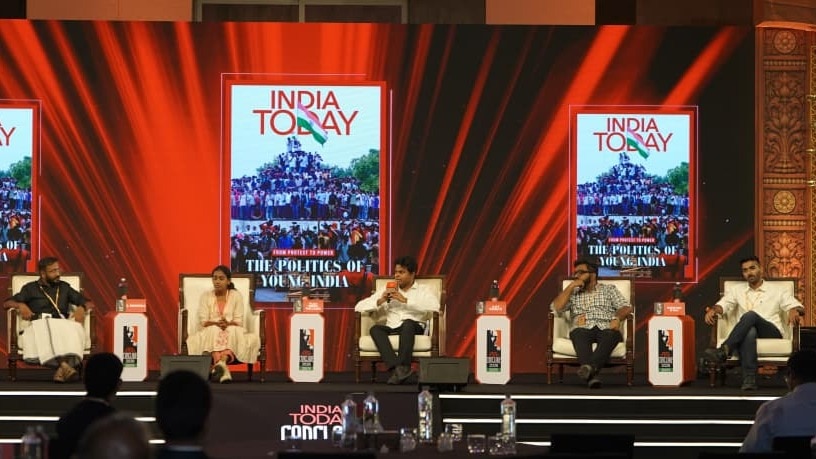
Student politics and unemployment took centre stage at the India Today South Conclave. Dr Aloshious Xavier said student organisations consistently raised issues like NEET and paper leaks. Vijay Reddy Mallangi added that CJP was not born out of the failure of student unions, as many groups supported the common platform.
Student politics, public education, unemployment and electoral reforms took centre stage at the India Today South Conclave, where representatives of different student organisations debated whether traditional student unions had failed to adequately represent the concerns of young India.
The discussion also turned to the recent protests associated with CJP and whether the emergence of a platform beyond established political affiliations reflected a gap in traditional student politics.
DID STUDENT UNIONS FAIL YOUNG INDIA?
Dr Aloshious Xavier, state president of the Kerala Students Union, rejected the suggestion that student organisations had failed to be the voice of young India.
He said student organisations associated with different ideologies had consistently raised issues affecting students and young people across the country. According to Xavier, protests over the past 12 years had focused on issues ranging from NEET and CBSE to unemployment and paper leaks.
"Actually, if you look into the history, if any particular issues are happening in the country, the student forces are coming forward. Every student organisation is addressing the issue," he said.
Xavier said student organisations had organised a series of protests across the country since 2024, but many of them failed to receive adequate visibility.
He pointed to the protests at Jantar Mantar, saying students and youth had come together because mainstream political parties did not want the demonstrations to be seen as being led by any particular political organisation.
"The youths and student communities came forward and have led a very good protest. It was not limited to a particular single issue," Xavier said.
He argued that the recent CJP protests received greater visibility precisely because they were not aligned with any mainstream political party. Several student factions, he added, participated in the protests.
'CJP WAS NOT BORN OUT OF FAILURE OF STUDENT UNIONS'
Vijay Reddy Mallangi, national media lead and South India in-charge of CJP, disagreed with the suggestion that the platform emerged because student unions had failed.
He said several student organisations had supported the movement and that students and other groups had found a common platform that went beyond established political narratives.
"It wasn't the failure of the student unions that led to the birth of CJP. We had a lot of student unions who came in support for us," Mallangi said.
He said the idea was to bring organisations together under one umbrella despite their ideological differences.
"People and student unions found a common platform beyond any political narratives. They were under one umbrella and we want to do the same going forward with all the ideologically aligned student unions together," he said.
Mallangi added that the same approach would be taken in the ongoing agitation over electoral reforms.
'PUBLIC EDUCATION IS BEING ATTACKED'
Ajay Kamath, Karnataka state secretary of the All India Democratic Students' Organisation, shifted the focus from political affiliations to public education.
He said the concerns of students went beyond electoral politics and argued that the public education system was facing pressure irrespective of which political party was in power.
"Beyond politics, whoever are in power, we are seeing the institution of public education in our country being attacked," Kamath said.
He claimed that 94,000 government schools had been closed over the last decade and that there were 10 lakh vacancies for teachers in government schools.
"Irrespective of political affiliation, we should fight against it," he said.
HAS PROTEST POLITICS DENTED ABVP?
The discussion also turned to whether the recent protests had affected the ABVP's standing on campuses.
Shravan B Raj, national secretary of the ABVP, said the recent developments reflected what he described as the rise of "alternate politics" in India.
"If you are seeing the recent protests, we can see the rise of alternate politics in India," he said.
Shravan argued that the protests represented an attempt at what he described as the "subversion of democracy through democratic methods". He said such unity-based protests had been visible in the country for several years.
He also pointed to the role of student union elections in responding to challenges faced by the ABVP, saying rival organisations had targeted the ABVP on several recent issues.
"We have given them the response through the student union election and its poll," he said, pointing to the Delhi University Students' Union elections, which he described as an "one-sided contest".
"There has to be resistance so that we can work more for the student community," Shravan said.