
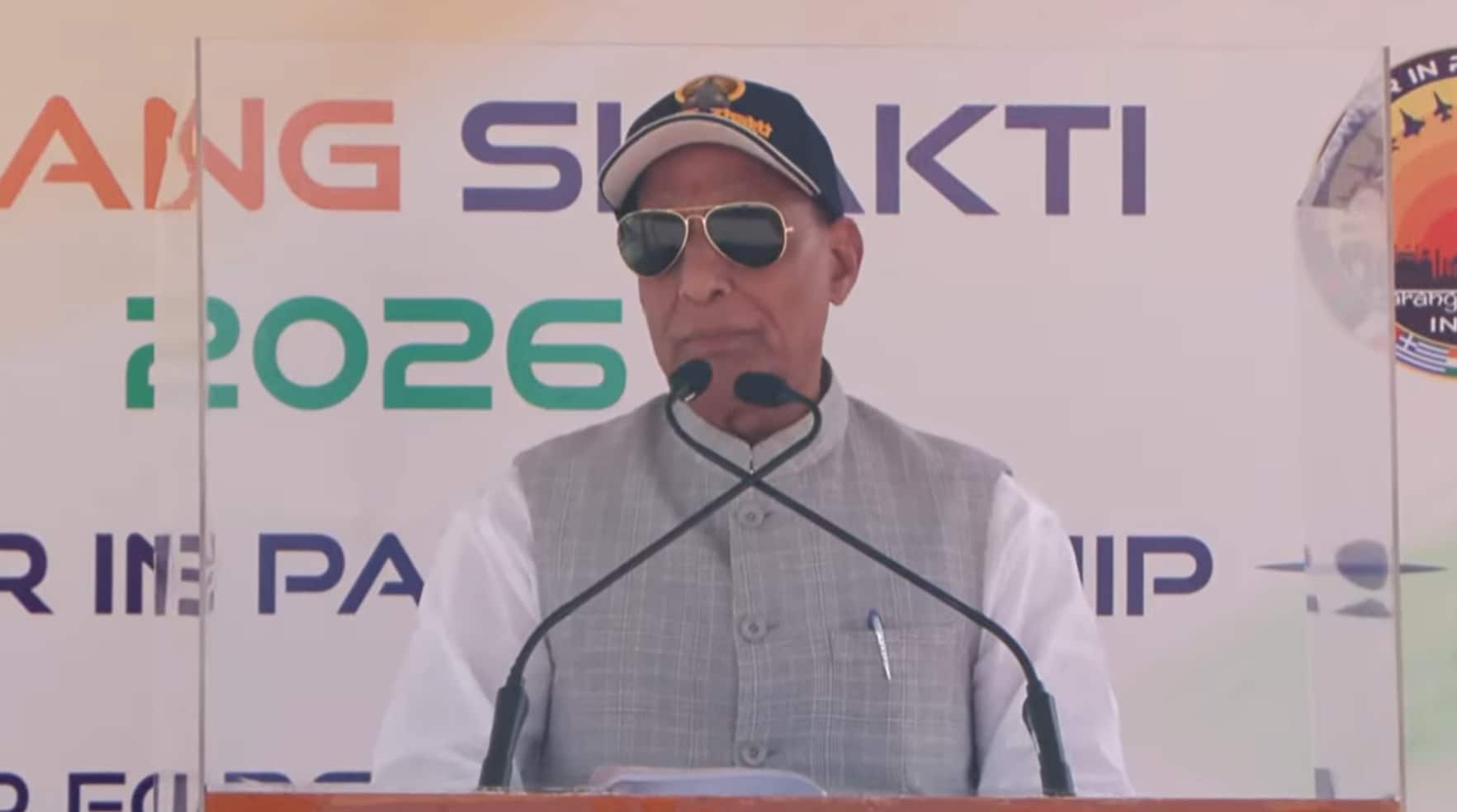
Defence Minister Rajnath Singh spoke at Exercise Tarang Shakti 2026 in Jodhpur on October 10. He said, “Atmanirbhar Bharat does not mean isolation; it means developing domestic capacity to design, develop critical technologies.” Singh stressed that India must produce its own weapons to stay strong and secure during any future crisis.
Market Mastery
Webinar by Vishal Malkan
Find the weak links
in your portfolio by Vishal Malkan
Defence Minister Rajnath Singh on Saturday (October 10) said India was continuously monitoring developments in its neighbourhood and beyond, along with their strategic implications, while stressing that self-reliance in defence was essential to strengthening national security.
Speaking at the Indian Air Force's Exercise Tarang Shakti 2026 at Jodhpur Air Force Station in Rajasthan, Singh said the Indian armed forces were undergoing fundamental changes in their structure, equipment and strategic approach.
“We have understood a hard reality of modern statecraft: in times of crisis, no nation can sustain prolonged wars unless it can produce its own weapons and critical technologies. This led us to adopt Aatmanirbharta, or self-reliance in defence, as a national policy. This vision forms the bedrock of our national strength. Driven by this vision, the Indian armed forces are undergoing a fundamental transformation... structurally, materially and strategically,” he said.
Singh also clarified that the vision of Atmanirbhar Bharat was not about isolating the country from the world but about strengthening its indigenous technological capabilities.
“Atmanirbhar Bharat does not mean isolation; it means developing domestic capacity to design, develop critical technologies,” the Defence Minister said.
Highlighting the changing nature of warfare, Singh said technological advancements were increasingly influencing military operations, with drones, artificial intelligence (AI), electronic warfare and long-range precision weapons reshaping the battlefield.
“Unmanned systems and drones have changed the speed, scale and nature of military operations. Artificial intelligence is reshaping decision-making, electronic warfare requires absolute spectrum control, and long-range precision weapons have expanded the battlespace,” he said.
He added that future military power would depend less on the number of platforms a country possessed and more on the speed of sensing, understanding, deciding and acting.
At the conclusion of the second edition of Exercise Tarang Shakti, Singh congratulated the Indian Air Force and all individuals, institutions and organisations involved in conducting the multinational air exercise. He also welcomed the participating nations and acknowledged the contributions of their leadership and crew members.
Rajnath Singh presents SIDM Champion Awards 2026
Separately, Singh presented the SIDM Champion Awards 2026 at the eighth annual session of the Society of Indian Defence Manufacturers (SIDM) in New Delhi. According to a Ministry of Defence release, 15 organisations were recognised for achievements in indigenous technology development, product innovation, design, import substitution, manufacturing excellence and exports.
The session was themed “Sovereign Capabilities, Contested Frontiers: Accelerating India's Strategic Autonomy in an Era of Disruption.”
Singh urged the defence industry to increase private sector participation, strengthen research and development (R&D), expand manufacturing capacity and accelerate technological innovation. He expressed confidence that India's talent pool, young workforce, industrial capabilities and policy support would help the country emerge among the world's leading defence manufacturing nations.
India's defence exports reached a record ₹38,424 crore in the financial year 2025-26, registering growth of more than 60 per cent over the previous financial year. Singh reiterated the target of achieving ₹50,000 crore in defence exports by 2029.
He also recalled his earlier call to increase the private sector's share in India's total defence production from approximately 24 per cent to 50 per cent, noting that its contribution had grown significantly over the past 12 years.
“Defence manufacturers must treat expenditure on R&D as an investment that strengthens operational preparedness, improves competitiveness and contributes to national security,” he said.
Referring to Operation Sindoor, Singh emphasised the need for domestic manufacturing facilities to rapidly scale up production to meet operational requirements.
He also highlighted government initiatives supporting domestic defence manufacturing, including the Defence Acquisition Procedure, Defence Procurement Manual, Positive Indigenisation Lists, SRIJAN portal and Innovations for Defence Excellence (iDEX).
Established in 2017, SIDM represents large enterprises, micro, small and medium enterprises (MSMEs), startups, academia and foreign original equipment manufacturers.
The event was attended by Defence Secretary Rajesh Kumar Singh, Director General (Acquisition) A Anbarasu, SIDM Founder President Baba Kalyani, SIDM President Arun Ramchandani, senior government officials, representatives of the Defence Forces, and leaders of Indian and international defence companies.