
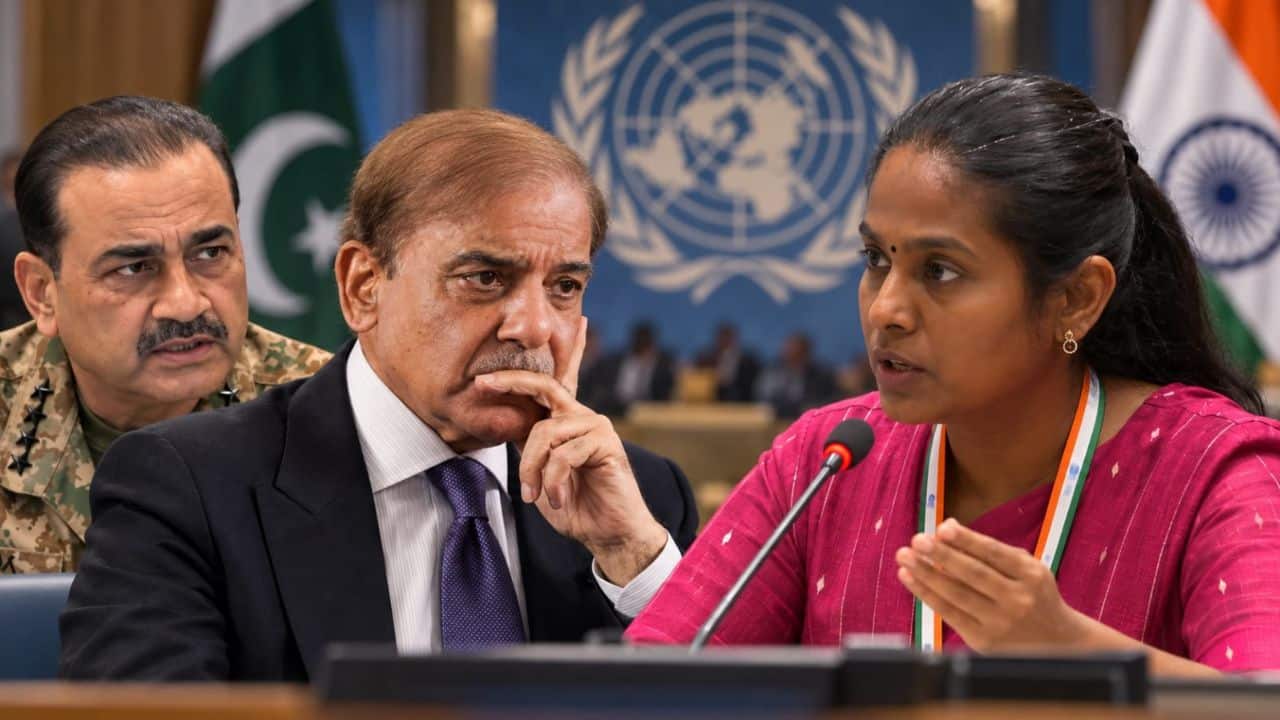
India hit back at Pakistan at the United Nations on October 9, accusing Islamabad of using false allegations to hide its internal crises. Diplomat R Mythili said, "At the home, the Army is the rule, and the Army is the law." She also slammed Pakistan for suppressing press freedom and minorities.
UMANG for EPFO members: Create UAN, check PF contributions, claim funds and more
India hit back at Pakistan at the United Nations, accusing Islamabad of raising false allegations over minority rights in India solely to deflect attention from its own internal crises. Exercising India's Right of Reply, diplomat R Mythili challenged Pakistan's human rights and rule-of-law record, citing the military's overpowering influence over state institutions and rising curbs on press freedom. In a separate UN session, New Delhi also issued a stern warning against cross-border terrorism and nuclear threats originating from across the border.
Delivering India's Right of Reply to Pakistan at the UN General Assembly's Sixth Committee on October 9, Mythili rejected Islamabad's criticism of India's treatment of religious minorities, calling it a "tactical diversion". The committee was discussing the rule of law at the national and international levels.
Mythili accused Pakistan's military of exercising excessive influence over the country's institutions and questioned its record on judicial independence, civilian trials in military courts and the treatment of political opposition.
"At the UN, Pakistan lectures others on the rule of law. Yet at home, the Army is the rule, and the Army is the law. Judicial independence undermined, civilians tried in military courts, political opposition suppressed," she said, according to a statement shared by India's Permanent Mission to the UN and cited by ANI.
Mythili also questioned Pakistan's record on religious freedom, claiming that the proportion of religious minorities in its population had declined since independence, ANI reported.
Pakistan has repeatedly raised concerns about the treatment of minorities in India, allegations that New Delhi has rejected.
Mythili also questioned Pakistan's Foreign Media Facilitation Guidelines, issued in August 2026. The rules require accredited journalists working for foreign media organisations to obtain a no-objection certificate (NOC) before travelling on reporting assignments outside Islamabad, Lahore and Karachi. They also cover Pakistani nationals working for international media outlets.
The restrictions have drawn criticism from the International Federation of Journalists and local press organisations, which have raised concerns about their impact on journalists' ability to report freely.
Pakistan's Information Ministry said that the guidelines were not intended to curb press freedom. Mythili, however, cited the rules while questioning Islamabad's claims about upholding the rule of law.
"The rule of law bestows an obligation upon those in positions of power to do good for those they govern. However, in the case of Pakistan, unfortunately, this promise is broken again and again," she said.
She accused Pakistan of repeatedly targeting India with allegations instead of addressing its own domestic challenges.
The exchange also touched on the military confrontation between India and Pakistan in May 2025. The conflict followed the April 22 terror attack in Pahalgam, Jammu and Kashmir, in which 26 people, most of them tourists, were killed.
On May 7, India launched Operation Sindoor, striking what it described as terrorist infrastructure in Pakistan and Pakistan-administered Kashmir. The two countries exchanged attacks over the following days before agreeing to stop military action on May 10.
India has described Operation Sindoor as a measured and proportionate response to the Pahalgam attack. Pakistan has disputed New Delhi's account and criticised India's military action.
Responding to Pakistan's claims of success during the confrontation, Mythili said, "As far as the result of the same is concerned, if bombed airfields and destroyed hangars are victory, they are welcome to enjoy it."
She also rejected Pakistan's repeated allegations against India, saying, "Reading and rereading the same laundry list of false allegations against my country will not absolve Pakistani representatives of the promises that they have made to their people and which they have no intention to keep."
In a separate exchange at the UN General Assembly's First Committee on October 9, Indian diplomat Anmol Sher Singh Bedi addressed concerns over nuclear threats and terrorism. Bedi said India's military capabilities were defensive and shaped by its security needs.
He warned that nuclear weapons should not be used as a tool of diplomatic pressure and said India would respond to attacks against it. Bedi also argued that countries should not be allowed to escape responsibility for terrorism by operating through non-state groups.
India, he said, would "not bow to nuclear blackmail".
Stay informed on all the latest news, real-time breaking news updates, and follow all the important headlines in india news and world news on Zee News.