
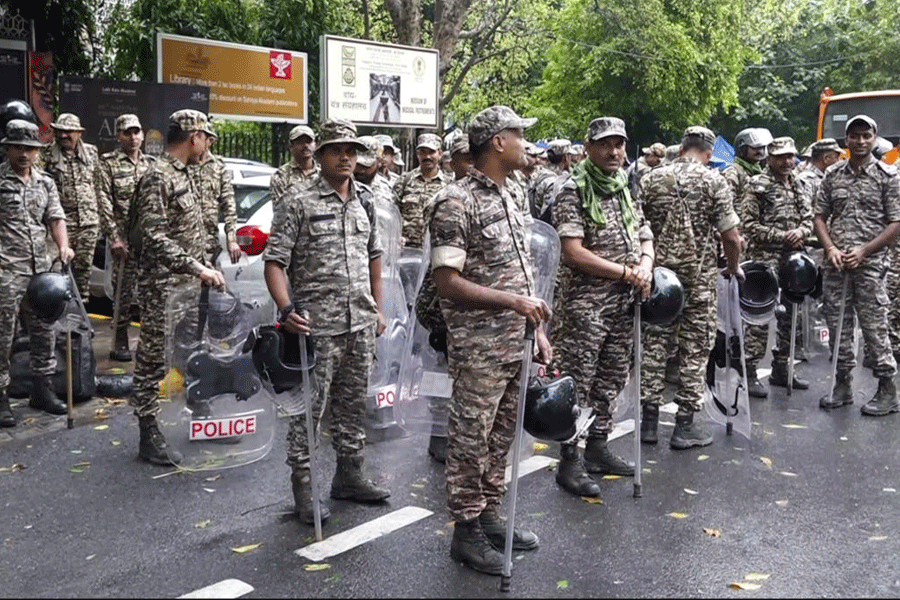
Delhi metro shut entry and exit gates at six stations on Monday ahead of a Congress protest against Chief Election Commissioner Gyanesh Kumar. Rahul Gandhi and Mallikarjun Kharge planned a march to the Supreme Court. Security forces got deployed across the capital as many leaders sought a meeting with the CJI.
Delhi metro shuts entry, exit at 6 stations ahead of Congress protest
The entry and exit gates at six Delhi Metro stations, including Central Secretariat, Rajiv Chowk and Patel Chowk, will remain closed till 4 pm on Monday ahead of a protest announced by the Congress against Chief Election Commissioner Gyanesh Kumar.
The Delhi Metro Rail Corporation (DMRC) said the entry and exit facilities at Janpath, Mandi House, Barakhamba Road, Central Secretariat, Rajiv Chowk and Patel Chowk will be closed due to security reasons. However, interchange facilities will remain available at all the affected stations, the DMRC said in a post on X.
"The situation will be reviewed by the security agencies and necessary updates will be shared accordingly. However, interchange facility will remain available at all the concerned metro stations," it further said.
The BJP on Monday took a swipe at the Congress over Rahul Gandhi's request for a meeting with the Chief Justice of India, saying the judiciary must remain above day-to-day political battles.
In a post on X, BJP spokesperson Gaurav Bhatia said, "From separation of powers to desperation for power, Rahul Gandhi has confused constitutional law with political theatre!"
"Read it. Respect it. And learn the doctrine of separation of powers.The Constitution is a guide to governance, not a prop for political performance!" he added.
Intensifying their agitation against Chief Election Commissioner Gyanesh Kumar, the opposition parties would march to the Supreme Court on Monday, with Rahul and Mallikarjun Kharge seeking a meeting with Chief Justice of India (CJI) Surya Kant to raise the issue of "vote chori".
Both Rahul and Kharge had written to the CJI, seeking a meeting between 4 and 5 pm on Monday to hand over a memorandum, demanding an end to "vote chori", CEC's resignation, halting of the Special Intensive Revision (SIR) of electoral rolls, and switching back to the paper ballot format.
Delhi was on high alert for the third consecutive day on Monday, with over 30,000 police and paramilitary personnel deployed across the capital ahead of an Opposition protest march to the Supreme Court to intensify the agitation against CEC Gyanesh Kumar.
Opposition parties announced on October 11 that they would march to the Supreme Court on Monday to demand an end to "vote chori" and the resignation of the chief election commissioner (CEC).
Security has been tightened at the city's borders, railway stations, bus terminals and other sensitive locations to prevent unauthorised gatherings and maintain law and order, Delhi Police officials said.
More than 120 companies of the Central Armed Police Forces (CAPF) are assisting Delhi Police in managing the situation. The New Delhi district has been divided into 20 zones, with joint commissioners, deputy commissioners and additional deputy commissioners monitoring developments on the ground, the officials said.