
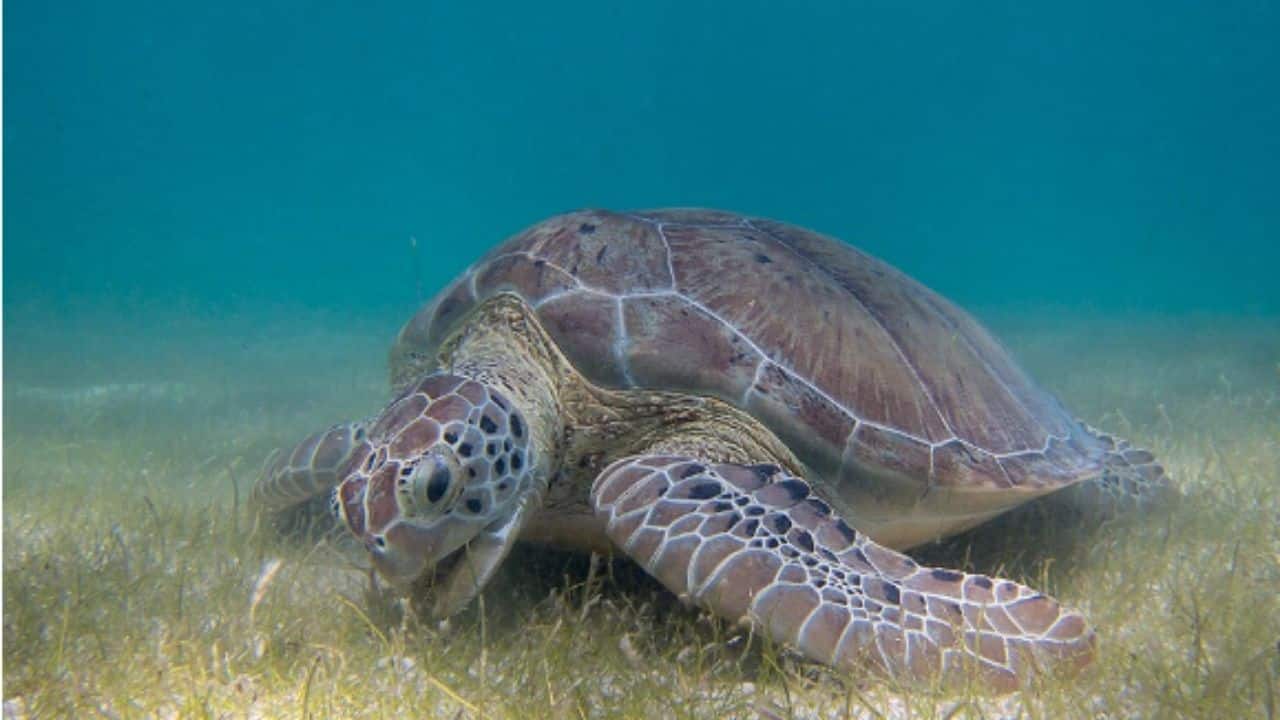
Italian climbers discovered strange markings on a limestone slope in 2019. Scientists studied these impressions in the Monte Cònero area and said they may be traces of sea turtles fleeing an earthquake 80 million years ago. Many paddle-shaped prints showed how these creatures moved across the ancient deep sea floor.
Market Mastery
Webinar by Vishal Malkan
Find the weak links
in your portfolio by Vishal Malkan
Scaling a cliff along the coastline is largely a task of careful observation, during which one tries to spot something on its surface where one’s fingertips or boots can rest. One day, some climbers scaling a limestone slope near the sea found themselves looking at something unusual on its surface. It was smooth but slightly undulating, covered with repeating ovals, which looked like something man-made and not created by the natural process of erosion.
Photographs taken by the climbers caught the attention of Paolo Sandroni, Alessandro Montanari and their colleagues, who went on to study the site. During the next few years, attempts were made to answer these simple questions: what could create such markings, when it happened, and how they could survive in the environment. All of the proposed explanations remain hypotheses.
Paolo Sandroni and Alessandro Montanari study the Monte Cònero slab
According to the study published in Cretaceous Research, the climbers discovered the markings in 2019 in the Monte Cònero area near Ancona on Italy's Adriatic coast. In their Cretaceous Research study, the authors report more than 1,000 paddle-shaped impressions across roughly 200 square metres of limestone that was once part of a pelagic sea floor. In their opinion, this track surface contains evidence of a synsedimentary earthquake and, according to the authors, the most likely originators were marine turtles. Their team documented the surface, drones included, and reported the results in the study Reptile footprints on a pelagic seafloor as a vestige of a synsedimentary seismic event in the lower Campanian Scaglia Rossa basin of the Umbria-Marche Apennines (Italy), published in Cretaceous Research.
Microfossils and magnetic stratigraphy place the layer in the lower Campanian
The rock belongs to the Scaglia Rossa, a limestone formed from deep sea sediments, according to Montanari’s comments to Live Science. In the Cretaceous Research study, the researchers combined biostratigraphic and magnetostratigraphic analysis to place the footprint-bearing layer in the lower Campanian of the Late Cretaceous, about 80 million years ago. Live Science's coverage of the study gave a slightly younger figure of about 79 million years.
Microfossils point to deep water, pelagic bottom conditions; thus, the creature that left prints had to walk on loose deposits under the bottom, not on a beach. Montanari also stated that currents and burrows normally wipe out such tracks, and therefore, their preservation requires some explanation.
Sea turtles as team's leading candidate over plesiosaurs and mosasaurs
The authors of the Cretaceous Research study excluded fish as possible trackmakers because fish do not use their fins to paddle along the seafloor, which left three groups of marine reptiles: plesiosaurs, mosasaurs and sea turtles. Sea turtles are the scientists' leading candidate because their paddle-like limbs resemble the prints and some living turtles gather in groups. The researchers considered plesiosaurs and mosasaurs less likely because they were probably solitary predators.
Fossil comparisons are scarce. In a study published in Quaternary Research, Helm and colleagues reported two new hatchling sea turtle trackway morphotypes from three Cape south coast sites in South Africa, which they identified as the first fossil traces of the brief post-hatching "run-for-the-sea" phase. The researchers report two new hatchling sea turtle trackway morphotypes from three Cape south coast sites and identify them as the first fossil traces of the brief posthatching “run-for-the-sea” phase. These are Pleistocene beach tracks left by hatchlings, so they show what fossil turtle tracks can look like but are not a direct match for the deep-sea Monte Cònero prints.
The researchers propose an earthquake
The authors hypothesize that an earthquake may have disturbed the marine reptiles, most likely sea turtles, prompting them to flee the shaking and possibly skim the soft seafloor as they moved away, although the study notes that this reconstruction remains uncertain. The authors suggest that the earthquake may have triggered a fluxoturbidite, a sediment flow that rapidly buried and preserved the trace fossil. This is an interpretation and not an observation.
The mechanism itself is well understood. The U.S. Geological Survey explains that earthquakes can shake the seafloor near coastlines hard enough to send turbidity currents, fast and sediment-laden, down steep slopes into deeper water. It cites the 1929 Grand Banks earthquake, which snapped transatlantic cables off Newfoundland.
Michael Benton and Spencer Lucas question the turtle identification
While all experts concur on the setting, not everyone endorses the interpretation. According to Michael Benton, a vertebrate paleontologist from the University of Bristol, the geological context is well understood but the attribution of sea turtles for making the prints, as well as the "underwater punting behavior" implied by the hypothesis, was uncertain. Spencer Lucas, curator of the New Mexico Museum of Natural History, said the basic data are not enough to evaluate the hypothesis. The authors of the Cretaceous Research study acknowledge that the identity of the trackmaker remains uncertain. The most definite conclusion is that there are numerous, reptilian tracks that were made on a deep marine bottom shortly after a seismic event.