
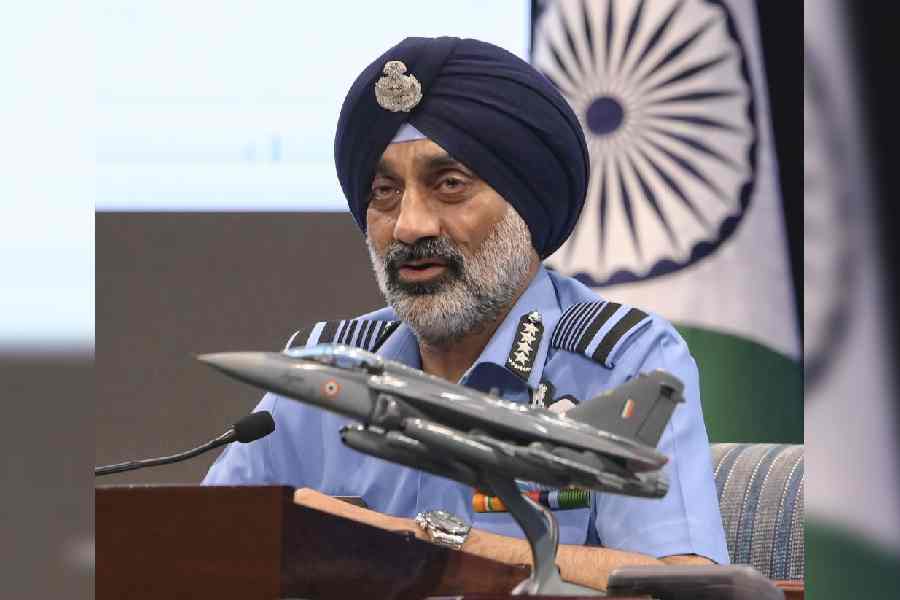
Air Chief Marshal AP Singh said on Saturday that India needs 36 to 40 new fighter jets every year. Delays in indigenous projects might force the country to look abroad for aircraft. "We may have to look at other fighter platforms in case of delays," the air chief said.
Air Chief Marshal AP Singh addresses the media in New Delhi on Saturday. PTI
India needs at least 36 to 40 new fighter jets every year, and any delays in developing the indigenous fifth-generation Advanced Medium Combat Aircraft might compel a look at the option of buying foreign, Air Chief Marshal A.P. Singh said on Saturday.
"We need 36 to 40 aircraft every year. India needs to further ramp up its air power as it remains crucial in the context of overall military strength," the air chief told a news conference ahead of Air Force Day, October 8.
"We may have to look at other fighter platforms in case of delays in AMCA fifth-gen and other programmes to fill in the gaps. Russia has offered (fifth-generation) Su-57 jets but no decision has been made."
The Indian Air Force has 29 fighter squadrons (of 16 to 20 aircraft each) -- the least since the 1960s -- against an authorised strength of 42.
Besides, several existing aircraft are approaching retirement, and maintaining the older platforms is becoming increasingly difficult. Questions have been raised about India's airpower in the event of a simultaneous conflict with Islamabad and Beijing.
The air force is pursuing the purchase of 114 Rafale fighters from France, in addition to the 36 already procured, and has placed orders for 180 indigenous LCA Mk1A aircraft.
An internal assessment following Operation Sindoor in May last year indicated that the air force might need to field more than the authorised number of squadrons to meet future challenges.
Military veterans have long highlighted the systemic challenges that constrain India's efforts at being atmanirbhar (self-reliant) in defence production.
As the IAF seeks faster delivery of new aircraft, the prolonged delays affecting indigenous programmes have caused concern. For instance, the Tejas MK-1A variant programme, launched by Hindustan Aeronautics Limited in 1983, has missed multiple deadlines, causing frustration among the IAF top brass.
The AMCA programme, India's most ambitious project, has now moved to the industry selection stage, with requests for proposals issued to short-listed Indian companies. These fighter jets are expected to take at least another decade to enter service.
Singh said India was looking at finalising the multi-role fighter aircraft (MRFA-Rafale) deal by this financial year, provided things went to plan. Price negotiations and other critical discussions are currently under way.
Singh had previously, too, underlined the need to prevent further erosion of the IAF's fighter strength and urged faster production and induction of new aircraft.
In 2024, then an air marshal, Singh had said that "atmanirbharta cannot be at the cost of the nation's defence".
Singh had expressed full support for the drive towards self-reliance in defence but flagged the deficiencies in domestic manufacturing. "Atmanirbhar Bharat should not just be a buzzword," he had said.
Drones
Singh ruled out a separate drone force, saying unmanned aerial systems and loitering munitions should instead be integrated with the IAF's existing weapons and operational structure.
Loitering munitions are warhead-fitted drones that loiter overhead until the target is located, and then crash into the target. They are also called "suicide drones".
"Whether we need a separate drone force, I don't think so. They should be a part of the same setup, and we have to be operating together," Singh said.
"We cannot be operating one type of weapon separately somewhere and another type of weapon separately. So we have not thought of having a separate drone force."