
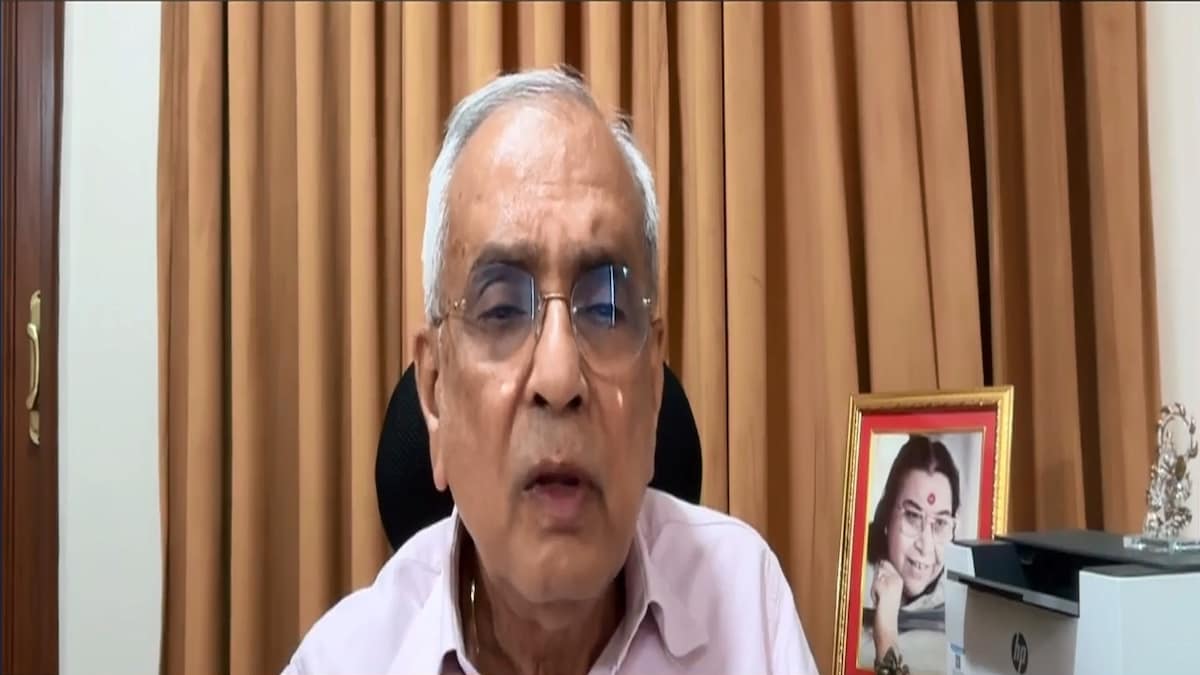
Rajiv Kumar said India’s next phase of growth depends on private investment. He noted that the government must create a supportive environment for businesses by reducing regulatory burdens. While infrastructure and innovation remain key, Kumar warned that higher interest rates could weigh on consumption and smaller businesses in the future.
Rajiv Kumar, former Vice Chairman of Niti Aayog, said India's next phase of growth will depend on creating a more supportive environment for businesses to invest. He called for lower regulatory and compliance burdens, predictable policies and stronger Centre-state cooperation, while warning that higher interest rates could weigh on consumption, investment and smaller businesses in the months ahead.
Prime Minister Narendra Modi's 25 years as a head of government have been marked by a strong focus on infrastructure and innovation, according to Rajiv Kumar, former Vice Chairman of Niti Aayog. But as India looks to push growth towards double digits, Kumar believes the next phase will depend increasingly on private investment.
Speaking to CNBC-TV18, Kumar said the government can support growth by providing infrastructure, skills, healthcare and other public goods. But private enterprise will have to play the bigger role in investment and expansion.
Modi took charge as Gujarat chief minister on October 7, 2001, and became Prime Minister in May 2014. He is now serving his third consecutive term. During that period, the government's economic agenda has included infrastructure expansion, welfare programmes, GST, digital payments, higher public capital expenditure and initiatives focused on technology and innovation.
Kumar, who worked closely with the government's economic policymaking during his time at Niti Aayog, said infrastructure development has been one of the most consistent features of Modi's leadership.
Infrastructure and innovation have been key themes
Kumar said the focus on infrastructure was visible during Modi's years as Gujarat chief minister and continued after he became Prime Minister.
He pointed to the expansion of highways and railways, greater electricity availability, ports and rural and urban housing. He also cited the reconstruction of Kutch following the earthquake during Modi's tenure in Gujarat.
For Kumar, the significance of infrastructure goes beyond the physical assets being created. He said infrastructure does not generally have a bias and can therefore benefit underprivileged sections as well.
Innovation is the other feature Kumar highlighted.
He recalled meeting Modi when he was Gujarat chief minister and seeing his willingness to look beyond conventional approaches. Kumar cited examples such as generating power through micro-turbines in canals and using Narmada water to reach arid areas of Gujarat.
At the Centre, he pointed to initiatives such as the Aspirational Districts Programme, Atal Tinkering Labs and Startup India as examples of an emphasis on innovation and encouraging young people.
These priorities have also been accompanied by a broader expansion in public infrastructure and technology. Public capital expenditure has risen from ₹2 lakh crore to more than ₹12 lakh crore, while electronics production has increased from ₹2 lakh crore to more than ₹13 lakh crore. UPI, a domestic COVID vaccine and Chandrayaan-3 have also featured prominently in the government's technology and science agenda.
Why private investment is now the bigger growth question
Kumar's assessment of India's next phase is centred on one issue: getting private businesses to invest more.
He said India has not yet done enough to make it easier for private enterprise to operate and expand. In his view, the government needs to create conditions that give businesses greater confidence to invest.
Kumar summed up the change he believes is needed in one sentence: "India has to change from being a regulatory state to a promotional state."
That means reducing the regulatory and compliance burden, ensuring greater policy predictability and giving investors confidence that they will not face unexpected changes.
Kumar said businesses need to feel welcome in India and called for predictable policies, "zero retroactive action" and less uncertainty in the investment climate.
He pointed to the removal of more than 1,200 redundant laws as a step in that direction, but said more work would be required.
The distinction is important because Kumar does not see government spending as a substitute for private investment. The government can provide the infrastructure, skills, healthcare and other public goods needed by businesses, but private enterprise needs to take the lead in investment and growth.
Why the states matter to private investment
For Kumar, improving the investment environment is not something that can be achieved from Delhi alone.
He said businesses ultimately invest at the state level, making cooperation between the Centre and state governments critical to the next phase of reforms.
"The rubber meets the road actually in the states," Kumar said.
He suggested that Niti Aayog, a revived Inter-State Council or another mechanism could be used to create a more collaborative and federated structure focused on promoting private enterprise.
The idea is to make the investment environment more consistent across the country rather than relying only on measures taken by the central government.
Can India achieve 7.1% growth in FY27?
The question of private investment becomes more important against the backdrop of the Reserve Bank of India's 7.1% growth forecast for FY27.
Kumar said the target should still be achievable, but described it as "a bit aspirational" given the challenges he expects in the second half of the financial year.
One of his concerns is that investment in capacity expansion is not happening at the pace it should. He also expects the growth rate to slow in the second half compared with the first half.
Smaller and medium-sized enterprises could face an additional challenge from higher interest rates, Kumar said. The 25-basis-point repo rate hike by RBI could affect their appetite and capacity to expand.
That could widen what he described as a K-shaped recovery, with larger companies continuing to grow while smaller and medium-sized businesses find it harder to keep pace.
Kumar also cited the El Nino effect, agricultural production and the fragmentation of global markets as factors that could weigh on growth.
What does the RBI's rate hike mean for demand?
The RBI's decision to raise the repo rate by 25 basis points and shift its stance from neutral to calibrated tightening adds another pressure point for the economy.
Kumar said higher rates could have a dampening effect on both consumption and investment demand.
He questioned whether the tightening could have been delayed by a couple of months to allow consumption demand to receive a greater boost during the festival season.
At the same time, Kumar acknowledged that the RBI may have reasons for acting now, particularly if it is concerned about inflationary expectations becoming embedded in the economy.
He said the central bank has access to its own surveys and information that could give it a different assessment of the economy.
For Kumar, however, the balance between inflation and growth will remain important because tighter financial conditions could make it harder for businesses, particularly smaller ones, to increase investment.
What does Modi's 25-year record mean for the next phase?
Kumar's assessment of Modi's 25 years points to infrastructure and innovation as two of the defining features of his tenure.
The broader record has also included welfare schemes, GST, digital payments, changes to colonial-era laws, higher public capital expenditure and a greater focus on technology. India's role in the G20 and BRICS, its advocacy for the Global South and Vaccine Maitri have also been part of the government's wider agenda.
But Kumar's focus on the next phase is different.
The challenge, in his view, is to move from an economy where the government is a major driver of spending to one where private enterprise has the confidence to invest at a much larger scale.
For India to move towards double-digit growth, that will require not just more investment, but greater policy certainty, lower regulatory friction and stronger cooperation between the Centre and the states.