
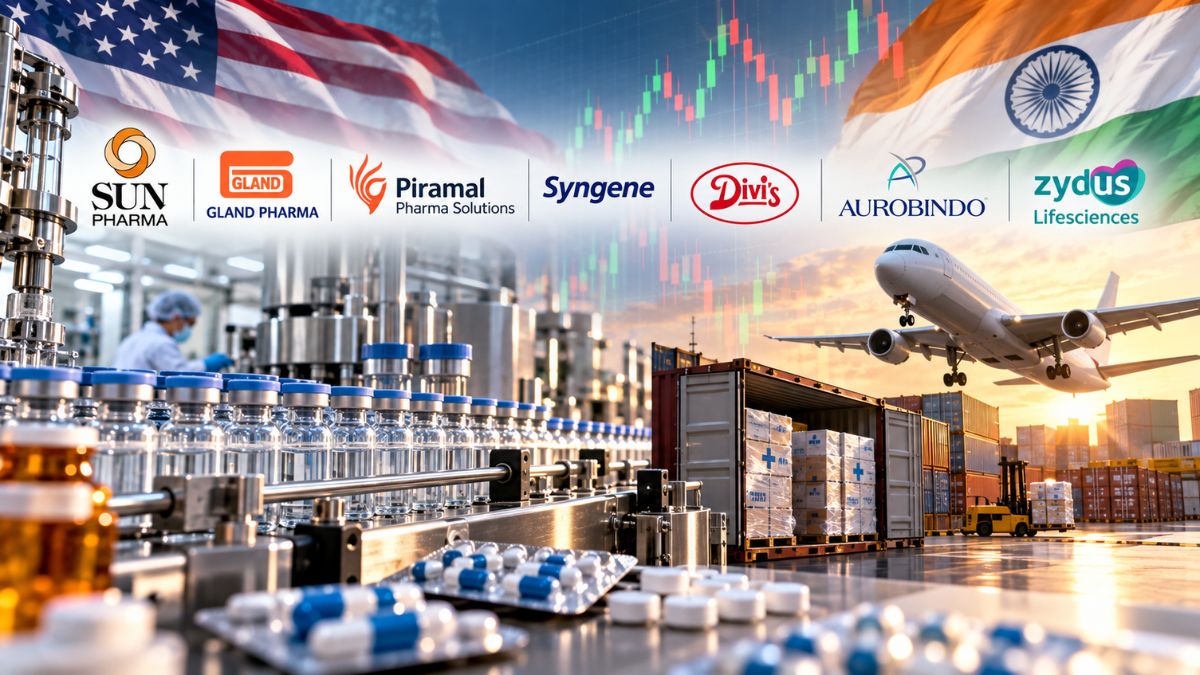
New US tariff updates bring relief to Indian pharma companies. Bharat Celly of Equirus Securities said, “US pharma tariffs were never really an issue for the generic side of Indian pharma companies.” While specialty medicines face some trade risks, India remains on the list of countries receiving duty-free specialty treatment.
Financial Express spoke with industry experts to understand how the latest tariff changes could affect these pharma companies, where the relief could translate into better earnings visibility and which businesses remain exposed to changes in US trade policy.
Generic drugs largely remain outside the tariff impact
The assessments of most pharma sector analysts differ based on direct tariff exposure, US revenue concentration, customer-order visibility and exposure to specialised products. Bharat Celly, Equity Research Analyst at Equirus Securities, said the tariff issue was concentrated in specialty medicines rather than the generic business.
“US pharma tariffs were never really an issue for the generic side of Indian pharma companies. The exposure was primarily on the specialty side, and most Indian pharma companies have a large part of their business coming from generics. Sun Pharma was the only company with measurable exposure given its specialty business, but even there, the impact was limited to around 4-5% of earnings.”
“With the latest update, I believe the impact will be even lower,” Celly said, adding that the update removes the possibility of a future tariff impact on generics and provides further clarity.
Celly also said, “US generics exist primarily to bring down healthcare costs, and imposing tariffs on them would undermine that objective. Therefore, in our view, the applicability of tariffs to generics is likely to be negligible.”
Aurobindo Pharma and Zydus Lifesciences have large US generic businesses, alongside specialty, biosimilar and differentiated products. Their direct tariff exposure therefore differs from companies selling patented medicines in the US or CDMOs whose customers bear the duty at the US border.
Ritvik Manglik, Equity Research Analyst at InCred Equities, said Indian companies are touched by the tariff framework in three ways.
“Some specialty medicines are now let in duty free, and the list has just been widened to include rare disease drugs, radioactive medicines, blood-derived products, fertility treatments, cell and gene therapies, antibody drug conjugates, emergency medical supplies and animal medicines.”
He added that contract manufacturers are affected through their foreign clients because “the client pays the duty at the US border, not the Indian factory”, while companies selling their own patented branded medicines in the US include Sun Pharma and a small part of Zydus.
Manglik also pointed to the countries covered by the exemption. “The duty free specialty treatment only applies to product coming from 19 named countries. India is on that list and China is not. For Indian companies making specialty medicines on contract, that is a direct advantage over Chinese rivals.”
Sun Pharma
Sun Pharma has direct exposure because it sells its own patented medicines in the US. Manglik said its patented US medicines book was worth more than $1.1 billion and that the company had secured a zero rate until January 2029 under its agreement with the US government.
He also said around 56% of Sun’s patented sales come from Korea and Europe, where the applicable rate was 15% rather than 100%. The agreement also includes US lowest-price terms for future innovative launches.
Sun Pharma’s US business reported sales of $427 million in Q1 FY27, down 9.7% year on year, and accounted for 26.6% of consolidated sales. The company said innovative medicines continued to grow, while lower generic sales, largely due to Lenalidomide erosion and additional competition, weighed on the US business.
Innovative medicines sales stood at $351 million in Q1 FY27, up 12.8% year on year.
Kirti Ganorkar, Managing Director, Sun Pharmaceutical Industries, said during the company’s Q1 FY27 earnings call on July 31, 2026, “I think our focus is on innovative business. And here, we would like the innovative business to continue to grow at a healthy rate. So we are expecting healthy growth to continue for innovative business in U.S., driven by new launches, as you know, Unloxcyt and Ilumya is also doing well.”
Richard Ascroft, Sun Pharma’s North America head, said during the company’s Q1 FY27 earnings call on July 31, 2026, “Overall, the U.S. business reported sales of USD427 million for the quarter, declining by 9.7%. Our Innovative Medicines portfolio continued to grow, and this was offset by lower sales in the generic business, largely due to Lenalidomide erosion.”
Sun’s US business therefore has two different components. Generic sales are facing erosion and competition, while innovative medicines are growing through products including Ilumya and newer launches such as Unloxcyt.
Piramal Pharma
Piramal Pharma does not pay the US border duty on behalf of its CDMO customers. Manglik said the company’s benefit comes through its customers, whose orders face less tariff uncertainty, as well as through the addition of ADCs to the duty-free list.
Piramal Pharma reported revenue of Rs 2,270 crore in Q1 FY27, up 17% year on year. CDMO revenue rose 19% to Rs 1,187 crore, EBITDA increased 72% to Rs 285 crore and EBITDA margin stood at 12.5%.
Nandini Piramal, Chairperson, Piramal Pharma, said during the company’s Q1 FY27 earnings call on July 30, 2026, “Our CDMO business delivered broad-based growth across India and overseas sites. Over the last year, we have strengthened our commercial team, deepened customer engagement, and sharpened our go-to-market approach.”
Piramal has also expanded its ADC manufacturing capabilities. It inaugurated a commercial-scale payload-linker development and manufacturing site at its Riverview facility in the US and is expanding sterile injectable capacity at Lexington as part of its $90 million expansion programme.
Peter DeYoung, CEO, Global Pharma, Piramal Pharma, said during the company’s Q1 FY27 earnings call on July 30, 2026, “We continue to strengthen our differentiated capabilities, particularly in the ADC space. During the quarter, we inaugurated a new commercial-scale payload-linker development and manufacturing site at our Riverview facility.”
Piramal’s Q1 FY27 management commentary also pointed to customer demand for manufacturing capacity across multiple geographies, with overseas sites receiving a significant portion of RFP activity.
Syngene International
Syngene International provides drug discovery, development and manufacturing services across small molecules, large molecules and ADCs. Its Q1 FY27 revenue from operations was Rs 736 crore, down 16% year on year, while operating EBITDA margin stood at 12%. The quarter was affected by a lack of offtake from a major large-molecule CDMO client and a forex hedge loss.
Manglik said, “The company that gains most from this particular announcement is Syngene, because antibody drug conjugates were added to the duty free list for the first time in this update, and Syngene is building a facility in Bengaluru to make exactly those.”
He said the facility is still under construction, making the opportunity relevant to future earnings rather than FY27.
The ADC opportunity is therefore linked to future capacity and customer programmes rather than an immediate FY27 earnings benefit.
Syngene’s operations span Bengaluru, Mangalore, Hyderabad and Baltimore, with customers across the US, Europe and Japan. The company expects business momentum to improve in the second half of FY27 after the weaker first-half performance.
Gland Pharma
Gland Pharma has high US exposure through its complex injectable business. Sukhad Kumar Sahu, Research Analyst – Pharma at Axis Direct, said the company derives around 53% to 54% of consolidated revenue directly from the US market, predominantly from complex generic injectables.
Sahu said the primary beneficiaries of the zero-duty exemptions include Sun Pharmaceutical Industries, Gland Pharma and Zydus Lifesciences, particularly companies with specialty portfolios, complex injectables and biosimilars.
“The tariff relief framework grants a 0% ad-valorem duty to specific high-value categories, including orphan drugs, cell and gene therapies, antibody-drug conjugates (ADCs), and plasma-derived treatments,” Sahu said.
He added, “Pure-play injectable manufacturers like Gland Pharma and contract development and manufacturing organizations (CDMOs) also gain significant operational clarity.”
Sahu also said Gland Pharma and AurobindoPharma have high structural earnings sensitivity to US trade and tariff policy, with Gland leading on a margin and net profit basis.
“U.S. market analysis and brokerage data indicate that Gland Pharma derives approximately 53% to 54% of its total consolidated revenue directly from the U.S. market, predominantly from complex generic injectables,” Sahu said.
He added that Aurobindo Pharma has more than 45% of revenues originating in the US, while its domestic, European and US manufacturing footprint provides a cushion compared with Gland’s more concentrated US export profile.
Gland Pharma’s Q1 FY27 revenue rose 20% year on year to Rs 1,800.3 crore. US revenue was Rs 981 crore, accounting for 54% of total revenue and growing 32% year on year. CDMO revenue grew 48%, while B2B revenue increased 27%.
Srinivas Sadu, Executive Chairman, Gland Pharma, said during the company’s Q1 FY27 earnings call on August 10, 2026, “Our CDMO business continued to deliver strong growth during the quarter and remains one of the key pillars of our long-term strategy. Revenue from the CDMO segment stood at INR 8,915 million, which grew by 20% year-on-year and contributed 50% of total revenues during the quarter.”
Sadu also said during the earnings call, “Our customer engagement remains strong, and we continue to attract robust global pharmaceutical companies seeking reliable sterile manufacturing partners.”
Gland has also signed an agreement for 55 sterilised injectable SKUs across three sites, with annualised potential of $90 million to $100 million once commercialised. Technology transfer is expected to take two years and revenue is expected from calendar 2029.
Divi’s Laboratories, Aurobindo Pharma and Zydus Lifesciences
Divi’s Laboratories enters the tariff discussion through its custom synthesis business. Manglik said, “In plain size terms it is Divi’s, but that benefit has already happened and the market has already priced it. Custom synthesis is ~60% of its 1QFY27 revenue, mostly for the world’s largest drug companies, and 26 of those companies have now secured zero rates, covering 89% of the US branded market.”
“The risk sitting in Divi’s order book has largely gone away,” Manglik said.
Divi’s therefore gets exposure through the tariff position of its global pharmaceutical customers rather than through a large own-branded US portfolio.
Aurobindo Pharma reported Q1 FY27 revenue of Rs 9,150 crore, up 16.3% year on year, while US revenue increased 8.1% to Rs 3,770 crore. The company launched 10 products in the US during the quarter and received 10 final approvals.
Zydus Lifesciences reported North America revenue of Rs 3,100 crore in Q1 FY27, up 5% sequentially. It filed five ANDAs, received nine approvals including four tentative approvals and launched 11 products in the US. Its branded business accounted for 10% of US revenue.
Sharvil Patel, Managing Director, Zydus Lifesciences, said during the company’s Q1 FY27 earnings call on August 11, 2026, “We have steadily strengthened our position in the US generics market through our diversified portfolio, a stronger execution, and a resilient supply chain.”
Patel also said during the earnings call that Zydus’ branded business in the US now contributes 10% of US revenue and that the company expects the share to increase as its specialty and innovation-led business expands.
CDMO exposure depends on customer orders
Manglik said the tariff sensitivity of Indian contract manufacturers is indirect because the duty is paid by customers at the US border.
“Because Indian contract manufacturers never paid the duty themselves, their sensitivity is indirect. It shows up as whether clients keep placing orders, not as a cost line anyone can measure.”
Piramal’s management has also linked customer decisions to supply-chain diversification.
Nandini Piramal said during the company’s Q1 FY27 earnings call on July 30, 2026, “Geopolitical and trade-related uncertainties are reinforcing the importance of supply chain resilience and diversification efforts across the pharmaceutical industry.”
She said customers were increasingly seeking reliable CDMO partners with differentiated capabilities, high quality standards and manufacturing footprints across multiple geographies.
Copy medicines remain a policy risk
Manglik said the US Commerce Department must report by April 2, 2027 on whether to extend these tariffs to copy medicines.
“If that goes against India, ~$10.5bn of exports moves from completely safe to taxed,” Manglik said.
For companies with large US generic businesses, that review remains separate from the current exemptions. Aurobindo Pharma and Zydus Lifesciences have substantial generic operations in the US, while Sun Pharma also has a large US generic business alongside its innovative medicines portfolio.
The companies covered in the analysis therefore face different tariff-related channels. Sun Pharma has direct exposure through patented US medicines. Gland Pharma’s exposure comes from its high US concentration and complex injectables. Piramal Pharma’s exposure is through CDMO customers and ADC capabilities. Syngene’s opportunity depends on its ADC facility and future customer programmes. Divi’s Laboratories is linked to the tariff position of its large global pharmaceutical customers, while Aurobindo Pharma and Zydus Lifesciences have substantial generic exposure alongside specialty and differentiated products.
Conclusion
The expanded US duty exemption covers several specialised pharmaceutical categories, but its effect on Indian drugmakers depends on their business mix. Companies selling patented medicines in the US face a different outcome from generic manufacturers, while CDMOs are affected mainly through customer orders and sourcing decisions.
The treatment of copy medicines remains a future policy variable. Experts point to April 2, 2027 is the date when the US Commerce Department will report on whether tariffs could be extended to that category. It’s a wait and watch till then.