
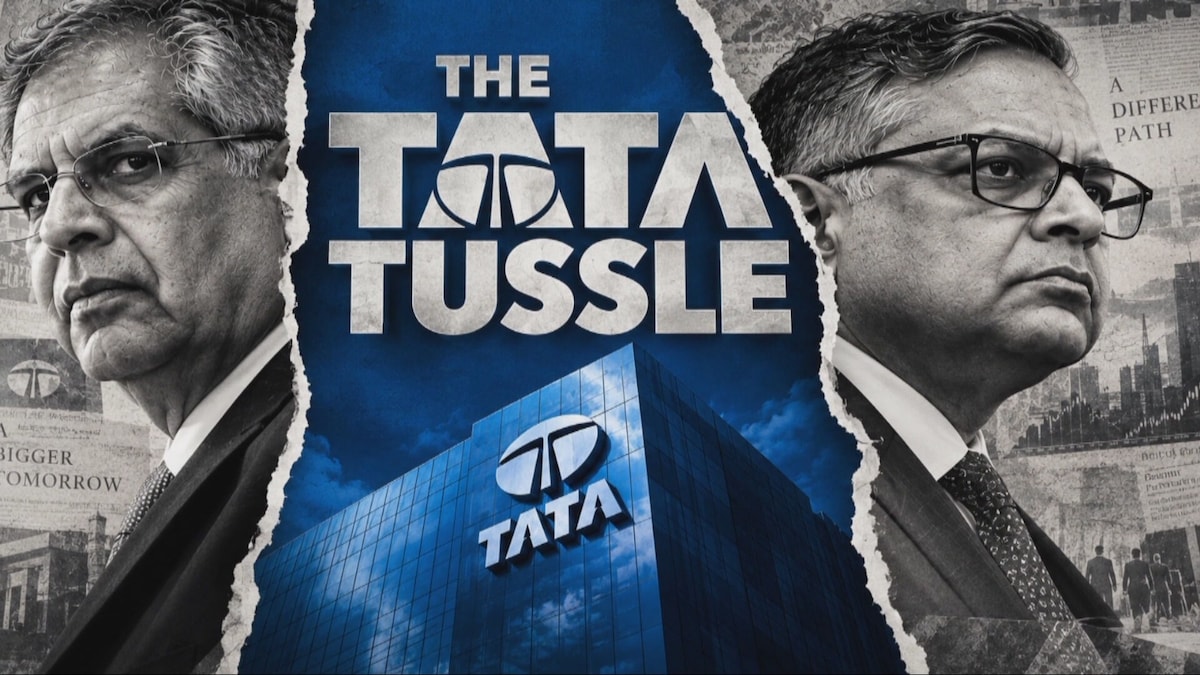
The Tata Sons boardroom battle is alarming Indian promoters and foreign investors, raising concerns about ownership rights and India’s global image. Thomas Mathew said, "if an owner holding a 66% stake in the company is being told they have no rights, what happens to promoters with far lower shareholdings?"
The Tata Sons boardroom battle is alarming Indian promoters, foreign investors, and officials, with warnings that the dispute threatens majority rights, harms India's global image, and raises regulatory concerns.
The Tata Sons boardroom battle is being watched closely by India Inc and foreign Investors alike.
Of primary concern are ownership rights. A veteran corporate leader who has been a witness to previous boardroom battles believes the current impasse will be a 'blow to India'.
Speaking on the condition of anonymity, he says, "if an owner holding a 66% stake in the company is being told they have no rights, what happens to promoters with far lower shareholdings?"
Tata Trusts holds 66% in Tata Sons, which also gives them the right to place three nominees on the board. Currently, Noel Tata and Venu Srinivasan are two such nominees of the Trusts serving on the board of Tata Sons.
"If Tata Trusts as majority shareholder of Tata sons, are left with no say in it's affairs, it will be the start of an upending of ownership rights. It will corrupt the economic framework of the country. A move like this will send shivers down the spine of Indian promoters," says Thomas Mathew, former Secretary of the Govt Of India and the author of Ratan Tata's official biography.
Mathew also questions what is, in his words, the "U Turn" made by the Board of Tata Sons, particularly Tata Trusts' nominee director (Venu Srinivasan) on the question of a public listing by Tata Sons.
"This director supported a unanimous resolution in March 2024, guided by Ratan Tata, to keep Tata Sons private. Later in 2025, this same director also supported the unanimous resolutions passed by both SDTT and SRTT to keep Tata Sons private," he points out.
"It is also quite disturbing that the same representative of Tata Trusts decided to vote in favour of a person whose family was financially connected with his company. It is immediately hit by the principle of bias that is a core pillar of administrative law. It implies that any person exercising judicial, quasi-judicial, or administrative functions must be free from any connection that could influence his or her decision," he goes on.
Mathew says that were Ratan Tata alive, "this question [of Tata Sons listing] wouldn't even be up for consideration."
Indian promoters are watching every development in this boardroom battle with concern, for foreign investors the larger issue of possible policy unpredictability is back on the table. The same corporate leader quoted above who did not wish to be named, who also has close dealings with many foreign investors, says the Tata imbroglio could be 'worse than the Vodafone Moment'.
This refers to the Indian government's 2012 decision to retrospectively amend the tax laws all the way back to 1961 in an effort to revive a ₹22,000 crore tax demand (including penalty and interest) against telecom giant Vodafone; the demand had initially been struck down by the Supreme Court.
Another veteran industry leader with a deep understanding of the Tata Group, who also does not wish to be named, says the current stalemate is "intriguing" and "unusual"; particularly the role of the Charity Commissioner who has disallowed one of the crucial Tata Trusts (Sir Ratan Tata Trusts) from holding any meetings. "It's quite unique that someone like a charity commissioner can bring one of India's most important conglomerates to a standstill, that too with an ex parte order," the veteran notes, adding that this public battle will send out "dangerous signals" about the perceived role of state intervention in the affairs of a private company.
The regulatory move that sparked this battle -- the Reserve Bank of India (RBI) decision that Tata Sons would remain classified as an Upper Layer Non-Banking Finance Company (NBFC), and so would have to mandatorily list -- is also being looked at askance from a foreign lens.
"Perhaps there is no example anywhere in the world where the Central Bank has required a pure investment holding company to go public. This may appear very unusual to foreign investors," the veteran goes on to say.
It's not just India Inc and foreign investors who are unsettled by the turns in this dispute. CNBC-TV18 learns from a top government source that the tussle is being viewed with quite some discomfort in the corridors of power as well. Particularly distressing, they indicate, is that this feud is playing out in public, and at a group that is globally renowned and enjoys significant resonance with India's corporate image on the world stage.
This source says, "a professional CEO or Chairman being seen at loggerheads with the company's largest shareholders is not a good look."
That this is not the first such messy and very public boardroom battle at the conglomerate is not lost on spectators either. The last time was in 2016, when Cyrus Mistry was removed from the position of Chairman of Tata Sons. That battle lasted nearly 6 years.
It was fought in the media and in the halls of the National Company Law Tribunal (NCLT) and its appellate body, before culminating in the Supreme Court. The apex court then ruled that board decisions which adhered to the powers and framework laid out in the Articles of Association did not constitute oppression or mismanagement of minority stakeholders.
A former senior policymaker, with decades of experience in regulatory matters, who also did not wish to be named says, "the whole corporate ecosystem should be worried about what is happening in the Tata Group, because such standoffs could occur elsewhere. The issues should be resolved by mature conversations among the protagonists, provided they focus on issues and not on individuals. Structures and processes are more important. It will be a sad day if courts, which are the last resort, have to resolve these matters."
The government source concurs, and says the hope is that this time around, the dispute will not drag on for years, but will be resolved internally and amicably.