
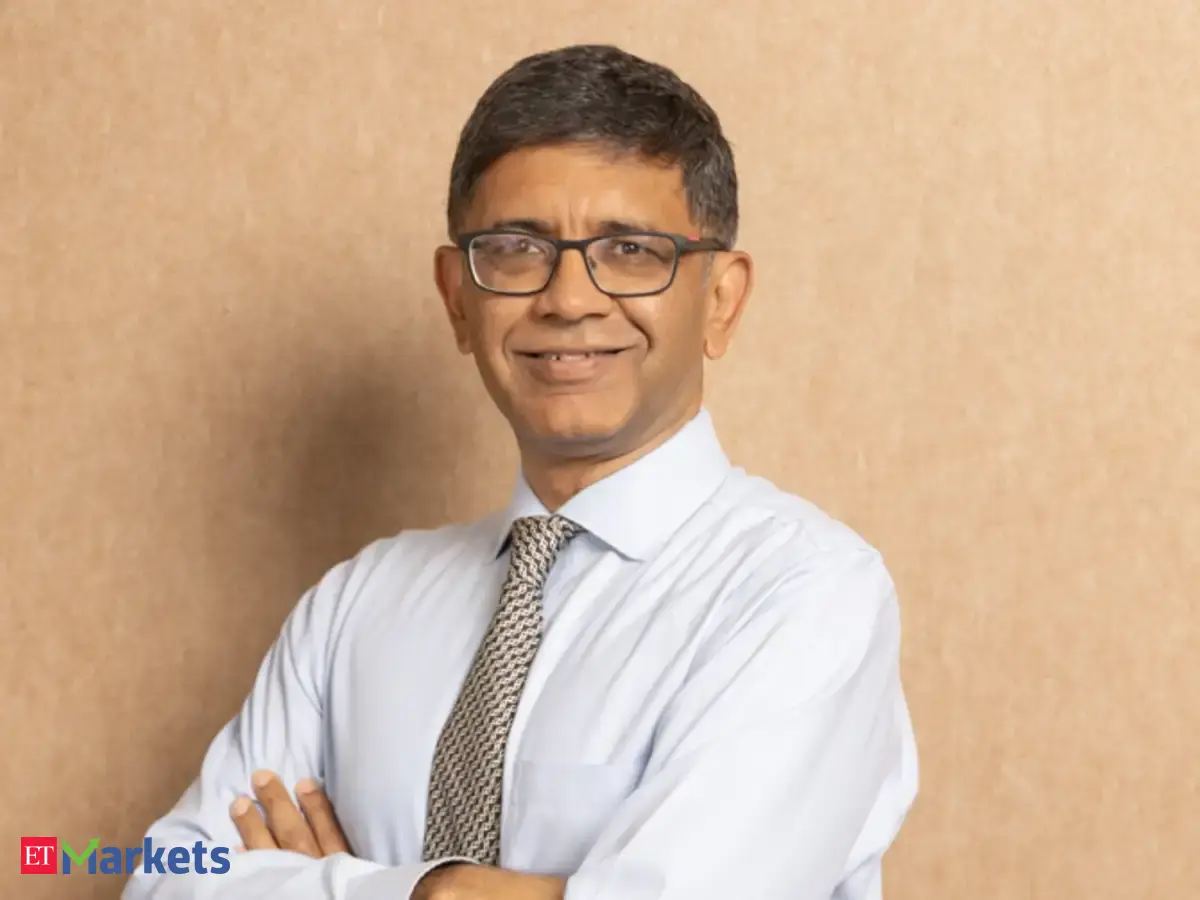
Anish Tawakley, CIO at DSP Mutual Fund, said predicting foreign fund flows is like predicting mood swings. He advised investors to focus on earnings rather than liquidity for portfolio decisions. With Nifty earnings growth muted in FY25 and FY26, he expects reasonable, earnings-led returns over the next 12–18 months instead.
Synopsis
At any point in time the market is influenced by multiple factors and it is impossible to attribute performance across those factors. I focus on earnings rather than flows. I would caution anyone against basing investing decisions based on flows for three reasons.
Investors trying to time Indian equities by tracking foreign fund flows are effectively betting on “mood swings”, according to Anish Tawakley, chief investment officer at DSP Mutual Fund, who says earnings, and not liquidity, should drive portfolio decisions.
With Nifty earnings growth muted in FY25 and FY26, Tawakley expects reasonable, earnings-led returns over the next 12–18 months. He sees the risk-reward favouring largecaps and remains positive on banks, while cautioning investors against chasing popular themes and remaining cautious on listed IT companies. Edited excerpts from a chat:
The sell-off in Indian equities has accelerated in the last few weeks and the FIIs are also back to selling mode. Is the market facing a liquidity problem, an earnings problem or simply a valuation reset?
At any point in time the market is influenced by multiple factors and it is impossible to attribute performance across those factors. I focus on earnings rather than flows. I would caution anyone against basing investing decisions based on flows for three reasons.
One, there is no good model for predicting flows – predicting flows is akin to predicting mood and mood swings. So it is better to respond to flows (sell when flows drive up valuations and buy when flows pull down valuations) than try to predict flows.
Live Events
Two, if you are buying based on expectations of flows then you are basically betting on the greater fool theory. In my view that is not a good way to invest.
Three, even if inflows create the demand for paper, the rich valuations also create a supply of paper. That is what has happened in the Indian market over the last 3 years. Strong demand from retail investors has resulted in a lot of supply from promoters and private equity investors.
So I would rather look at the market from an earnings perspective and not a flows perspective. From an earnings perspective Nifty earnings growth over FY 25 and FY 26 was muted and that would explain the weak market.
What is your market outlook for the next 12–18 months? Do you expect returns to be driven more by earnings growth or multiple expansion?
The Indian economy is in good shape. Demand is growing and there is still spare capacity. That should lead to healthy earnings growth. Market valuations are reasonable (neither expensive nor cheap). This should translate into reasonable, earnings driven, returns over the next 12-18 months.
Largecaps have lagged mid- and smallcaps over the past few years. Has the valuation gap now shifted the risk-reward in favour of largecaps?
In my view the risk return trade-off is in favour of large caps. As a general rule one should not chase performance. It is better to invest in segments that have lagged in the past few years than in segments that have done well. Also one should be extremely careful in buying when promoters and private equity are diluting (either through primary or secondary issuances).
If you’re investing in small caps I would strongly recommend that you should go with fund managers who are experienced and understand the challenges of handling funds when the market cycles turn.
Foreign investors are increasingly participating in IPOs and other primary issuances. Is this diverting capital away from the secondary market, and how long can this persist?
As I said earlier, it is impossible to predict flows and when they will turn. I would rather respond to flows than try to predict them. In physics, there is a concept of “unstable equilibrium”. If something is in unstable equilibrium one cannot say when it will be disturbed and when it will fall. But one can say that once the equilibrium is disturbed it will not return to the same position. The same is true of flow driven markets.
Crude oil remains a major macro risk for India. Which sectors and businesses are most vulnerable if prices remain elevated for an extended period?
High crude oil prices are a drag but it is important to dimension the risk and not to panic. The point I would like to make is that given the level of our foreign exchange reserves the Indian economy can be resilient in the face of reasonably elevated crude oil prices. India consumes ~ 5 billion barrels of oil per day. If oil prices increase by $ 20 per barrel and for a full year then the impact for the full year is $ 37 billion. India has foreign exchange reserves of over $ 600 billion. We are not in the early 90s when the country had no reserves and had to mortgage gold to pay its export bill. So I am not saying that crude prices are not an issue but I am saying that one needs to keep them in context and not panic.
Rising global bond yields can put pressure on equity valuations. At what yield levels would Indian equities become less attractive relative to fixed income?
One should always have an asset allocation approach based on an individual’s risk profile.
For the Indian markets it is the Indian bond yields that matter rather than global bond yields. I am not expecting Indian bond yields to spike meaningfully from current levels. The yield curve is already fairly steep and is already pricing in some tightening of monetary policy. Given that core inflation is still reasonable and inflation expectations are well anchored (the RBI’s credibility is good) I do not expect a big rate hike cycle.
Banks have corrected, while IT continues to face uncertainty from AI and weak discretionary spending. Which of the two sectors is better placed to lead the next market recovery?
I am positive on banks. Once equity markets become more skeptical and discriminating in providing capital, the role of banks in aggregate capital formation will pick up.
IT is less bullish on and my problem with IT is not AI or some fancy disruption. My concern on IT is that the listed Indian IT vendors are losing share to captives (the GCCs) and I am struggling to see how that changes. I will wait for IT hiring by the listed companies to pick up before I turn positive on IT. I think hiring will be a leading indicator of revenue growth.
Defence, power, manufacturing and capital goods remain popular themes. Are investors underestimating their earnings runway, or are valuations already discounting too much optimism?
I have a simple rule, if you like a company at 100 you should like it less at 200. As themes play out one should take money off the table.
The market is increasingly rewarding companies linked to AI infrastructure, power and data centres, even outside traditional technology stocks. Is this a durable earnings cycle or another crowded theme?
Again, if the market has already rewarded these companies then I would recommend taking money off the table. More specifically, I would point out that demand growth alone is not a sufficient condition for an industry to be profitable. If supply expands as much as capacity or supply expands faster than capacity the anticipated improvement in profitability does not materialize. So investors looking at investing in these sectors should ask the question – do these companies have a moat/competitive advantage. Only if one is convinced that the companies have a genuine and sustainable competitive advantage does it make sense to invest.
(You can now subscribe to our ETMarkets WhatsApp channel)
(What's moving Sensex and Nifty Track latest market news, stock tips, Budget 2025, Share Market on Budget 2025 and expert advice, on ETMarkets. Also, ETMarkets.com is now on Telegram. For fastest news alerts on financial markets, investment strategies and stocks alerts, subscribe to our Telegram feeds .)
Subscribe to ET Prime and read the Economic Times ePaper Online.and Sensex Today.
Top Trending Stocks: SBI Share Price, Axis Bank Share Price, HDFC Bank Share Price, Infosys Share Price, Wipro Share Price, NTPC Share Price
...moreless
(You can now subscribe to our ETMarkets WhatsApp channel)
(What's moving Sensex and Nifty Track latest market news, stock tips, Budget 2025, Share Market on Budget 2025 and expert advice, on ETMarkets. Also, ETMarkets.com is now on Telegram. For fastest news alerts on financial markets, investment strategies and stocks alerts, subscribe to our Telegram feeds .)
Subscribe to ET Prime and read the Economic Times ePaper Online.and Sensex Today.
Top Trending Stocks: SBI Share Price, Axis Bank Share Price, HDFC Bank Share Price, Infosys Share Price, Wipro Share Price, NTPC Share Price