
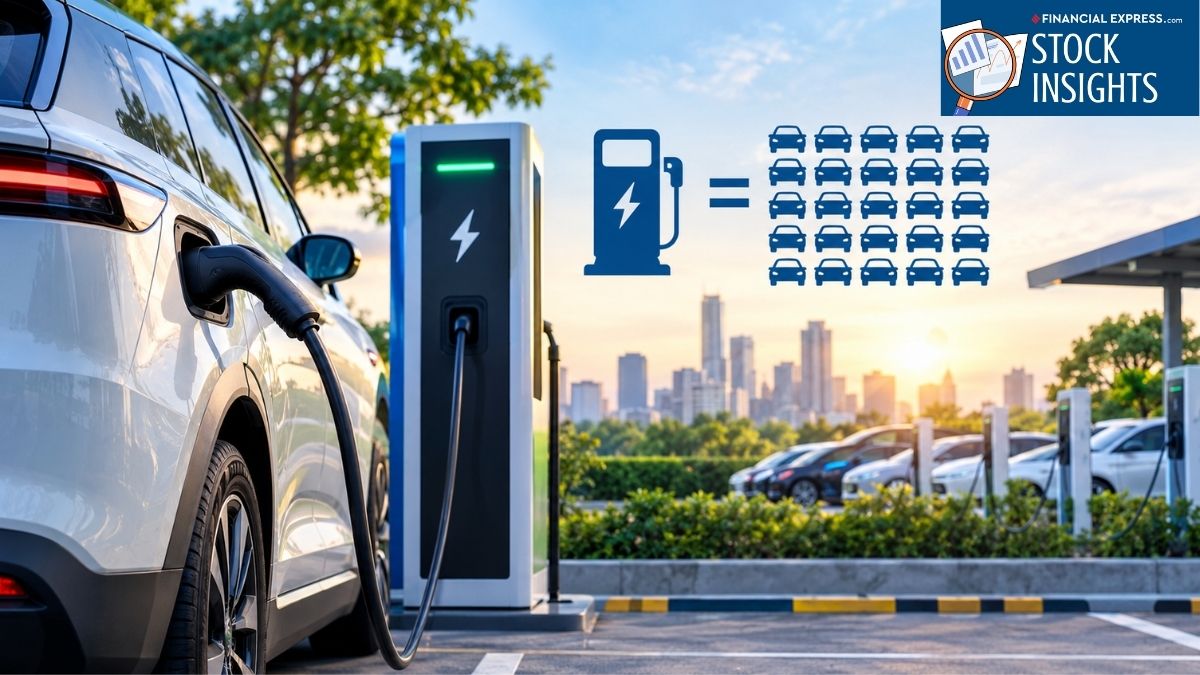
India had only one public charger for every 235 electric vehicles by December 2025. While registrations reached 24.5 lakh units in FY26, the charging network remains small. Tata Power leads the market with 7,200 charging points, as the government earmarked ₹2,000 crore to help build more infrastructure across the country.
The numbers suggest that the gap is still wide. Electric Vehicle registrations reached 24.5 lakh units in FY26, up 26% from 19.5 lakh in FY25, taking EVs to 8.7% of total vehicle sales. At the same time, public charging stations crossed 29,000 by December 2025. The government has also earmarked ₹2,000 crore under the PM E-DRIVE scheme to support charging infrastructure.
But the charging network is growing from a relatively small base. CareEdge Research estimates that public EV charging stations increased from 5,151 in CY2022 to 26,367 by April 2025. Even after this expansion, India had only around one public charger for every 235 EVs, leaving considerable room for the network to grow.
That gap is beginning to shape a new part of the EV investment story. As more electric vehicles enter the country’s roads, the demand for EV chargers is also expected to be strong. Against this backdrop, this article outlines two leading EV charging companies at the forefront of this market.
#1 Tata Power: India’s EV charging network at scale
Tata Power, part of the Tata Group, operates India’s largest EV charging network under its Tata Power EZ Charge brand. The company covers public, bus, home, and highway locations across India. The company has one of the largest charging networks in India.
Inside Tata’s 7,200-Plug Network
As of Q1FY27, the company had 5,970 public charging points across 717 cities and towns. By the end of FY27, the company plans to expand its electric bus network to 1,258 charging points. Overall, the company has 7,200 charging points. Additionally, Tata Power’s total residential installations increased to 246,065 home chargers.
To help drivers with long-distance trips, it also installed over 1,160 fast chargers on 254 highway corridors. Last year, in 2025, Tata Power also formed a partnership with Tata Passenger Electric Mobility. The venture launched its first co-branded charging hub near Terminal 2 of Chhatrapati Shivaji Maharaj International Airport in Mumbai. This facility runs entirely on renewable energy.
App Drives 65% Revenue Surge
Tata Power EZ Charge mobile application has 5.6 lakh registered users in FY26. During FY26, the platform recorded 30.2 lakh charging sessions and delivered 2596.4 lakh units of electricity. The electric vehicle charging division generated ₹192 crore in operational revenue during FY26. Public charging revenue specifically grew by 65% during FY26.
2030 Target: Tier II Expansion
Looking ahead, the company aims to install over 10,000 public charging points nationwide by 2030. Home charger installations are projected to reach over 7.5 lakh units by 2030. This aligns with the government’s objective of reaching 30% electric vehicle adoption across India by 2030.
Tata Power plans to expand charging points deeper into Tier II and Tier III cities and towns. Management states that the installation of fast chargers will continue to grow along major highway stretches. This would help address driver range anxiety during long-distance travel. The focus would be on charging setups for electric buses, workplaces, and residential complexes.
Q1FY27: Net Profit Jumps 11%
Financially, the company reported an 8.2% year-over-year increase in revenue to ₹17,464 crore in Q1FY27. EBITDA (earnings before interest, taxes, depreciation, and amortisation) increased 8.1% to ₹4,249 crore, while margin stood at 24.3%. Consequently, net profit increased 11% to ₹1,410 crore.
Tata Power Share Price
#2 Exicom Tele-Systems: Building the hardware behind India’s EV charging growth
Exicom Tele-Systems operates across two main business segments: EV Charger Business and Critical Power Business. In the EV Charger business, the company provides hardware, software and integrated charging solutions for passenger vehicles, commercial fleets and public networks.
Exicom is a major player in India’s electric mobility infrastructure. The company has sold over 215,000 EV chargers globally. Consolidated revenue from the EV charger business grew 49.7% year-over-year to ₹153.9 crore in Q1FY27. Management stated that internal volume momentum continues to grow. The business now accounts for 46.5% of revenue.
Inside the ₹1,400-Cr Order Book
The company’s order book stood at ₹200+ crore as of June 2026, which includes direct export orders worth ₹16.5-17 crore. The total consolidated order book reached a record ₹1,400+ crore across the EV charger business and Critical Power. The company acquired a 100% business share for 7.4 kW home wallbox chargers with a leading passenger 4W OEM.
Exicom also launched a special Type-7 charger for a large 7W OEM. The company also renewed and expanded its supply agreement with a large commercial truck OEM. Notably, the company holds a 50% market share in India’s passenger vehicle wallbox charger segment.
Hyderabad Ramp & 10-Nation Push
In Q1 FY27, Exicom added 15 new charge point operator (CPO) network accounts. For this, it has confirmed orders for 180+ DC chargers to be delivered by October 2026. Existing CPOs have placed repeat orders worth over ₹50 crore. The company also launched new products during the quarter.
The company is also commissioning new production lines in Hyderabad and has increased its monthly volume capacity for AC chargers. Management expects the run rate to increase by another 50% in three months. At its existing plant, the capacity utilisation is currently 100% for AC chargers, 65% for DC fast chargers and 90-100% for PCBA lines.
In terms of exports, the EV charger business expanded to 10+ new countries in Europe, South America, South Asia, and Western Asia in Q1FY27. The company currently has ₹16.5-17 crore in export orders in hand. Management aims to increase EV charger export sales as a percentage of segment revenue to 15%, up from 8%.
Losses Narrow Ahead of Breakeven
In Q1FY27, the company’s consolidated revenue increased 61.2% year-over-year to ₹331.1 crore. EBITDA loss narrowed substantially to ₹21.9 crore (-6.6% margin), down from an EBITDA loss of -₹38.6 crore (-18.8% margin) in Q1FY26. Consequently, Exicom reported a net loss of ₹73.6 crore, compared to a net loss of ₹83.1 crore in Q1FY26.
Management expects consolidated operations to reach EBITDA breakeven over the next 2 quarters of FY27.
Exicom Tele-Systems Share Price
Financial Comparison: P/E Valuations vs Return Ratios (ROE & ROCE)
Because Tata Power’s business is capital-heavy, the company’s return on capital employed (ROCE) and return on equity (ROE) are lower than the industry median of around 12%. Exicom is still at a loss, so its ROE and ROCE are negative. This is why we have used the Price-to-Sales (P/S) multiple.
Accordingly, Tata Power trades at a premium to the industry median and at a discount to its historical 3-year median P/S multiple. Exicom trades at a discount to both the industry and its own historical median multiple.
In conclusion, India’s EV charging market is moving from an early infrastructure-building phase towards wider adoption. Tata Power offers scale, an established charging network and a broader power ecosystem. Exicom provides more direct exposure to EV charger manufacturing and is working towards EBITDA breakeven.
However, the opportunity also comes with challenges, including charger utilisation, capital requirements and the pace of EV adoption. The key is not only to track how quickly charging points are being added, but also whether companies can convert this network expansion into sustainable revenue and profitability.
Keep these companies in your watchlist to analyse how they capture the industry tailwind.
Disclaimer
Note: Throughout this article, we have relied on data from http://www.Screener.in and the company’s investor presentation. Only in cases where the data were unavailable have we used an alternative, widely accepted source of information.
The purpose of this article is only to share interesting charts, data points, and thought-provoking opinions. It is NOT a recommendation. If you wish to consider an investment, you are strongly advised to consult your advisor. This article is strictly for educational purposes only.
About the Author: Madhvendra has been deeply immersed in the equity markets for over seven years, combining his passion for investing with his expertise in financial writing. With a knack for simplifying complex concepts, he enjoys sharing his honest perspectives on startups, listed Indian companies, and macroeconomic trends.
A dedicated reader and storyteller, Madhvendra thrives on uncovering insights that inspire his audience to deepen their understanding of the financial world.
Disclosure: The writer and his dependents do not hold the stocks discussed in this article.
The website managers, their employees (s), and contributors/writers/authors of articles have or may have an outstanding buy or sell position or holding in the securities, options on securities, or other related investments of issuers and/or companies discussed therein. The articles’ content and data interpretation are solely the personal views of the contributors/ writers/authors. Investors must make their own investment decisions based on their specific objectives, resources, and only after consulting such independent advisors as may be necessary.