
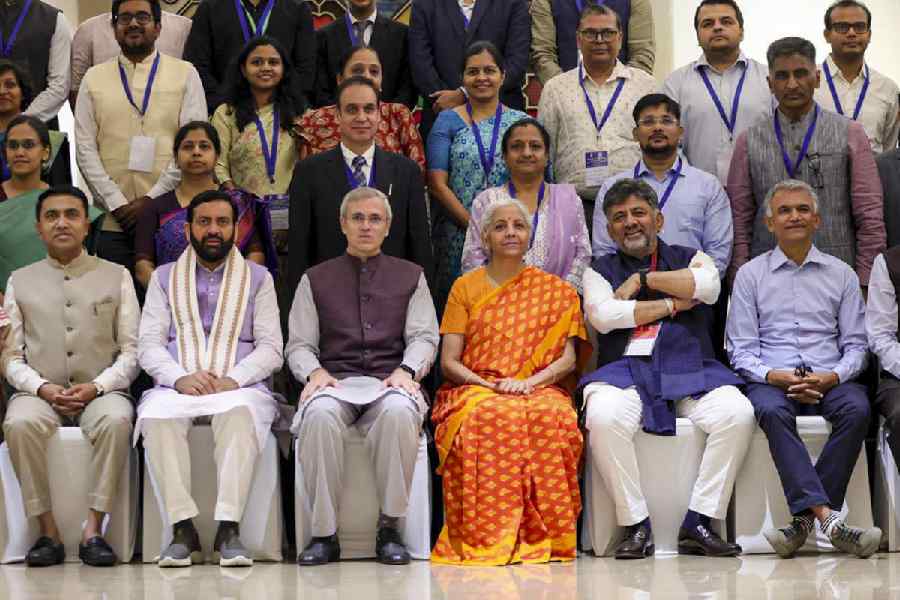
The 57th GST Council meeting cleared reforms to ease compliance and reduce physical inspections. Finance minister Nirmala Sitharaman said the measures were "aimed at making GST administration more taxpayer-friendly." The Council raised the prosecution threshold to ₹5 crore and cut general penalties, helping many businesses get faster refunds and relief.
The 57th GST Council meeting has cleared a slew of process reforms to ease compliance, speed up refunds and reduce physical intervention by tax officials, a year after the government simplified the GST rate structure.
Finance minister Nirmala Sitharaman said the latest measures focused on processes rather than rates and were aimed at making GST administration more taxpayer-friendly.
A key change is the proposed removal of arrest powers under GST provisions. The Council has also recommended raising the prosecution threshold from ₹1 crore to ₹5 crore. Cases involving amounts below ₹5 crore will not face prosecution.
The general penalty, where no specific penalty is prescribed, will be cut from ₹25,000 to ₹10,000. The Council has also proposed a ₹10,000 monetary threshold for issuing notices, along with the withdrawal of pending notices below the threshold.
The rules for physical inspection of goods in transit will also be tightened. A vehicle can be stopped only on the basis of specific intelligence and with prior authorisation from an officer not below the rank of Joint Commissioner. Only the source and destination states will be allowed to inspect goods in transit, while states along the route will not be permitted to stop the vehicle.
The Council has proposed reducing the time for acknowledging refund claims from 15 days to 10 days. If no acknowledgement or deficiency memo is issued within that period, the claim will be deemed acknowledged. The government expects 90 per cent of claims to be sanctioned within three working days of acknowledgement, based on risk assessment.
GST registration and amendments will also see greater automation. Routine changes, including an additional place of business, will be automatically accepted. Taxpayers will also get a simplified route for cancellation of registration.
The Council has proposed wider input tax credit (ITC), including on health and life insurance, telecommunications towers, pipelines outside factories, outdoor catering and certain free samples and expired stock required to be destroyed. t has also recommended extending inverted-duty refunds to input services from November 1, 2026, and to plant and machinery from April 1, 2027.
An optional annual return scheme has been approved in principle for taxpayers with turnover up to ₹5 crore supplying only to consumers. Such taxpayers would pay tax quarterly but file returns annually.
The Council has also proposed allowing refunds to Indian companies providing services to overseas clients through their own foreign branches. Small sellers using e-commerce platforms will get a new route to establish a place of business in another state.
"Honest taxpayers will gain real comfort, and withdrawing low-value notices will substantially reduce litigation," said Jitendra Motwani of Trilegal.
"Allowing refunds on input services under the inverted duty structure is a significant reform for FMCG, pharmaceuticals and jewellery," said Karthik Mani of BDO India.
"The officially approved input tax credit on health and life insurance policies by employers is a welcome move," said Sajja Praveen Chowdary of Policybazaar for Business.