
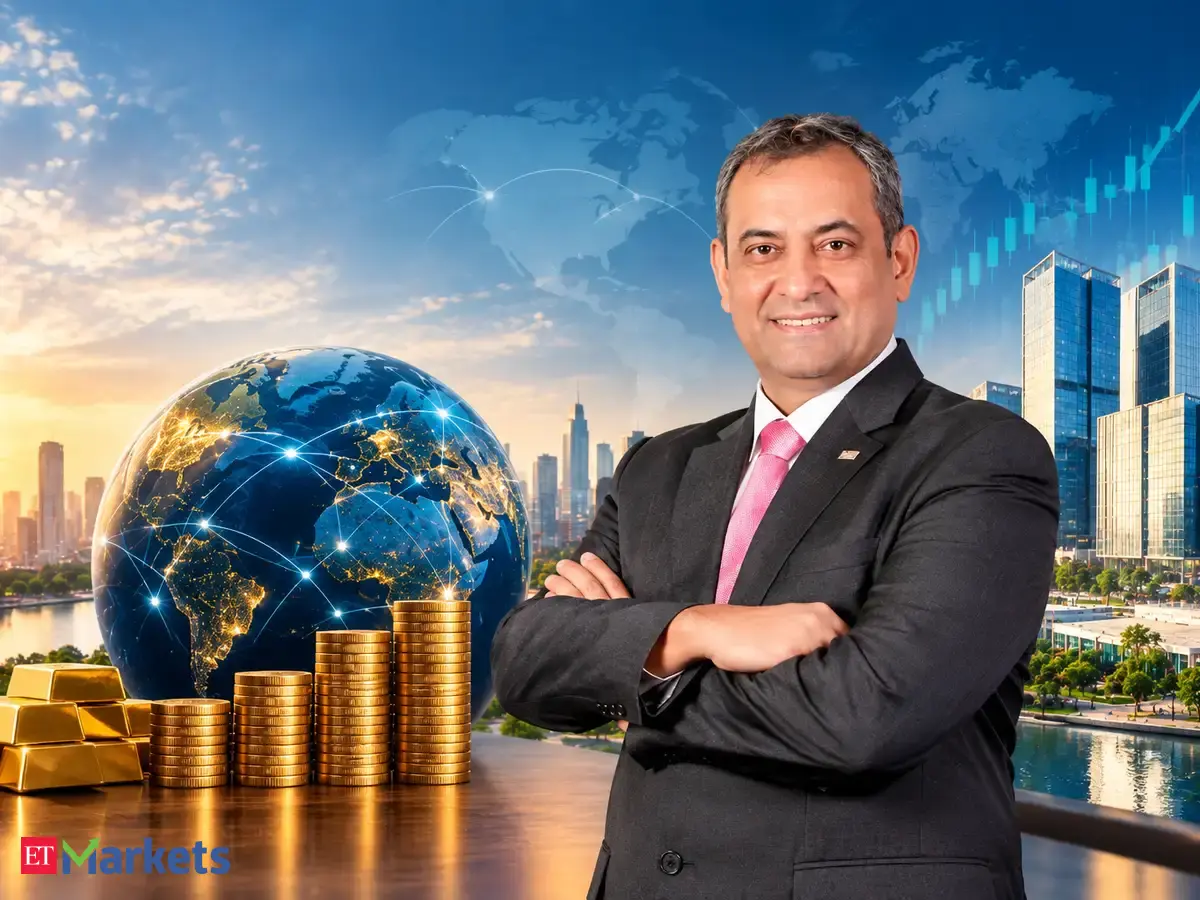
Indian investors are now looking beyond local shores to build global portfolios. GIFT City acts as a bridge, helping people access international sectors like AI and semiconductors. Mustafa Pardiwala said, "It is bringing international opportunities closer to Indian investors." This shift allows many to diversify their money across global markets.
Indian investors are no longer limiting their portfolios to Indian shores. From US stocks and ETFs to AI, semiconductors and other global opportunities, the appetite for investing beyond India is growing.
And this is where GIFT City is emerging as an important bridge between Indian investors and global markets—offering a way to diversify portfolios, access sectors that are not easily available in India, and build exposure to global growth stories.
S&P 500 Top Gainers
Accenture212.69(19.96%)
Synopsys490.54(18.18%)
Cadence Design Systems350.73(8.19%)
Fair Isaac661.76(7.30%)
S&P 500 Top Losers
Corteva12.56(-83.87%)
McCormick & Co44.15(-8.76%)
Coterra Energy32.56(-8.62%)
AppLovin281.31(-7.97%)
But how easy is it to actually invest abroad? Do you need a large portfolio to get started? What role can ETFs and fractional investing play? And does investing through GIFT City eliminate currency risk?
To understand how GIFT City is changing the global investing journey for Indians, I spoke to Mustafa Pardiwala, Chief Business Officer, Mirae Asset Capital Markets (IFSC). Edited Excerpts –
Kshitij Anand: We have heard that GIFT City is India's gateway to global investing. So, what role is GIFT City playing in bringing the foreign capital?
Mustafa Pardiwala: As far as GIFT City is concerned, it is basically India's gateway to global investing, and it is very similar to global investing with a local feel. And I think it is bringing international opportunities closer to Indian investors, and that is how I would look at the role of what GIFT City is doing for all of us.
Live Events
Kshitij Anand: I use this term whenever I am doing any GIFT City-related podcast: going from desi to videsi.
Mustafa Pardiwala: Something very similar.
Kshitij Anand: Where your money travels the globe and you are there where you are, but then your money travels the globe and makes more money for you. Let me also get your perspective on the fact that global investing is primarily about returns, diversification, or currency, which you are seeing right now, or access to businesses or sectors that are not necessarily available here in India, such as AI, semiconductors, and so on and so forth. So, how does the story unfold on that?
Mustafa Pardiwala: So basically, when we talk about global investing, all the factors which you mentioned, whether it is about returns or diversification, definitely come into play. Currency depreciation is also something which is very important. But the real story is something which probably all of us are very familiar with, which is how AI is changing our lives. And at least global investors are very keen on investing for the future, and that is why we are seeing very high demand for stocks related to AI—not only chip manufacturers but also data centres and all the peripheral industries associated with AI. I think that, unfortunately, in India, we do not have any such companies which are directly associated with this particular field, and hence, if you want to be a part of the future, it becomes very important that you have to go globally to be able to access companies which are in this particular field.
Kshitij Anand: Valid point there. In fact, in the recent past, or especially in the last 6 to 12 months, we have seen a lot of money getting poured into some of the companies which are directly dealing with AI or semiconductors, and now media reports, or the noise on the street, suggest that valuations have also been stretched at this point in time. So, how should investors take that with a pinch of salt, or maybe look at some more sectors which are more upcoming or mushrooming at this point in time?
Mustafa Pardiwala: It is a very good question, and for us at Mirae Asset Sharekhan, it is not about really moving money from India to these companies. Our whole idea is that our customers and clients should do some kind of diversification, which basically helps them mitigate the losses associated with a single-country concentration and with rupee depreciation. So, our way of understanding this issue in terms of overvaluation is best is not to ignore the noise which is there out in the market, think long term, and I think that that is the way which really can help them in thinking correctly about their investments, rather than trying to capture the noise which is there around all the stocks right now.
Kshitij Anand: We have talked about stocks. In fact, I was having this conversation yesterday with one of my dear friends, whom I met after 25 years, and he is also globally invested, or invested in the US, and he said that I am better off investing, let us say, in a Vanguard or BlackRock ETF. So, not going specific to the names, but yes, how does ETF investing usually work for investors here in India?
Mustafa Pardiwala: So, as far as ETFs are concerned, first, I will just touch upon the domestic market. I think ETFs are becoming very popular in India too, although they still remain a very small percentage of the overall market size. But passive investing, which is basically ETFs, is actually very popular, especially in developed countries like Europe and the US. ETFs are a very good vehicle for diversification. Today, you can select the best AI company, but something goes wrong with that company and your entire capital is at risk. An ETF gives you that umbrella or that protection. And especially, global investing is going to be new for most of us, including our clients, and we strongly recommend using the ETF platform, which is diverse, it is really diverse. So, ETFs are not just about industries; they can be about countries, they can be about some very exotic metals like platinum and palladium. So, it is a very highly diverse and one of the best platforms for Indians to invest, and you have a variety of them which really help you in terms of being part of what you want to be, yet at the same time not having the kind of risk associated.
Kshitij Anand: In fact, good that you touched upon the part on different countries. So, apart from the US, which are the other countries which investors can look at if they are looking to diversify beyond Indian borders?
Mustafa Pardiwala: So, I will just first touch upon specifically Indian markets. Like everyone knows, the last two years we are practically at zero or slightly negative as far as returns are concerned. In the same period, something like South Korea is up 300%, KOSPI has gone up from 3,000 to 9,000. The Taiwanese market has doubled. The Japanese market has doubled, and so has the US, and China has done very well. As far as global markets are concerned, all global markets have different kinds of opportunities. Like, when we talk about chip makers, you have stocks like Samsung and Hynix in South Korea, which is why the markets have done well. So, it is not really about any specific country, but investors should look at what each country has to offer and be a part of it. So, it is not just about the US; it could be any country. It could be across Europe. It could be across Japan. But all countries offer an opportunity for people to diversify and be a part of the future. At least, that is how global investors are looking at it.
Kshitij Anand: In fact, on a separate topic related to this only, one of the comments which I saw was the fact that someone in the Gulf wanted to invest in the US, and he was asking whether this platform would help him invest, let us say, in the US if he is in a Gulf country.
Mustafa Pardiwala: Yes. So, the GIFT City process which we have is actually allowing not only resident Indians but also non-resident Indians to be able to open their accounts. If it is a foreign national, then, you know…, but naturally, they would have direct access to the US markets. But for non-resident Indians, this option is open that they can invest through us.
Kshitij Anand: How the Indian psychology usually works is the fact that, I have X amount of money in Indian markets, and if I want to diversify, what should be the ideal portfolio mix that I should be looking at, just to make sure that everything is hedged or protected, or at least my portfolio is not that vulnerable to external shocks?
Mustafa Pardiwala: So, in terms of the asset allocation percentage, again, we would follow the normal norms of your age, your risk, your tenure. But a few things which I would like to point out here, which are very specific to global investing: any family which has future expenses in dollar terms, be it in terms of children's education, foreign travel, or the desire to purchase a property outside India, your allocation… So, if you already have an expense in mind in the next five to seven years of, say, X amount, then it would be ideal for you to be able to invest that money here so that it grows in global assets.
Kshitij Anand: So, the corpus can grow.
Mustafa Pardiwala: Yes, and you are protected against the depreciation in the rupee. But if I were to stick my neck out and put a percentage, I would say anywhere from 10% to 20% is something which would be ideal for most investors, depending on their risk and their age.
Kshitij Anand: Also, is the IFSCA structure different from the structure that we have here from a regulatory point of view?
Mustafa Pardiwala: So, the IFSCA structure is…, one thing very unique about the IFSCA structure is that it is a unified body. So, like when we talk about the domestic markets, we have SEBI for the markets, we have the RBI, then we have IRDAI for insurance, etc. In GIFT City, IFSCA is the single authority which takes care of everything. And one very unique feature which I have to mention is that they truly want to build an international financial hub, and they are very willing to listen to people going to them with ideas. They are willing, and they are all the time innovating. And I must take this opportunity to thank them for providing this platform for resident Indians to be able to invest seamlessly, which seemed like something so difficult that people did not even think about it earlier.
Kshitij Anand: Now that we are talking about the IFSCA, I also wanted to get your perspective as to how a human, or how an Indian investor's psychology, works. How is it protecting me? So, in case something does happen, what is the kind of safety net I have?
Mustafa Pardiwala: So again, taking this opportunity to comment on the wonderful work done by IFSCA, the complete regulatory framework which they have created is to make sure that resident Indians are completely protected from any kind of regulatory compliances as far as other countries are concerned. So, that is one thing which we need not worry about. Over and above that, there are also a few other things which I would take this opportunity to at least inform investors: please only use registered IFSCA brokers to do any kind of global investing because it is very important for you to be covered on that front. And also, in the US, all resident Indians who are investing there are protected by something called the SIPC, which is like an insurance that ensures that, in case of any kind of defaults which happen at the US end in terms of the broker, at least the money is protected. So, in a nutshell, I would say that it is very safe for resident Indians as long as they are using the right channels to invest.
Kshitij Anand: A lot of people have now started to invest beyond the borders. What are the frictions that you see or come across? Is it the documentation, KYC, or taxation which usually acts as a hurdle if you propose, acha aap bahar kyo nahi lagate hai, and they say, documentation bahut hai ya taxation bahut hai ya woh bahut complicated ho jayega. Do you also hear these kinds of frictions usually, and what are the common ones?
Mustafa Pardiwala: So, in your question, you mentioned the common reasons. One is that the documentation is extremely difficult. Understanding the regulations of other countries is also something which is very difficult. The third is your entire currency conversion, transfer of money, your banking, which is really very difficult in an environment which is not regulated. And the fourth important thing is what do you invest in and the kind of taxation structures. These are the important things for the customer.
Most of it is very, very, very simplified. Like I said, in the last few years, IFSCA has made a lot of efforts to get everything together in place. We have a very simple system, which is the LRS, which actually regulates how much money you can send abroad. The limit is about two-and-a-half lakh dollars. You have set rules, and as an investor, you do not have to do anything. Your bank has to do all the work for you in terms of maintaining the LRS book.
Your account opening is as simple as opening an account in four minutes. This is how easy it is, and you add your bank in three minutes, and within two or three working days, you have your money available for buying, whether it is Google or Microsoft or Nvidia, or you name it, and you are ready. So, it has become as easy as that. So, a lot of the concerns you said were there earlier have now gone, and that is why you are seeing that there are a lot of clients who are much more interested now in opening an account and getting started.
Kshitij Anand: But there is a popular misconception that if we are going through GIFT City, it eliminates currency risk. Is that fact or fiction?
Mustafa Pardiwala: No. So, when you go through GIFT City, the currency risk remains. So, just to give you an example, if the rupee appreciates against the dollar, then whatever your investment is, and if there is a 5% appreciation in the rupee, then your investments will definitely go down by 5%. But on the flip side, if the rupee depreciates by 5%, then your investment will go up. So, the currency risk does not, per se, go away. It is just that your money is parked in the currency, so the risk of the rupee weakening is something which you mitigate, but currency risk does remain.
Kshitij Anand: Valid point there, and we have seen the currency depreciating more often than the currency appreciating…
Mustafa Pardiwala: So, there is a 10-year history…
Mustafa Pardiwala: So, it is a 10-12-year history that 4% to 5% every year is how the rupee has weakened against the dollar.
Kshitij Anand: Also, what role does Mirae Asset play in making sure that investors have a smooth journey and connecting the globe to their domestic portfolio?
Mustafa Pardiwala: So, at Mirae Asset, the entire idea of enabling global solutions is primarily to A) help them allocate some money to a global portfolio. We want to make it very transparent and easy for them to be able to invest and be a partner to them in their global investment journey. This is how we think about it, and that is how we have started this endeavour.
Kshitij Anand: So, fractional investment is something which is there in the US and not so much here in India, but I am sure a lot of investors would want to own MRF in the fractional investment form, but it is not exactly available at this point in time. But yes, if you can just help investors understand what fractional ownership is all about.
Mustafa Pardiwala: So, first of all, there is some good news for Indians. As I understand, there is a paper which has been released that fractional investing will be introduced in India too. I do not know the time, but this fractional investing is available in the US. Now, today, as somebody who wants to do some kind of investments, if I wanted to buy Apple stock, then Apple is trading at approximately $340. If I have to buy one share, then I need a minimum of Rs 30,000 to buy even one share. But fractional investing means that I can buy even Rs 3,000 worth of Apple, which means I will buy about 0.01 of Apple, and this basically helps me have a not very concentrated portfolio, especially for customers and clients who have smaller ticket sizes. So, I can have a much more balanced portfolio rather than buying just one stock. And fractional investing gives me the same rights in terms of voting rights, in terms of dividends, everything. So, this helps smaller investors also participate in growth stories. So, like you mentioned, if MRF is a great stock, but today most of the investors are not able to participate in that story because you need a minimum of 1.3 or 1.4 lakh rupees, so this fractional investing eliminates this imbalance in terms of clients wanting to own something but not being able to own it because of the price.
Kshitij Anand: And just to add, the names are just for reference and not a buy or sell recommendation. So, I add that disclaimer to the podcast. So, there is also this fear, or you could say thought, in every investor's mind that for global investing there should be a big portfolio. It is like that—we have to have a crore-plus portfolio, then it makes sense. So, if someone says that, okay, I have Rs 25,000-30,000, maximum Rs 50,000, can I start global investing with that?
Mustafa Pardiwala: Good question. So, global investment can start as low as $1; that is the kind of base minimum kind of thing which you require. And I think that clients really need not think about lakhs and crores. It is basically about, like I said, first is to look at what is your investable surplus and then do some asset allocation. And after that, even if you are left with whether it is Rs 50,000 or a lakh, it is something which you can get started on your global journey. You can create wealth out of it and, like I said, it is more about diversification. So, that is a complete myth that you need very big money. You can start your journey with the smallest amounts and, in fact, our preferred method is the same thing: do asset allocation, stick to large caps, stick to ETFs, get your journey started. And as and when you mature, your understanding gets better, you have more corpus, then you slowly add to it. But any client, even with Rs 50,000, can build a decent global portfolio with sectors which you are interested in.
Kshitij Anand: And finally, largely on the GIFT City landscape, I mean, GIFT-IFSC is increasingly attracting fund management and private wealth structures as well. So, could GIFT become an access point for Indian investors to global private equity, venture capital, private credit funds or alternatives?
Mustafa Pardiwala: So, as GIFT City has been evolving over the last few years, the possibilities are endless.
Kshitij Anand: Yes, because leasing has also picked up recently.
Mustafa Pardiwala: Yes, so there is leasing, there is aircraft, there is shipping. There are so many industries which are coming into play. And just like you have other international financial centres, I think that we are moving in the right direction, and it is something which we should all be proud of as Indians, that we finally have our own International Finance Centre. And I would just like to say that it is not just that it is India or the rest of the world, but it is India with the rest of the world. This is something which I think is how GIFT City is going to shape up, and the opportunity is galore, and we see a lot of opportunities.
So, while, just to add, our first attempt is to get our clients to invest abroad, we are also working simultaneously on how we can get foreign nationals to invest in India, which is the inbound part. And also, we have a large NRI diaspora. Across the world, we have close to 35 million people, and we want to also help them get their money into India and invest in India. So, multiple opportunities, really excited about GIFT City.
(You can now subscribe to our ETMarkets WhatsApp channel)
(What's moving Sensex and Nifty Track latest market news, stock tips, Budget 2025, Share Market on Budget 2025 and expert advice, on ETMarkets. Also, ETMarkets.com is now on Telegram. For fastest news alerts on financial markets, investment strategies and stocks alerts, subscribe to our Telegram feeds .)
Subscribe to ET Prime and read the Economic Times ePaper Online.and Sensex Today.
Top Trending Stocks: SBI Share Price, Axis Bank Share Price, HDFC Bank Share Price, Infosys Share Price, Wipro Share Price, NTPC Share Price
...moreless
(You can now subscribe to our ETMarkets WhatsApp channel)
(What's moving Sensex and Nifty Track latest market news, stock tips, Budget 2025, Share Market on Budget 2025 and expert advice, on ETMarkets. Also, ETMarkets.com is now on Telegram. For fastest news alerts on financial markets, investment strategies and stocks alerts, subscribe to our Telegram feeds .)
Subscribe to ET Prime and read the Economic Times ePaper Online.and Sensex Today.
Top Trending Stocks: SBI Share Price, Axis Bank Share Price, HDFC Bank Share Price, Infosys Share Price, Wipro Share Price, NTPC Share Price