
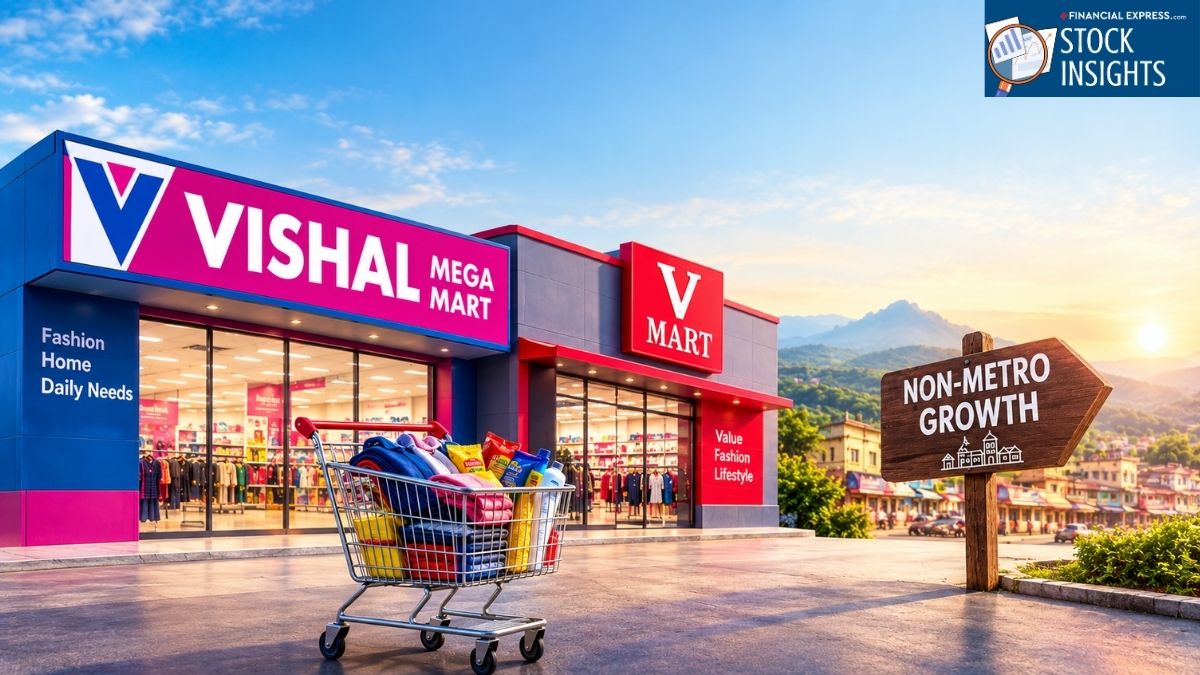
DMart CEO Anshul Asawa said growth in mature stores remained flat while non-metro stores grew. Vishal Mega Mart and V-Mart Retail both beat their Q1FY27 same-store sales growth targets. These numbers showed that demand in the value-led, non-metro segment remains healthy, even as large metro stores saw slower growth recently.
Early signs are visible. DMart CEO Anshul Asawa said in the June quarter earnings release that growth in their mature stores (older than 2 years) in large metros remained flat while non-metro stores continued to grow. For a retailer known for its scale and value pricing, it can easily pick up signals of where consumer demand is strengthening or slowing before it shows up clearly in the broader numbers.
It puts retailers with a deeper presence in smaller towns in focus. Vishal Mega Mart and V-Mart Retail both delivered strong Q1FY27 numbers, but the similarities largely end there.
Same Opportunity, Different Growth Paths
Vishal Mega Mart has 75% of its stores in Tier-2 and Tier-3 cities, while V-Mart has nearly 80% across Tier-2, Tier-3, and Tier-4 cities. Both retailers beat their FY27 same-store sales growth guidance in the June quarter.
Vishal Mega Mart reported 10% same-store sales growth, ahead of its full-year guidance of 9-9.5%, while V-Mart delivered 9%, well above its 5-7% target. One quarter does not establish a trend, but similar growth momentum at both retailers warrants a closer look.
Although comparing both companies is not an apples-to-apples comparison, both sit within the same structural trend. The Q1 numbers indicate that demand in the value-led, non-metro segment remains healthy, even as mature metro stores at DMart see slower growth.
Vishal Mega Mart: Scale is the advantage, but expectations are high
Vishal Mega Mart’s Q1FY27 numbers show why scale matters in value retail. The company added 27 stores during the quarter, taking its network to 819 stores across 559 cities.
Vishal Mega Mart: Financial Performance
Source: Company Presentation
During Q1FY27, revenue from operations rose 18.7% to ₹3,727 crore, while net profit rose 25.6% to ₹258.8 crore, supported by a slight improvement in gross margin. The 30-bps expansion in gross margin to 28.7% may look small, but for a value-focused retailer, protecting margins while growing at this pace points to operational resilience.
Improving Capital Efficiency
Source: Company Presentation
Vishal Mega Mart’s return metrics underline the benefit of scale. Return on Capital Employed (ROCE) remained strong at 31.2% in FY26 versus 30.8% in FY25, while Return on Equity (ROE) improved from 8.0% to 9.9%. The key test is whether it can sustain these returns as it expands into new markets.
But the more important number was same-store sales growth (SSSG). Vishal grew SSSG by 10% in Q1, meaning growth was not simply coming from adding stores. Customer footfall and acquisition increased 8%, while spending by existing customers rose 3%.
Another interesting shift is within the portfolio. Vishal has not changed the entry-point to protect its core value proposition, but its highest-priced fashion apparel grew 13.9% on a same-store basis. That suggests the customer is not necessarily trading down even in a value-focused format, with higher-priced merchandise seeing stronger traction.
Vishal Mega Mart: 1 Year Stock Chart
Source: Screener.in
Tighter Control Over Cost Protecting Margin
Private labels remain central to Vishal’s economics. Own brands accounted for 75.2% of revenue in Q1, including 100% of clothing sales, 75% of general merchandise, and 60% of FMCG volumes. That gives Vishal Mega Mart greater control over sourcing, pricing, and promotions.
The combination of strong SSSG and a high private-label mix is important. It means Vishal Mega Mart is generating growth without relying entirely on discounting, while its larger network gives it purchasing and supply-chain advantages that smaller rivals may find harder to replicate.
Further, the company is working on smaller formats and supply-chain automation. It has 16 smaller-format stores operating in dense Tier 2 and Tier 3 markets, with management seeing a much larger runway for the format. These stores can operate with roughly half the footprint while maintaining similar throughput and ROCE.
V-Mart Retail: The smaller base is doing more work
V-Mart’s smaller store base is translating into faster growth, with the retailer operating 591 stores across 335 cities. The smaller footprint also leaves more room for expansion, particularly across Tier 3 and Tier 4 markets, where V-Mart saw strong improvement in sales per square foot.
V-Mart Retail: Financial Performance
Source: Company Presentation
In Q1FY27, revenue increased by 23% YoY to ₹1,089 crore, and the profit increased by 40.5% YoY to ₹47.2 crore. The growth during the period was not only driven by new stores. Network-wide footfall increased 39%, while transaction volumes rose 18%, pointing to stronger customer engagement across the existing network.
Revenue from V-Mart’s Unlimited format stores increased 33% to ₹184 crore during the period. The format provides a way to expand beyond its core markets while tapping into the same value-conscious consumer.
One key concern in Q1FY27 results is an 80 bps dip in gross profit margin to 34.5%. The management has attributed the pressure to changes in product mix due to the seasonality factor and provisioning for aged inventory. For now, V-Mart’s cost structure is providing some cushion. Total expenses increased by only 15%, below the 23% revenue growth.
Improving Capital Efficiency
Source: Company Presentation
The improvement is also visible in capital efficiency. V-Mart’s Return on Capital Employed (ROCE) increased from 5.9% in FY25 to 14.5% in FY26, while Return on Equity (ROE) rose from 10.5% to 14.1%. The sharp improvement suggests that the stronger earnings profile is beginning to translate into better returns on the capital deployed in the business. That will become increasingly important as V-Mart accelerates store additions, because growth creates value only if new capital earns adequate returns.
The numbers therefore show both sides of V-Mart’s story. Customer traffic is rising, the Unlimited format is growing faster than the core business, and costs are being controlled. But the company will need to protect gross margins as it scales. A smaller network makes it easier to post high growth, but sustaining that growth becomes harder as the revenue and store base expand.
V-Mart Retail: 1 Year Stock Chart
Source: Screener.in
Valuation: Growth Comes at a Premium
P/E Trend
Source: Screener.in
The valuation gap reflects the different expectations built into the two stocks. Vishal Mega Mart trades at around 52.6 times earnings, above the industry Price-to-earnings (P/E) of 40.1 times. With no meaningful five-year median available because of its relatively recent listing history, the industry multiple provides a more useful reference point.
Vishal’s stronger margins and more established store economics may deserve a premium. However, the premium leaves less room for a slowdown in growth or margins.
V-Mart trades at 43.2 times earnings, well below its five-year median of 111.6 times. The lower multiple reflects a more modest valuation relative to its own history. V-Mart’s faster expansion offers a different proposition, but investors are also paying for growth that still needs to translate into stronger profitability.
The comparison is therefore less about which stock has the lower P/E and more about what each valuation is pricing in. Vishal needs to demonstrate that its scale and margins can sustain the premium, while V-Mart needs to show that its faster growth and improving returns can continue as the business gets larger.
Two Playbooks to Play the Same Consumption Trend
The DMart data suggests the opportunity is spreading beyond metros. The numbers from Vishal and V-Mart show that capturing it may take very different playbooks.
Vishal is betting on a large network, private-label depth, and consistent execution, which investors are rewarding but also scrutinising closely. V-Mart is betting on faster expansion and multiple formats, trading some margin stability for higher growth.
Neither strategy has been proven over a full cycle. The festive season will offer the first real test. If the non-metro momentum DMart is seeing holds, both may prosper. If it does not, the differences between them will show up quickly. Add these stocks to your watchlist and monitor how they execute their growth plans.
Disclaimer
Note: We have relied on data from www.Screener.in throughout this article. Only in cases where the data was not available, have we used an alternate, but widely used and accepted source of information.
The purpose of this article is only to share interesting charts, data points, and thought-provoking opinions. It is NOT a recommendation. If you wish to consider an investment, you are strongly advised to consult your advisor. This article is strictly for educational purposes only.
Deepan Datta has spent over a decade studying stocks and mutual funds. His passion is to uncover interesting stories in the financial markets and share them through his writings with investors at large. He is focused on delivering clear, easy-to-understand, and research-backed insights. Deepan began his career as a Research Associate at S&P Global, where he developed a strong foundation in financial research and data analysis.
Disclosure: The writer and his dependents do not hold the stocks discussed in this article.