
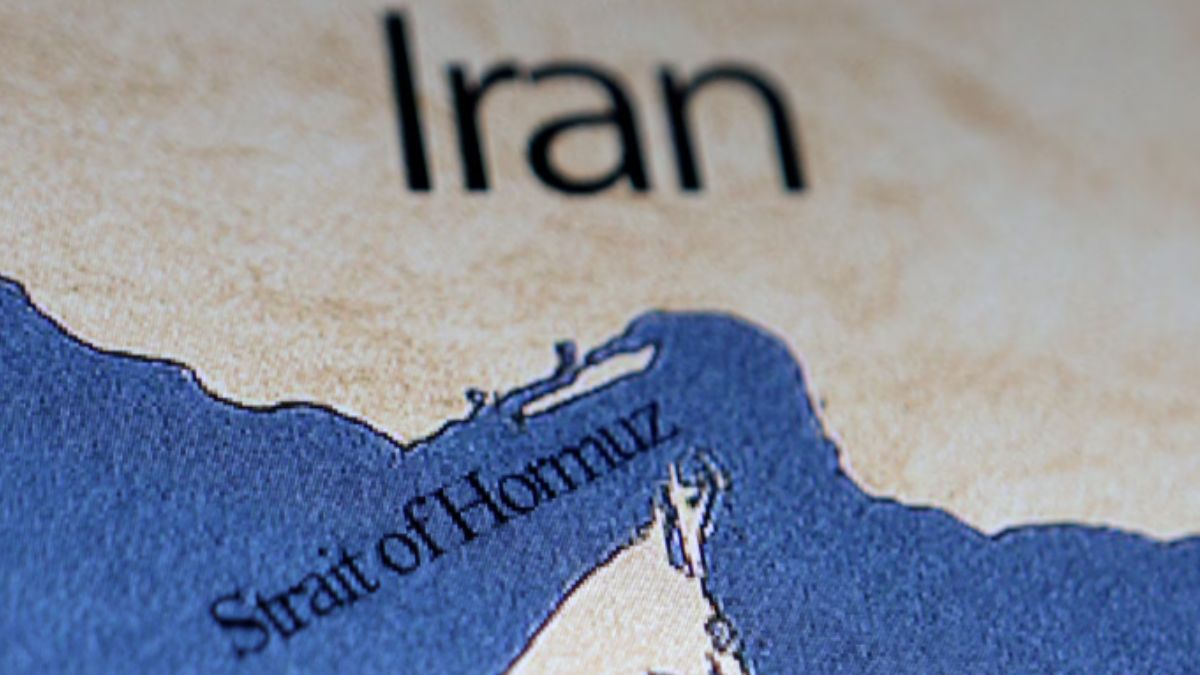
Five Indian nationals were rescued after their Kuwait-flagged tanker, MT Kazimah III, got hit by a projectile in the Strait of Hormuz. The Indian Embassy in Oman confirmed the crew is safe. "All 5 Indian nationals have been shifted ashore safely," the mission said, thanking Omani authorities for their help.
Five Indian nationals on board a Kuwait-flagged tanker struck by a projectile in the Strait of Hormuz have been safely rescued, according to the Indian Embassy in Oman. Sharing an update on the incident, the diplomatic mission's official X account thanked Omani authorities for their continued support and assistance in the coordinated rescue mission involving the tanker MT Kazimah III.
"Earlier today, the Mission coordinated rescue of five Indian nationals on board the Kuwait-flagged tanker MT Kazimah III, struck by a projectile in the Strait of Hormuz," the Embassy of India, Muscat, stated online. "All 5 Indian nationals have been shifted ashore safely. We thank the Omani authorities for their continued support and assistance."
The Kuwaiti crude oil tanker was en route to the port of Lome in Togo, according to ANI.
Indian officials sound the alarm about seafarers' safety
Earlier this week, External Affairs Ministry spokesperson Randhir Jaiswal said that more than 4,500 Indian nationals are currently on board numerous commercial vessels in the area, including 163 Indian seafarers on 12 active cargo ships. He also added during a media briefing that six India-flagged commercial vessels are currently in the Persian Gulf, along with six foreign-flagged vessels carrying cargo to India.
"Our Ministry of Shipping continues to monitor the movement of these ships and is looking at the well-being of all these seafarers, and as and when required, through our embassies and other stakeholders, they do the needful for their well-being and welfare," he said. "On our side, we remain committed to the safety and well-being of our seafaring community abroad."
External Affairs Minister Dr S Jaishankar also brought up the issue at the recent 81st United Nations General Assembly in New York.
He noted growing challenges in the maritime domain exacerbated by attacks on commercial shipping and seafarers in the Gulf, further spanning the Red Sea and the Black Sea.
"Indian seafarers have lost their lives, as have others from other nations. This is completely unacceptable," he said at the UNGA, adding that India had joined 24 partner nations in an international coalition to defend commercial shipping routes and mobilise global public opinion. Jaishankar also insisted on immediate de-escalation in the region not only to protect crews but also to ensure a smooth flow of energy supplies and international trade.
Strait of Hormuz closures persist amid US-Iran back-and-forth
The development comes as the United States and Iran continue to be entangled in a war in the Middle East. According to TIME Magazine and The Wall Street Journal, US President Donald Trump has been mulling renewing military action against Iran after the November midterm elections if Tehran and Washington fail to reach an agreement.
On Thursday (US time), he said that Iran "is ready to fold up," as he asserted his belief in the US winning the war "right after the election," though he also said, "maybe before the election."
A recent Reuters report also indicated that Iran is ramping up plans for renewed US attacks if America resumes large-scale military attacks. Tehran is also still testing diplomacy through a seven-day proposal, but the report further shed light on how Iranian officials are privately expressing skepticism about a potential breakthrough. No final decision has been made.
At last week's UN General Assembly in New York, Iran submitted a proposal to the US through Qatari mediators about potentially reopening the Strait of Hormuz and stopping hostilities in the region within seven days. The proposal hinged on certain conditions, including lifting the US blockade on Iranian ports, releasing frozen Iranian funds, and a waiver of oil sanctions.
However, Trump subsequently rejected it. Nonetheless, Iranian state media reported later that a response from the US was sent to Tehran through Qatar and is currently under review.
In the meantime, critical maritime routes face persistent hindrances as each country remains embroiled in a tussle for authority. The Strait of Hormuz, which is typically responsible for the passage of a fifth of the world's oil and LNG, has especially been at the centre of this tug of war since the US and Israel launched a joint military action against Iran on February 28.
According to a joint statement, the Group of Seven nations (France, Canada, Germany, Italy, Japan, the United Kingdom and the United States) has since announced that it will deploy 100 million barrels of reserves over the next four months "with a frontloaded substantial diesel release within the first 20 days."
In light of the big decision aimed at easing surging fuel prices, crude oil edged lower on Friday (US time), with Brent crude futures, the international benchmark, losing 6 cents and closing at $102.25 per barrel. Meanwhile, US West Texas Intermediate crude lost $1.26 and hit $91.11 per barrel.
Other recent attacks in the Strait of Hormuz
The United Kingdom Maritime Trade Operations Centre (UKMTO), said Thursday that a tanker was attacked as it was crossing the Strait of Hormuz. As per the British agency's statement, the vessel was hit by an "unknown projectile" in the waterway, "resulting in a fire."
Although the damage was unknown at the time, the crew was reported safe. It remains unclear which flag the tanker was carrying.
Much like these two attacks, The New York Times mapped out a pattern of Iranian media outlets publishing reports of explosions "heard from the sea" almost every day in September. However, they conspicuously left out who was behind the attacks.
While both the US and Iran have since resumed attacks in the strait, Iran's Islamic Revolutionary Guard Corps, for the first time, on Wednesday appeared to confirm it was behind the explosions heard from Iran's southern coast, saying it was hitting targets in the Hormuz Strait every 24 hours.
"We prevent them from passing, but for some time now, America has not responded," a spokesman for the Revolutionary Guards said in a state news interview.
Meanwhile, regional and Western officials told Reuters this week that Saudi Arabia is planning an assault against Iran-backed Houthi militants in Yemen to break the Red Sea chokehold. The report suggested that the aggressive operation is expected to be launched in the coming weeks and will be led by on-ground Yemeni forces overseen by Riyadh and supported by Saudi air strikes.