
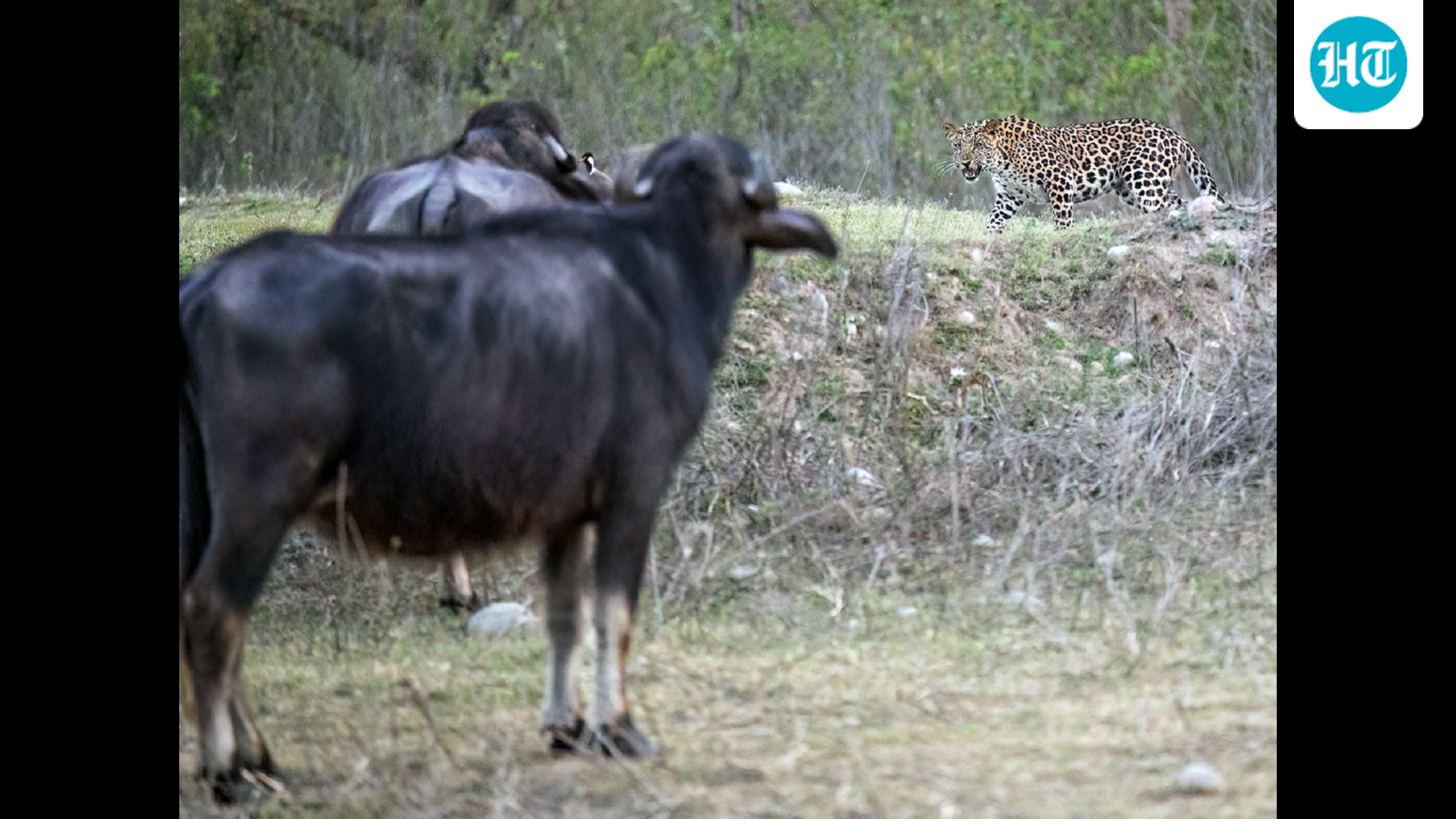
A leopard at Rajaji National Park ran away after buffaloes challenged it at a waterhole. Wildlife photographer Dr Kuldip Jaswal captured the tense moment, which was displayed at the Shutter Stories exhibition. As Jaswal said, "The leopard ran away!" Leopards often avoid larger animals that intrude into their forest territory.
For all their fearsome reputation, long, drooping whiskers and blood-curdling snarls, leopards invariably choose discretion as the better part of wild valour if the challenger is bigger. An incident from the Jhalana Leopard Reserve, Jaipur, had unfolded with a hulky, hardy, pugnacious nilgai taking on the dominant leopard, nicknamed Rana, who without a murmur slunk away from his resting spot of dominance over a waterhole.
A similar face-off occurred in Rajaji National Park's Chilla Wali range, when a juvenile male leopard was resting near a waterbody and buffaloes strutted into his domain. Wildlife photographer, Dr Kuldip Jaswal, captured the tension. Interdictions of the leopard's existence are frequent in protected areas and peripheral jungles as livestock intrudes deeper for foraging and to pilfer precious water from sources reserved for wildlife. Also, cattle dung contaminates the water.
Jaswal's photograph lent vision to a compelling story of conflict. A leopard faced with human-sponsored creatures, or described more grimly: invasive cattle acting as vanguards of the human colonisation of nature. The photograph was on display at last week's exhibition, Shutter Stories (Alliance Francaise). The visual feast was hosted by 10 passionate photographers to commemorate World Tourism Day (September 27).
Buffaloes are too big for leopards to handle routinely. All the cat can do is to grimly hang onto a thick, tough bovine neck and hope its canines sever a vital artery. And, buffalo necks are Goliathic -- Gurkha soldiers revel in severing the head with a single khukri blow at sacrifices. Leopards prefer small and medium-sized prey or smaller challengers to territorial monopolies.
So, mock aggression serves, at best, as dissuasive deterrence. In Jaswal's words: "The incident took place at Amrit Sarovar, a huge pond made by the forest department at Rajaji. The leopard charged the buffaloes whose first impulse was to go back a few steps. The leopard issued a snarl but the buffaloes being bigger realised that they could have the better of the duel. The buffaloes reversed their retreat and moved towards the leopard. The game was up. The leopard ran away!"
Birds fail airport security
For someone interested in wild birds, an addition to the checklist would be welcome. But if the chirping checklist is from the glitzy domestic terminal for outgoing passengers at the Shaheed Bhagat Singh International Airport, then it does not invite delight. Along with common pigeons and mynas, I witnessed a pair of intrusive red-vented bulbuls familiarising themselves within the terminal premises reserved for waiting passengers who have cleared security checks. The bulbul is a new one on my departure terminal checklist!
Apart from birds intruding into the terminal's eating outlets, pecking into plates and spreading excreta, there is the fatal health hazard to humans in the guise of 'pigeon lung', a form of hypersensitivity pneumonitis caused by the dry dust of feathers/droppings. Equally at fault are passengers who wantonly discard tidbits for birds. No advisory/warning boards have been put up to deter passengers from feeding birds. The hapless cleaning staff at the terminal literally break their backs as it is an arduous task to clean the shiny floors of sticky bird droppings. A big bird trap has been positioned but is not 100% successful.
The airport has been functional for 16 years and it begs the question: Why has the presence of birds not been removed? What measures have been taken to eliminate the hazard? Are airport authorities aware of 'pigeon lung' disease?
I contacted the office of Chandigarh International Airport Ltd (CHIAL) CEO Yogesh Nagaich, which directed me to the media relations officer, Nimit Sharma. On Sharma's advice, I emailed the above questions to the airport manager (with a copy to the CEO) on September 16, 2026. However, no written response has been given to the questions by CHIAL. All that was offered by way of an assurance was a cellphone call from Sharma on September 17, 2026, wherein he verbally assured this writer that "within a week we will have improved the situation as far as bird presence in the domestic terminal is concerned."