
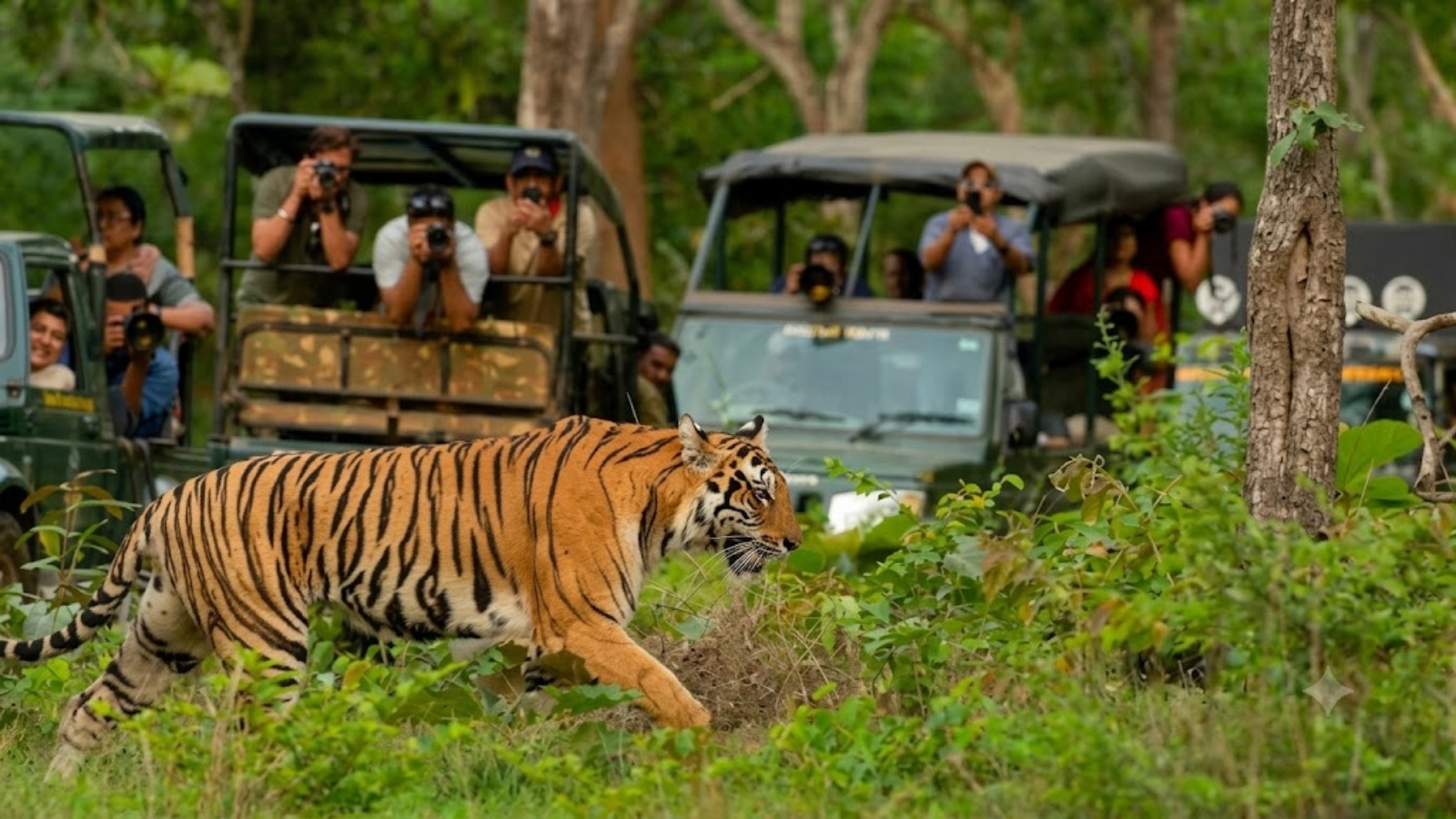
Indian safaris focus heavily on tigers, while African safaris offer diverse wildlife experiences across varied landscapes. Wildlife photographer Indrajit Ghorpade said, "It's a tiger safari and not a nature safari." Many vehicles often crowd tigers in India, whereas Africa uses a mix of private and government-run areas for tourism.
A safari is broadly understood as a vehicle-based drive through a natural area to observe wildlife. While the experience can vary across regions, one key difference between African and Indian safaris is the range of landscapes, species and tourism models available to visitors.
According to wildlife photographer Indrajit Ghorpade, Africa offers a mix of privately managed concessions and protected areas, while India's safari tourism largely centres on government-managed protected areas.
Africa has a mix of private and protected spaces
"Africa has both wild open concessions and protected areas, both private and government owned and run," Ghorpade explains. He cites Kenya's Masai landscape as an example, where areas such as the Masai Mara are managed through government-run conservation frameworks, alongside privately operated concessions.
"In Africa, privately owned concessions offer safaris. Most rules and guidelines are similar, depending on regions, seasons and landscapes," he says.
In India, safaris are conducted in protected areas such as national parks and wildlife sanctuaries, with management primarily under state governments and forest departments.
India's safari experience is often tiger-centric
The biggest difference, Ghorpade says, is not simply about the vehicle or landscape but what visitors are looking for.
"Unfortunately, the tiger is the most sought-after species in wildlife safari tourism in India," he says. As a result, many Indian safaris can become centred around locating a tiger rather than observing the wider ecosystem.
"When a tiger is sighted, vehicles will often crowd the animal, which normally uses the safari roads to move around," Ghorpade says. Mobile phones and walkie-talkies can quickly alert other vehicles, which then head toward the location.
"Dozens of vehicles literally surround the tiger to get a glimpse," he says, adding that this can be a stressful situation for the animal.
"It's a tiger safari and not a nature safari," Ghorpade says, describing the tendency to focus on one species rather than the broader wilderness.
Africa offers a wider range of wildlife experiences
African safaris are often associated with the so-called Big Five -- lion, leopard, elephant, rhinoceros and buffalo -- but the continent's wildlife tourism extends well beyond these species.
Ghorpade believes India has a similarly diverse range of wildlife that could form the basis of more varied safari experiences.
"This unfortunately will not change in India, where other species are also witnessed and the general wilderness appreciated," he says.
Examples already show that the absence of tigers naturally shifts the focus to other wildlife. In Gujarat, for instance, tourists can encounter lions alongside birds, wolves and several other species.
"Target species like the snow leopard, wolves, etc., are gaining popularity with many wildlife enthusiasts and tourists," Ghorpade says.
India needs to expand wildlife tourism beyond tigers
For Ghorpade, the larger opportunity lies in developing tourism around India's different ecosystems and species rather than concentrating overwhelmingly on tigers.
"We need to focus on expanding wildlife tourism to the many different species, habitats and natural worlds," he says.
That could mean building greater awareness and tourism infrastructure across diverse landscapes -- "from the Himalayas to the deserts, the mangroves to the grasslands".
Ghorpade argues that India's biodiversity is currently not being represented adequately through its wildlife tourism model. "Tiger tourism is 90 per cent of our wildlife tourism. A tiger-centric country," he says.
The challenge, therefore, is not to reduce interest in tigers but to broaden the scope of wildlife tourism. "We are neglecting so many other exotic, unique species that are as mysterious and beautiful," he says.
The need for healthier ecosystems
Ghorpade also links the expansion of wildlife tourism to conservation itself. "Building a broad infrastructure, across landscapes, habitats and including dozens of wildlife species, by increasing their numbers for sustainable tourism needs focus," he says.
He believes India needs greater emphasis on restoring wildlife populations and expanding suitable habitats. "Unfortunately, we are not reviving populations and rewilding our wild spaces to expand and include more species like tigers," he says.
The larger goal, according to Ghorpade, should be to market India's wildlife as a collection of ecosystems rather than around a single flagship species.
"Only if there are healthy populations and vibrant ecosystems will, like Africa, hundreds of other species become the focus of wildlife and nature tourism," he says. "And we have this, but barely surviving."
Explore more captivating stories about pets and animals here, and make us your daily stop for the latest from the animal kingdom.