
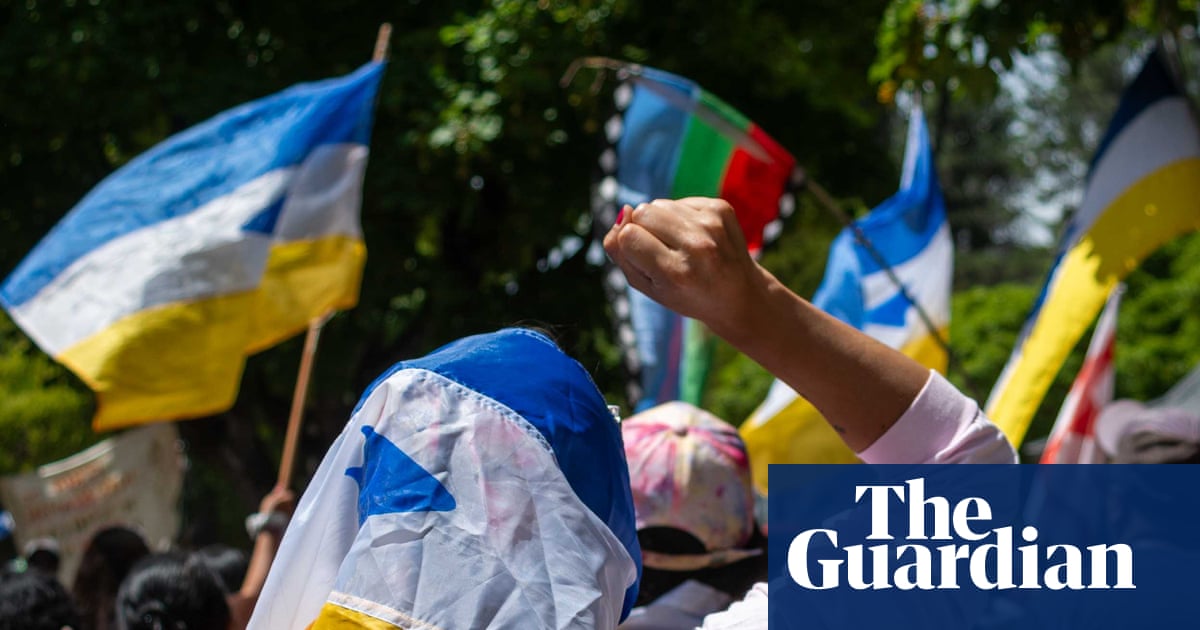
On 19 September, protesters in Argentina marched against President Javier Milei’s plan to sell land to foreign investors. Activist Marta Sahores said, "They take our water, they take our soil." Many fear these new rules will hurt the environment and local communities as the government removes old land ownership protections.
The country's far-right president is courting billionaire investors by removing a block on foreign ownership of land and natural resources
On 19 September, Marta Sahores, an 84-year-old chemistry professor and activist who has mobilised against mega-mining projects for more than two decades, took to the streets in Argentina. Alongside workers, retirees, students, Indigenous groups and human rights organisations, Sahores was there to protest against the country's far-right president, Javier Milei. During the marcha de la bronca - the "march of anger" - protesters held signs reading, among other rallying cries, "The land is not for sale".
Marching in Esquel, a town nestled in the foothills of the Andes in Chubut province, she also held up a sign defending the country's water resources against what she called the government's "handover" to investors.
"When foreigners buy land, they buy land with rivers and lakes. They take our water, they take our soil," says Sahores. "We stand for real democracy and environmental sovereignty."
Sahores and fellow activists are rallying to overturn Milei's broad deregulation decree, especially the measures against land protections. "Fortunately, we are many, and we are fighters," Sahores says. "We're in the streets when we need to be, and we're in the courts when we need to be."
In Argentina, land rights have become a critical political issue. Foreigners own about 13m hectares (32m acres) of the country's land - approximately 5%, an area roughly the size of England. Since Milei took office on December 2023, his campaign to open resource-rich areas to foreign investment and roll back the protections of the 2011 Land Law - which critics say is already undercut by its non-retroactive scope - has alarmed advocates who say it deepens extractivism, contributes to housing inequality and displaces Indigenous communities.
The 2011 Land Law caps how much rural land foreigners can own: no more than 15% of any single department - the subdivision below a province - and no more than 30% in the hands of a single nationality. Yet departments such as Lácar, in the Patagonian province of Neuquén, exceed both limits, explains Tomás Costa, a researcher with the Land Observatory at the University of Buenos Aires (UBA).
In Lácar, part of a region known for its glacial lakes and native forests, about 54% of land is foreign-owned. Of that, about 30% (144,313 hectares) is concentrated in a small number of US entities that own 14 times as much land as the Curruhuinca, a Mapuche community that has spent years demanding access to clean water.
Last week, the supreme court overturned a previous ruling that had blocked Milei's attempts to repeal the Land Law, effectively clearing the path for the controversial reform to move forward just two months after a failed effort in Congress.
Amid mass protests, Milei's party, La Libertad Avanza passed a stripped-down version of its inviolability of private property bill in the Senate this August, withdrawing its two most contentious provisions: one that would have raised the foreign land cap from 15% to 25%, and another that would fast-track land development after wildfires.
The approved bill, still pending in the chamber of deputies, also included articles to fast-track evictions and make it harder to expropriate lands for public works, favouring private interests.
The project is part of the libertarian president's broader scheme to court foreign investors such as Peter Thiel, who recently acquired a 1% stake in Vista, an oil producer in Argentina's main fossil fuel reserves, Vaca Muerta.
In 2024, Milei enacted his large investment incentive regime, or Rigi, which relaxes limits on how much money investors can send back to their parent companies, lowers the corporate income tax rate and exempts imported machinery from tariffs, with 30 years of regulatory stability guaranteed.
A proposed "super Rigi" expands on the regime for "frontier mega-projects" such as AI datacentres and semiconductor manufacturing, which require massive quantities of water and critical minerals including lithium, of which Argentina has one of the largest reserves.
The impact of Milei's agenda is being acutely felt by Indigenous communities threatened by eviction orders in land disputes that have dragged on for decades, says Pablo Volkind, professor at UBA's School of Economic Sciences.
"It's not 'what could happen'; it's what's already happening," Volkind says, noting that Milei's deregulation push has ushered in "a flood of evictions" in Jujuy, Neuquén, Chubut and Misiones, emboldening courts to move faster on property cases that might have been contested in a different political climate.
Volkind heads the Land Observatory, which produced an interactive map of foreign land ownership in Argentina, letting users visualise how foreign holdings overlap with natural reserves, national parks, glaciers and Indigenous presence. Many of the lands exceeding the ownership cap sit along the Argentine cordillera, stretching from Salta and Jujuy in the north to Tierra del Fuego, rich in mining resources and freshwater reserves in glacial and periglacial zones.
In April, Milei signed a reform to the glacier law that authorises mining in previously protected regions.
Another area of high foreign ownership is the Paraná River basin, along Misiones, Corrientes and Entre Ríos, a key export corridor. In Puerto Libertad, Misiones, near the Iguazu Falls, the Chilean forestry company Arauco controls so much land that the mayor must ask it for permission before advancing public projects such as a 10-hectare industrial park.
The areas high in foreign landholdings are also among those with the largest Indigenous populations, for whom Milei's advances are yet another chapter in what campaigners and experts consider a history of systemic racism and land dispossession.
"This policy of 'foreignisation' has been happening since the very formation of the Argentine nation-state on Indigenous territories, the forcible occupation of ancestral lands," says Moira Ivana Millán, Mapuche weychafe (leader) in Lof Pillan Mahuiza, in the province of Chubut.
Millán says the current administration represents an acceleration and official sanctioning of a practice once often carried out covertly. British billionaire Joe Lewis, for example, was accused of fraudulently purchasing 12,000 hectares in a border security zone in Patagonia for his Lago Escondido estate in the 1990s. The property continues to block public access to a lake campaigners say should not be private by law. Milei's government dropped the state's case earlier this year.
"What Milei is doing is legalising this. He's giving the green light, without restrictions, to land purchases by foreigners," says Millán.
In 2024, Milei's government repealed a law that had suspended Indigenous evictions pending a national land survey and dissolved the national registry of Indigenous communities, stripping another safeguard. Members of the Quintriqueo and Melo communities in Neuquén were forcefully threatened with removal from their lofs in August in the latest escalation of a case brought forth by the Belgian Broers family.
Though Argentina recognised the community's legal status in 2006 and its traditional land occupation in 2023, without a formal property title, they remain legally exposed to claims. "What this country has done is repeal what little Indigenous legislation we had, leaving us completely abandoned," said Amancay Quintriqueo, the lonko (leader) of the community, at a press conference last week.
Milei's investment-friendly policies may also come at a price for everyday Argentines, some experts say. The Center for Argentine Political Economy (CEPA), for instance, estimates that the cost to the public coffers of Rigi-incorporated projects will be between $1.3bn and $2.3bn annually (£962m-£1.7bn).
"What's actually being proposed," Volkind says, "is that individual private rights come to stand above any state authority meant to guarantee the common good - which is, supposedly, what states are meant to do."