
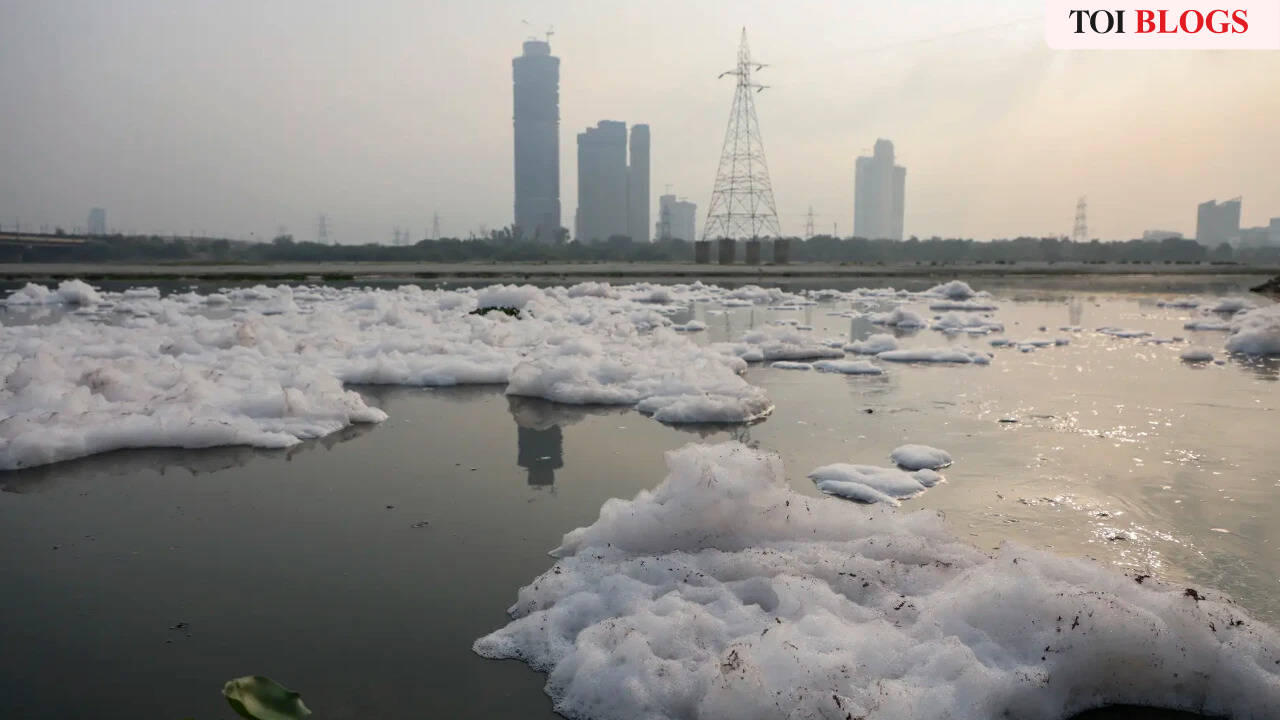
The Yamuna river faces severe pollution as 520 drains empty into its waters. A 22 km stretch in Delhi carries 80% of the total pollution load, leaving the river biologically dead. While the Delhi Jal Board plans to double sewage treatment capacity by 2028, many households still lack proper network connections.
In the Rig Veda she is Yami, in the Puranas, Kalindi. Scripture calls her the daughter of Surya and twin sister of Yama, a bond we celebrate every Bhai Dooj or Yama Dwitiya. Yamuna flows through Braj, the land of Krishna, her dark waters mirroring his shyam hue. At Prayagraj she meets the Ganga at the Sangam, home to the Kumbh Mela, the world's largest religious gathering, held every 12 years. Delhi has now added a Yamuna aarti at Vasudev Ghat, modelled on those of Varanasi and Haridwar. Yet the river we worship is the river we abuse. Ritual thrives while the river dies.The Yamuna rises clean in the Himalayas and degrades as it flows downstream, with 520 major drains emptying into it along the way. Of its 1,376 km journey to Prayagraj, the worst pollution comes from a single 22 km stretch in Delhi, between Wazirabad and Okhla barrage. That is under 2% of the river's length, yet it carries roughly 80% of its pollution load. At Wazirabad, almost all the water is drawn off for Delhi's taps, and the river stops flowing and becomes a stagnant, toxic sewer. CPCB's 2022 assessment placed it in Priority I, the most severely polluted category.The bathing standard for fecal coliform is 500 most probable number (MPN) per 100 ml. In Delhi the Yamuna has recorded levels in the millions. Dissolved oxygen (DO) frequently falls to zero, the working definition of "biologically dead," where no fish or complex aquatic life can survive.Delhi generates around 3,600 million litres per day (MLD) of sewage. The Delhi Pollution Control Committee's September 2026 report examined 22 drains entering the city's stretch: eight had no flow and 14 had very poor water quality. Shahdara drain was the worst, breaching every parameter, with Biochemical Oxygen Demand (BOD) at 120 mg/L, four times the permissible limit. Barapullah and Sen Nursing Home drains were close behind.Of Delhi's 4 million households, only 2.35 million are connected to the sewage network. The remaining 1.65 million, largely in 1,799 unauthorized colonies and slum clusters, send much of their waste into drains and, eventually, the river. Until the sewage network reaches them, the Yamuna cannot be saved. The Delhi Jal Board plans to double sewage treatment capacity by 2028, but connections are the harder task.The Yamuna Action Plan, begun in 1993, has spent over ₹1,514 crore across its first two phases, and phase III is under way with ₹1,656 crore. Yet the river remains severely toxic.Noida, Greater Noida, Ghaziabad, Gurugram and Faridabad all release untreated sewage into the river's 52 km NCR stretch, and Uttar Pradesh has the largest sewage treatment gap of 34%. A Supreme Court-appointed panel named Noida and Ghaziabad major hotspots in September 2026, and a recent CPCB inspection found only three of Noida's eight sewage treatment plants met discharge norms.Gurugram is at least reaching for technology. Under NGT directions, the Gurugram Metropolitan Development Authority has drawn up a ₹5.88-crore plan for flow meters, cameras and online water-quality analyzers on its main storm-water drains. Early-2026 estimates suggest nearly 150 MLD of untreated sewage and industrial effluent leaves the district of Gurugram for the Yamuna. Monitoring is a start, but authorities must still act against polluters.Pollution is only half the story. A 2026 study by Delhi University's Department of Geology and IISER Bhopal found that the Yamuna in Delhi has narrowed by 68% and lost 89% of its flow since 1799. Barrages, canals, embankments and floodplain construction have turned a wide, free river into a constrained channel.A river with almost no flow cannot dilute what we dump into it, and one hemmed in by concrete cannot absorb floods, so urbanization raises flood risk. Only the monsoon acts as an annual wash, and this year the flood volumes did not come, so even that dilution failed.The froth at Okhla barrage is a glaring photo-op for quick fixes. It worsened in winter despite record quantities of defoaming chemicals used by the Delhi Jal Board between October and December 2025. Masking the symptom only hides the deeper pollution.Festivals bring the same effort, and more. Each year governments pour energy, water and money into making the river presentable for Chhath Puja devotees, who are also voters. Nobody denies the right to worship, but a river cleaned for a few days and abandoned for the rest of the year is not being saved.The damage reaches our dinner tables. A 2026 Delhi University Botany Department study found that vegetables grown on the Yamuna floodplains and irrigated with its water contain nickel, chromium, cadmium and lead above FAO safety limits. Nickel in spinach and onions ran up to 97 and 65 times permissible levels, and chromium in mustard 22 times. TERI flagged similar metals in 2012. Yet floodplain farming continues unabated, and the produce is sold across Delhi.A TERI and Delhi government study released in early 2026 is another wake-up call. It found widespread, high microplastic contamination (particles smaller than 5 mm) in the Yamuna, its floodplain soil and even the groundwater across Delhi.