
New Zealand’s wētāpunga population is recovering after a breeding programme released 11,000 insects into the wild. Dr Chris Green said, "The future of wētāpunga is looking bright." Once endangered by predators, these heavy insects now thrive on predator-free islands. This success moved their conservation status from endangered to nationally recovering today.
Wētāpunga can weigh as much as a mouse and its numbers dwindled across New Zealand due to predators and habitat loss
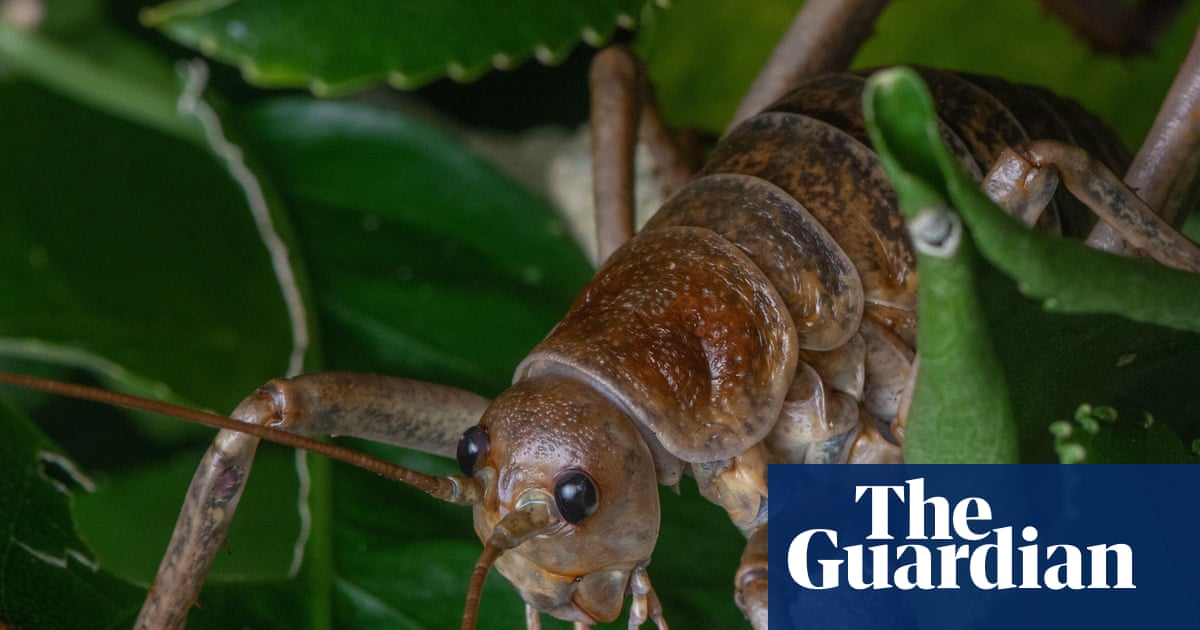
The population of New Zealand's endemic wētāpunga - believed to be the world's heaviest insect - is officially "recovering" thanks to a groundbreaking breeding programme that has overseen the release of 11,000 insects into the wild.
"The future of wētāpunga is looking bright," said Dr Chris Green, an honorary researcher at the department of conservation, who documented the success of the project for the New Zealand Journal of Zoology. Green co-authored a report released on 2 October that outlines the success of the breeding programme.
"Eleven thousand individuals for release is extraordinary and outstanding."
A female wētāpunga can weigh as much as a mouse. Its body can grow up to 10cm long (nearly 4in) and its leg span can be as wide as 20cm.
It is the largest of 70 wētā species and was once found across parts of the North Island before predation from introduced species and habitat loss contributed to their decline. By the 1990s, they were considered "endangered" and are now presumed extinct in the wild on New Zealand's mainland. The insects reside primarily on a smattering of predator-free islands in Auckland's Hauraki Gulf and off the coast of Northland.
But their fortune is starting to change. Over the past 15 years, tens of thousands of wētāpunga have been bred at Butterfly Creek, a wildlife facility, and Auckland zoo, enabling the release of wētāpunga across new predator-free islands and some mainland reserves north of Auckland.
Butterfly Creek and Auckland zoo established husbandry techniques that, over time, have been scaled up to rear large numbers of wētāpunga in communal creches. The young wētāpunga - or nymphs - are fed a three-part diet of fresh foliage, fish flake protein and leaf litter. The protein is "critical" to the survival of the youngest nymphs, Green said.
Once big enough to protect themselves, the insects are transferred to their new habitat. The efforts have led to 45 separate translocations to wild habitats, which is "a very high number in any recovery of a species", Green said.
Monitoring on two islands has shown wētāpunga have established self-sustaining populations, with fourth and fifth generations born there, in what Green said was a marker of success. As a result, the species' conservation status has improved from "nationally endangered" to "nationally recovering".
"It's so exciting, because we are unable to report that for so many of our other threatened species," Green said.
New Zealand is particularly vulnerable to species decline because of its high rates of endemism and problems with introduced pests.
Green said the country was at the forefront of invertebrate recovery work and he was not aware of any other examples of breeding programmes working to this scale, or with such success.
By documenting the project's work, he hopes other institutions will feel encouraged to develop their own programmes.
"That's the extraordinary aspect of it - that we've been successful," he said. "If other institutions can get into that sort of position, then there can be huge benefit for threatened species in New Zealand."