
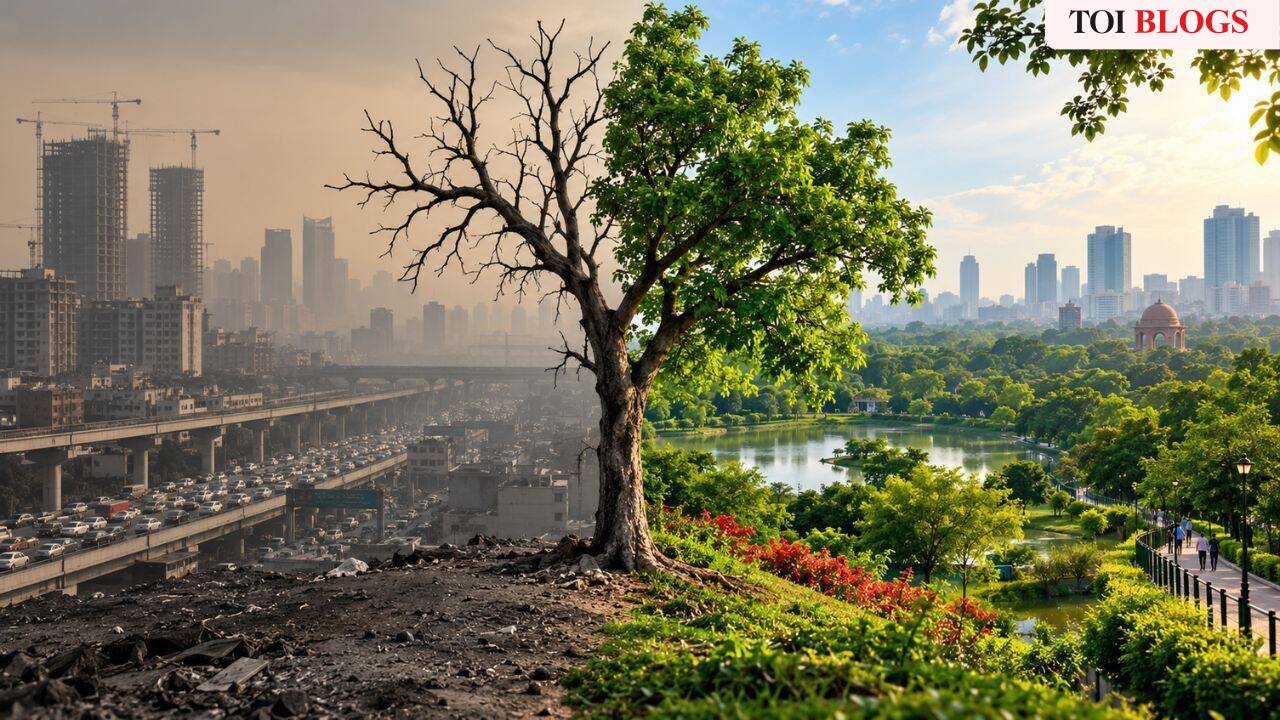
The NCR region faces a major shortage of sustainable green spaces despite having many parks on paper. A 2025 JNU study showed that green areas lowered temperatures significantly. Experts say these spaces are not a luxury, as they clean the air and help prevent thousands of premature deaths every year.
We revere trees, yet have too fewGreat cities are remembered for their green spaces. Central Park in New York, Hyde Park in London and Lodhi Gardens in Delhi draw tourists and locals alike. Oslo, the world's greenest capital, has 77% of its urban area under green spaces. In India, Gandhinagar and Chandigarh lead among state capitals, and Mysuru among cities.Trees run deep in our culture, from the banyan, our national tree, to the Chipko movement and Van Mahotsav. Yet the global average is about 422 trees per person, while India has only 28. Nowhere is the gap more visible than in NCR.Green spaces are not a luxuryThe WHO prescribes 9 sqm of green space per capita in urban areas. It defines green space as all urban land covered by vegetation, street trees, gardens, parks, sports fields, flowerbeds, green roofs and landscaping. These spaces are no luxury; they deliver social, environmental and long-term financial gains. A 2025 study of five Indian C40 cities, including Delhi, estimates that every 1% increase in green area could prevent 875 to 2,439 premature deaths a year.Green space cleans the air, keeps cities from trapping heat and is linked to longer lives, less cardiovascular disease and fewer mental health problems. Children gain most, better attention, creativity and a bond with nature they now mostly experience through mobile, iPad and laptop screens.Trees absorb water and release it back into the water cycle, which is why Copenhagen and several Chinese cities are becoming "sponge cities" and moving away from concrete. Trees can also help conserve water, as per 2021 study by CSE, 8,000 hectares of Delhi parks has potential to harvest 12,800 million liters of rainwater annually.Trees cool us down as well, a 2025 JNU study across 59 roadside plots found that green spaces lowered air temperatures by 0.80 to 2.24°C and ground surface temperatures by 3.80 to 8.37°C.Delhi: Green on paper, short on shadeOn paper, Delhi looks well provided for green space, with over 15,000 parks, around 1,000 larger than an acre, including Sunder Nursery, Nehru Park, Garden of Five Senses and Millennium Park. It also has real wild spaces: 8,000-acre Asola Bhatti Wildlife Sanctuary, Ridges, Sanjay Van and Aravalli Biodiversity Park. As of 2021, Delhi had the largest green cover of any Indian metro: 23.06% of its area.But a 2024 DW analysis of satellite data shows that only 12% of Delhi's residents live in areas with 20% tree cover or more, while the largest share, around 25%, lives in areas with just 0-2% tree cover.The MCD's first tree census in 2024 counted over 198,000 trees and flagged several thousand for de-concretization. An earlier 2020 census found around 180,000 trees in the smaller NDMC area. Parks do exist, but shade is unevenly shared.Noida, Greater Noida and Gurugram: Growth first, green laterNoida has over 74 major public parks, plus over 1,000 sector parks, the Surajpur and Dhanauri wetlands and Okhla Bird Sanctuary. Greater Noida is predominantly a green city, reserving 16.26% of its area for greenery. However, 2019 State Forest Report puts the district's forest cover at just 1.56%. The city's slogan is "Green Noida, Clean Noida"; the data suggests we still have far to go.Gurugram maintains about 529 parks, with residential sectors, green belts and biodiversity zones, the total passes 600-700. It has Sultanpur National Park (a Ramsar site since 2021), Mangar Bani and Bhondsi forests. A 2024 Gurugram Forest Survey report counts about 9.4 lakh trees, but urban forest cover sits below 1%.A measuring stick: The 3-30-300 ruleUrban forestry expert Cecil Konijnendijk of the University of British Columbia offers a simple, evidence-based benchmark:By this yardstick, a city where a quarter of residents live under 0-2% tree cover is failing a large part of its population.Green spaces are also an economic assetDelhi's urban forests are emerging as carbon sinks. A May 2026 JNU study found that one hectare of forest inside the campus stores nearly 346.9 tonnes of CO₂ equivalent. The researchers valued this at about USD 4,846 (~Rs 4 lakh) per hectare in carbon credits.In January 2026, Delhi's Cabinet approved a Carbon Credit Monetization Framework. Pollution reductions and plantation drives will be scientifically measured and converted into tradable carbon credits. Successful implementation will turn a standing tree from a development obstacle into a revenue-earning asset.The felling problemOfficial figures show five trees felled every hour in Delhi, prompting the Supreme Court in 2024 to call for an expert committee to oversee felling. By 2024, around 5,000 trees had been cut in Noida for infrastructure projects. In August 2026, the NGT directed the Noida Authority to address improper de-concretization around trees. Global Forest Watch in June 2026 showed Gurugram losing 15 hectares of its limited natural forest since 2021.Green spaces must be safe spacesA park that people are afraid to enter is not a public asset. Green spaces, especially along city fringes and in lonely patches, must be accessible and safe for all genders. They need round-the-clock surveillance, much as city traffic does. London, Washington and New York already have dedicated park policing, and NCR should treat this as the logical next step.Recommendations