
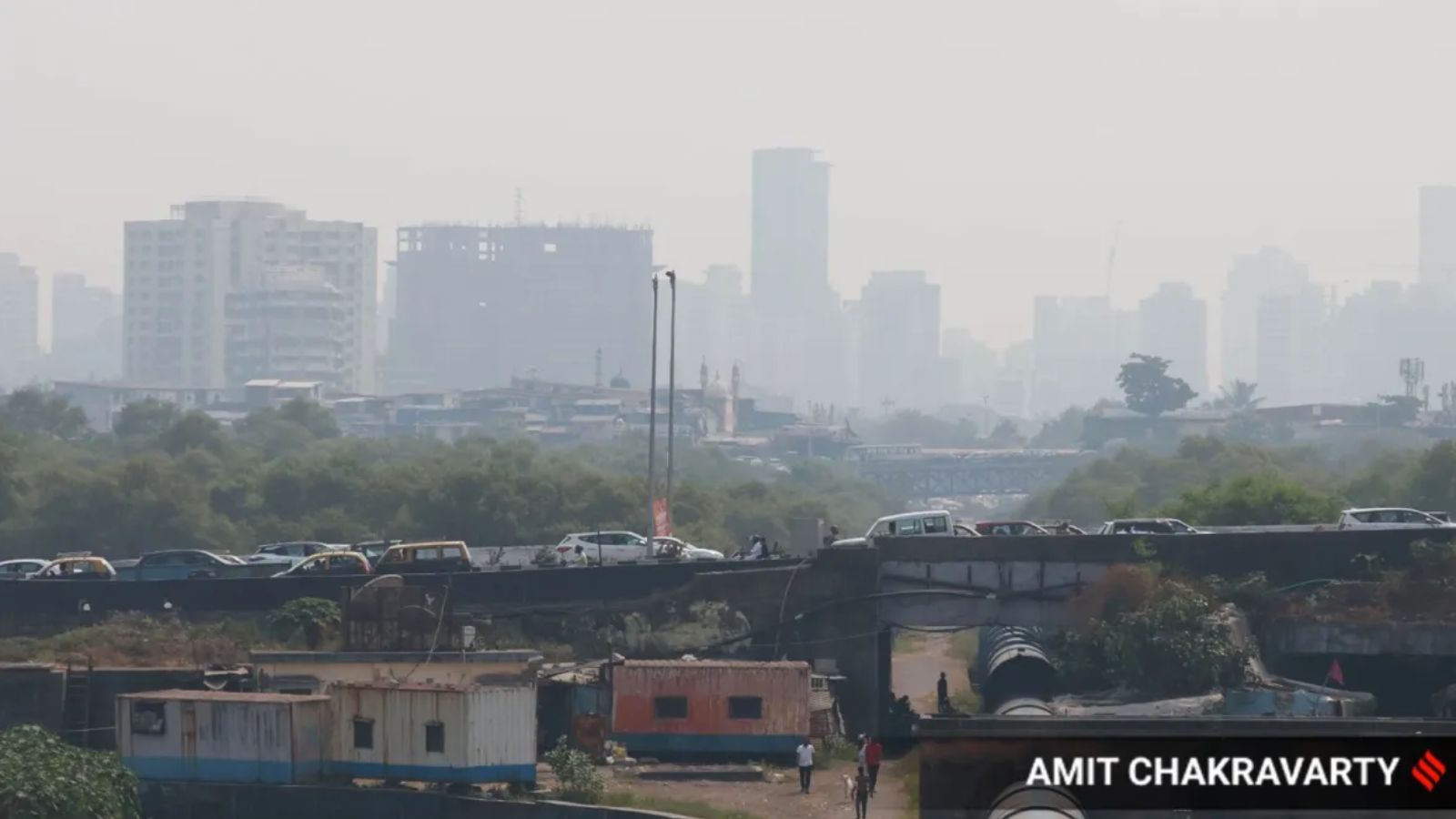
Mumbai’s air quality index crossed 100 on Friday as rain activity slowed down. The city’s skyline disappeared into a thick haze, with Worli recording the highest pollution levels. A civic official said, "Demolition sites will have to ensure proper barricading." The BMC started new rules to monitor construction sites daily.
With rain activity losing momentum, Mumbai's air quality deteriorated on Friday, with the city's Air Quality Index (AQI) crossing 100 for the first time this post-monsoon season as a haze settled over the skyline.
The overall AQI stood at 111 by Friday afternoon, with 10 of the 20 active monitoring stations recording 'moderate' air quality, according to Central Pollution Control Board (CPCB) data. Worli recorded the highest AQI at 178, followed by Colaba at 143, Deonar at 141 and Mazgaon at 138. PM2.5 and PM10 were among the prominent pollutants recorded at the stations.
The deterioration comes after four months of relatively satisfactory air quality, with the AQI generally remaining below 100 between June and September. Frequent spells of rain helped wash out dust and suspended pollutants. With rainfall now weakening, experts said changes in wind patterns and drier conditions were also contributing to the rise in pollution.
Experts told The Indian Express that the spike was not due to insufficient rainfall alone. Clockwise winds from the landward direction were also bringing dry air and dust from the north, they said.
The deterioration has prompted the Brihanmumbai Municipal Corporation (BMC) to issue fresh standard operating procedures (SOPs) for tackling pollution at the ward level.
Each civic ward will identify at least 10 pollution hotspots, including major construction and redevelopment sites, infrastructure projects, open waste-burning locations, debris dumping points and areas prone to traffic congestion. An officer will be assigned to each hotspot to monitor air quality and ensure corrective measures are taken.
Ward-level monitoring teams have also been directed to inspect at least two construction sites every day.
"Demolition sites will have to ensure proper barricading, cover debris with tarpaulin or green cloth and undertake continuous misting to suppress dust," said a civic official.
Developers and contractors will also be responsible for cleaning roads adjoining construction sites. Projects spread over up to 4,000 square metres will have to clean roads up to 100 metres; those between 4,000 and 10,000 square metres, up to 200 metres; and projects exceeding 10,000 square metres, up to 500 metres on both sides.
The BMC's action plan provides for escalating measures as pollution worsens. If the AQI crosses 200, authorities can undertake intensive cleaning, road washing, water spraying and misting, besides taking stricter action against open waste burning.
If the AQI remains above 300 for three consecutive days, polluting activities within a 2-km radius of the concerned air-quality monitoring station can be ordered to stop.
The civic body will also undertake a post-monsoon clean-up drive during the first two weeks of October to remove sludge, mud and accumulated road dust. The drive will cover major roads, medians, junctions and road edges.
"Roads may also be washed with recycled water or subjected to fine water spraying wherever required," civic authorities said.
According to CPCB norms, an AQI of 0-50 is 'good', 51-100 'satisfactory', 101-200 'moderate', 201-300 'poor', 301-400 'very poor' and above 400 'severe'.