
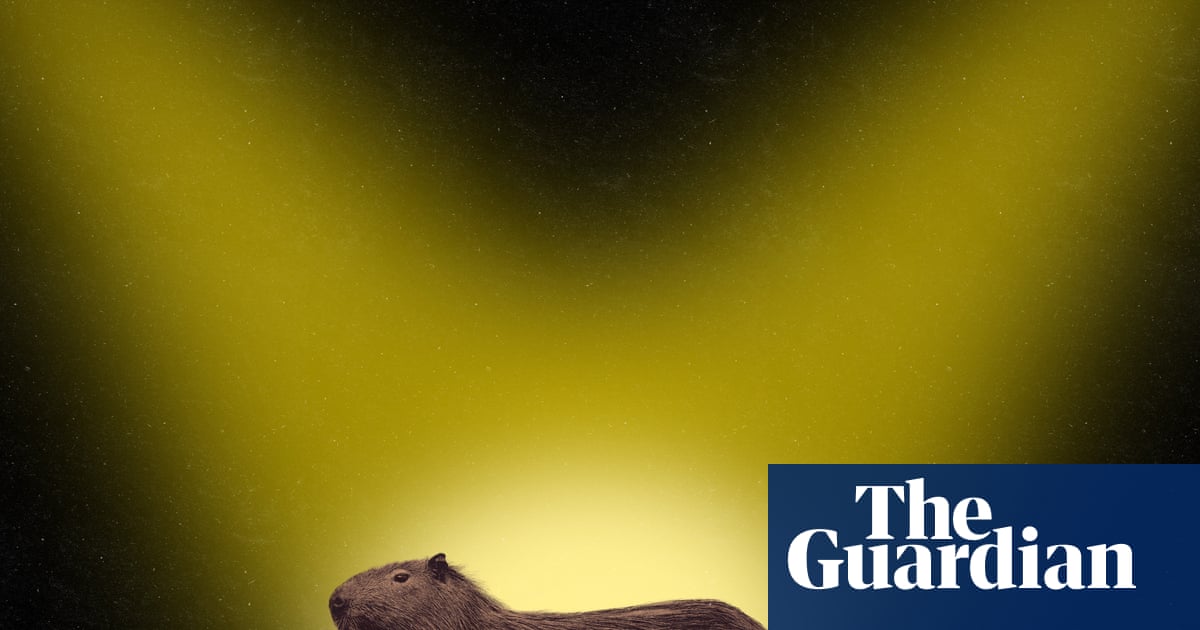
Samba the capybara remains at large six months after escaping from Marwell zoo in Winchester. She fled with her sister Tango on March 16, but only Samba stayed hidden in the Hampshire countryside. Laura Read said, "We think they really squeezed under a tiny gap in a gate."
Six months ago, Samba made a brave, unprecedented escape from Marwell zoo. Her life on the lam continues today. We join the team hunting desperately to find her in the Hampshire countryside
Samba the capybara is still at large. Along with her older sister, Tango, the intrepid rodent made her escape from Marwell zoo in Winchester in March. Tango all but gave herself up on day two; Samba broke for the marshy wetlands of the River Itchen. Word spread and within days the fugitive was an international social media star. But despite an intense search, the dense Hampshire countryside has afforded her a haven. Six months on, Samba remains elusive.
Marwell's staff still aren't sure how the capybaras escaped, although they have their suspicions. Tango and Samba were born on Jimmy's Farm and Wildlife Park in Suffolk in the summer of 2025. They arrived at Marwell zoo on Monday 16 March, to great excitement. "They were a little bit shy when they got here, as you would expect," says Laura Read, the chief executive of Marwell Wildlife. "But they were fine." They were immediately placed in a quarantined habitat, as is standard procedure for new arrivals. The plan was to keep them there for 30 days.
The next day, the vet and zookeepers did their morning checks and everything was fine. But when they returned that afternoon, Samba and Tango had vanished. "There was no sign of them digging out - they don't dig - and there was no sign of them chewing their way out," says Darren Ives, a senior zookeeper who has been at Marwell for 15 years. He's a member of the hoofstock team, who are responsible for "horses, equids, that kind of stuff ... basically anything that's big and shits a lot". That includes capybaras - which are native to most of South America - although rather than hooves they have partly webbed toes.
"We think they really squeezed under a tiny gap in a gate," says Read. "That's the only explanation we have." After 30 minutes of searching the enclosure, the alarm was raised. "In a situation like this, we are really well versed and have set drills that we practice regularly around animal escape."
When an animal escapes at Marwell, a call identifying the species and type of emergency is sent out over the zoo's radio network. Staff then send out searchers, contact the relevant authorities (Natural England, Winchester city council, the police) and mobilise drone support (provided by the University of Southampton, which Marwell already works with on population mapping conservation projects). Every species has its own emergency procedure, which include determining whether a firearm response is required. Despite being the world's largest rodents, capybaras do not demand a firearm response.
The search was initially confined to Marwell zoo's 57 hectares (140 acres). By the evening, staff had located two warm bodies inside a dense section of tree and bush clippings used for composting. Neither was reachable. As dusk turned to night, staff did their best to secure the perimeter, laid out some food and left. The next morning, Tango left the compost pile and was captured with throwing nets ("without trying to stress her out too much," says Read). Samba, however, had vanished.
Later that day, Marwell heard that Samba, who is about the size of a spaniel, had been spotted near the Ship Inn pub in Owslebury, nearly 2 miles away. A convoy of Land Rovers set off with transport crates and nets, while farmers were contacted to ask for permission to cross their land. Or, as Ives puts it: "In about five minutes, someone in Marwell uniform will be walking across - don't shoot them."
Read convened a crisis meeting, which looked at the threats to Samba's wellbeing. "It was cars," she says. "She's got no natural predators here. She's too big. We knew she'd probably seek out water as well, and they're fantastic swimmers. Water would be her sanctuary."
The decision was made to go public. Was there any hesitation? "That was the quickest way to find her and secure her welfare, so no. Our PR, you know, in terms of: 'We've lost an animal,' came second."
Local people poured out to look for Samba, including a woman with a trained search dog. "But, in hindsight, did all that activity drive her further away from our direct locality?" Read wonders.
By Friday, the local press was taking an interest, then social media, with waves of AI capybara memes appearing. Soon, the story was being reported as far away as the US and Australia.
Glenn Moores also joined the search after seeing the hunt on social media. "I had a bunch of drones and a skill set that could help." He runs Digital Fauna, a company that conducts wildlife surveys with drones, mostly counting deer ("there's far more deer than anyone even estimated," he says).
Moores' involvement has been pivotal, says Ives. "It meant that he could search areas and go: 'Don't bother looking there.'" Staff would have to respond to every credible sighting, but "until we had him, we were literally just on foot ... walking like a police search when they're looking for a lost person." Such was the quality of Moore's thermal imaging that he was able to detect rats. "We were going out at six in the morning, we were going out at night, we were walking the fields around the river," says Moores. "It's amazing that nobody saw Samba in that time."
Is he surprised how hard it has been to find her? "I'm used to counting deer at night, so we're not strangers to finding animals about the size of a capybara with thermal imaging. That's what we do. But finding one specific animal in an entire landscape is very different." How long has he spent hunting for Samba? "My goodness. Days, days and days. Probably about three weeks' worth of evenings." His selflessness is not lost on the Marwell team. "All of his time has been given for free!" says Read, appreciatively. (Moores says he wants a free pass to the zoo.)
On Sunday morning, five days after Samba vanished from her enclosure, a member of the public was walking along the bank of the Itchen in Twyford when she spotted a capybara sunning herself. Then her dog, Growler, chased Samba into the river. The video she took of the incident found its way to Marwell and the focus of the search shifted: staff donned waders and mounted paddleboards. On land, they looked for tracks, droppings, a body. They flushed out barn owls, deer, a pheasant, but no capybara. Read is convinced she caught a flash of her. "I just saw this brown furry bottom disappear into the river."
For the next week, the search was constant: at least six people a day, mornings and nights. "Everything went really quiet," says Read. "We just couldn't find any trace of her."
Six months later, my own trip to Marwell begins with a capybara hunt. Peering into their enclosure - a mixed wetland habitat they share with two swamp-dwelling antelopes called sitatungas - I can't spot Tango or her new companion, Ripple, a seven-year-old male. "They're in there, definitely. Don't worry," says Read, who has just come from proofreading a press release about a monkey vasectomy performed at the zoo. It's easy to see how Samba has evaded capture: "Try that in acres and acres and acres of an SSSI [site of special scientific interest] along the Itchen."
Ten minutes later, Tango and Ripple waddle out to the grazing area. Ripple was brought in from a zoo in Blackpool a few months after the escape - partly to breed with Tango, but mostly to keep her company. Capybaras are sociable animals, Ives says, used to living in packs of between 10 and 20. Ripple is calmer and much bigger than Tango - the size of a small sheep, he weighs about 40kg. Capybaras can start breeding once they are about a year old and Tango has already started showing signs that she is in the mood to do so. "When you put the two of them together, they seem to complement each other," says Ives.
So, how has Samba evaded capture for so long? For one, her biology. Capybaras are quick. "The things that would hunt these guys [in their native habitat] are jaguars. They need to be able to outrun them," says Ives. Capybaras are quite angular, he says, making them streamlined when running - it's an explosive speed, rather than one sustained over long distances. When chased, they head towards water and dive, barely breaking the water's surface as they do so. Submerged, they can hold their breath for up to five minutes, or furtively breach the surface revealing just their eyes, ears and nose. "They're designed to be quite stealthy. They're very good at hiding in the undergrowth."
Is Samba a danger to the public? "They've got a cracking set of teeth," says Ives. "If she were to bite you, she'd probably take your finger off. But also if you get that close - I mean you're doing better than us! - she would just run away. She would see you, smell you, hear you way before you see her." As Read says, capybaras have "a reputation, shall we say, for being quite slippery customers in the zoo world".
Also in Samba's favour is her likeness to local wildlife, particularly muntjac deer. Marwell set up a hotline for sightings. "We had everything from: 'We've seen her dead on the side of the M3,' to: 'She's in my back garden,'" says Read. "We had one man who was absolutely adamant that she was in his back garden and was behaving weirdly. And we were like: 'Right!' We went down there ... and it was a hedgehog."
Some calls came from as far away as Stonehenge, about 40 miles away. More frustrating were the prank calls from drunk people in the middle of the night. "You very quickly got the gist of who was serious," Read says. (If you think you have seen Samba, take a picture, record your exact location and send it to the zoo.)
In August, Marwell received an image of a rodent-like creature from a camera trap used to spot poachers. The zoo set up its own cameras and a week later received unmistakable proof of life. The first image: a hairy, rotund animal bottom. The second: Samba. "Without a doubt, that's our girl looking fat and healthy," says Read.
She was two to three miles away from the zoo, near where she had been chased by Growler. "It's an ideal location for her to stay and disappear," says Ives. The plan now is to make Samba feel comfortable in that area, allowing the keepers to narrow their search. They want to tempt her back to the same spot repeatedly with food (sweet potato and honeydew melons, apparently). They have laid more camera traps and put down bedding used by Tango and Ripple to see if she is enticed by their scent.
Read and her team insist they are doing everything they can, but interest in Samba has brought with it criticism of the zoo. "It's been really upsetting for me and for the team, because we know how hard we're working, still, on bringing Samba back," says Read. "A lot of what we're doing isn't necessarily publicly visible, because it is things like drone flights at 6am, it's camera traps, it's someone sitting at a desk reviewing camera-trap footage hour after hour. It's scientifically grid-mapping where we're camera-trapping. We know that loads of boots on the ground will just drive her further away."
She dismisses accusations of carelessness. "We've been here for 50 years. Our record speaks for itself. We're award-winning for our animal welfare. No one did this because of carelessness. No one did this because they couldn't be bothered or didn't do their job properly. This happened because an animal did something that we could not have foreseen it doing."
As for whether Marwell should have capybaras in the first place: "Just because the capybara itself is not an endangered species doesn't mean that the ecosystems and the habitats that they occupy aren't under threat," says Read. The Amazon and Pantanal - the capybaras' native habitats - are under threat and Read believes capybaras could be used to tell that story, not least because they are trendy and draw a crowd. "With the caveat that their welfare needs to be exceptionally well met," says Read. "Yes, they're here for conservation, for breeding programmes, for insurance and all the rest of it, but also they're here to tell a story and to inspire people."
Samba's story will help with that, she hopes. "We are a conservation charity first and foremost," says Read. "We are hands-on with our conservation work. We don't just make donations to NGOs. We have teams in the field doing the work. We want to be really famous for the great work that we do and if Samba is one way of us doing that, then great. We'd like to shine a light on that as well as 'we've lost a capybara'." She pauses. "Although we did. We own that."
Winter could prove crucial: with less vegetation, Samba may be easier to spot, but capybaras are not built for harsh weather. Is it a race against time? "If we got a really cold snap, we'd all be pretty worried," says Read. If, on the other hand, it's just "wet and windy, she'll be fine with that. It's more that we have no control over her welfare out in the world, whereas here we can give her everything she needs, including socialisation."
Are they confident they'll find her? "Well, technically, we've already found her!" says Ives. "We've seen her on the camera-trap footage. She's very chunky. She's very healthy." If they do catch her, a reunion with her sister beckons. "But when - when, not if - we get her back, it's going to be a very slow process to mix them, because she's now a wild animal."
How much longer she stays that way remains to be seen. For Samba, the net is closing in.