
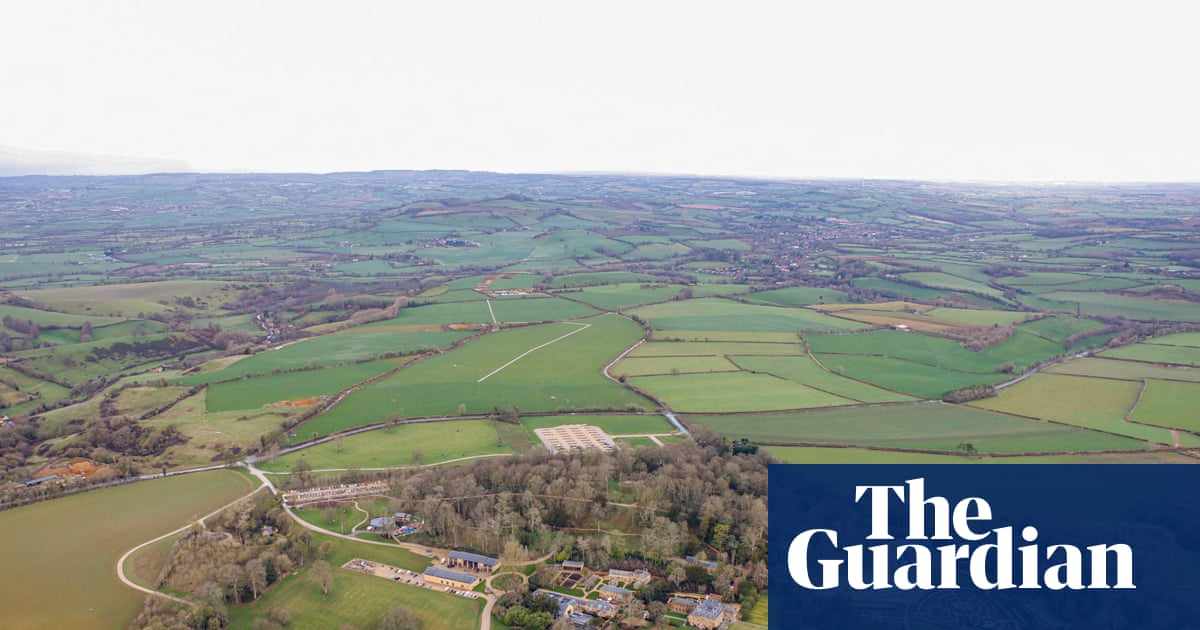
South African billionaire Koos Bekker bought an old country estate in Somerset to turn it into a luxury hotel. He has been buying thousands of acres around Bruton and Castle Cary. Many local people now worry about his growing influence, as he snapped up high street businesses and local pubs.
Koos Bekker's Newt estate encompasses luxury hotels, pubs and high street business, with local concerns including flooding
When South African billionaire Koos Bekker bought an old country estate in a sleepy corner of Somerset to turn it into a luxury hotel, residents thought it was a sign their area was on the up.
Walking through his peaceful manicured gardens, which feature a maze of apple trees twisted into perfect shapes using the espalier method, it's easy to feel that all is well in this quiet, picturesque pocket of England.
But if you venture beyond the orchards and into the local pubs, where the local cider sets tongues wagging, you'll hear a very different story.
Bekker has been embroiled in a row with local people over a number of issues ranging from the vast expansion of his estate, the use of pesticides on it and branding deals - described as "brazen" by one local person - which have seen the local train station named after his hotel, the Newt in Somerset.
The businessman has a net worth of about £3bn and is the chair of Naspers, one of the world's biggest technology firms. He has been buying thousands of acres around Bruton and Castle Cary - more than 2,700 acres (1,090 hectares), according to Guardian analysis - through his company Emily Estate (UK) Limited, which trades as the Newt.
As well as swathes of the countryside, Bekker has also snapped up high street businesses from a deli to a beauty parlour, as well as pretty former farmhouses and local pubs.
And it is this expansion of Bekker's influence beyond the boundaries of the Newt - beloved of celebrities such as Charli xcx and Kate Moss - into the heart of the local Somerset villages where tensions have begun to emerge.
Bekker is not the only moneyed arrival in this corner of Somerset. The area boasts famous residents including former chancellor George Osborne, fashion designer Stella McCartney, and broadcaster Mariella Frostrup.
The George pub in the centre of Castle Cary currently serves senior citizens a hot dinner for just £12, but local people do not expect these prices will remain now the Newt has bought the inn: a bag of chocolate buttons in its farm shop costs £11.95, while a bottle of "cyder" grown on the estate is £12.50.
Bekker bought the 17th-century manor Hadspen House in 2013, along with 16 acres of land, converting it into the luxury hotel. Last year he acquired Yarlington Lodge, a Grade II-listed Georgian house a mile away, and converted it into a 32-guest property with its own pool, tennis court and cinema room.
He is hardly a silent investor - the sign for the local train station, Castle Cary, now reads "Castle Cary for the Newt". By the tracks is the new Creamery cafe, which serves afternoon tea in a vintage Pullman carriage at £45 a head.
Hugh Thomas, a food writer from Frome, said the renaming of the station seemed "arrogant and brazen", adding: "The station does feel somewhat colonised by the Newt regardless, which I find an encroaching thing, given it is supposed to be a public service."
Some, though, have welcomed the investment, saying it has cheered up a previously unloved train station and the Bekker family were creating jobs as well as bringing new people to the area to eat in the restaurants and drink in the pubs.
Visitors to the £800-a-night Newt hotel are invited to enjoy being immersed in the nature of deep Somerset. The hotel recently welcomed a cage of endangered red squirrels. But there, too, lay a problem.
The Newt consulted rewilding expert Derek Gow about keeping five red squirrels in a pen. They became extinct in most of England after invasive grey squirrels were introduced from America which carry a virus that causes a disease called squirrelpox, which kills off the reds.
Gow said: "The Newt did talk to me about it; we did have one conversation. I said: 'It is not going to be viable.' It is performative - [the squirrels] are in the cage to show guests. That's it. Keeping five squirrels in a cage does nothing for wildlife. If they do release them, they will just get squirrelpox and die."
While the Newt has created spectacular gardens around the hotel, including a historically accurate Roman villa, a "four seasons" garden featuring marble water fountains and a treetop walkway, these are not freely accessible to the public. Only hotel guests and those with an £85 annual pass can enter the grounds.
People living nearby have also been concerned that there has been an increase in flooding since the Newt was built. The hotel has acknowledged this, and has been digging pools to hold any run-off water from the farm and paved areas.
Local people have set up a group to coordinate complaints about the issue. Emma Craigie, a writer who lives nearby, said: "I live in a village below the hill the Newt is on. In our immediate locality there were incidents of flooding which seemed clearly exacerbated by their road building and hardcore use."
The worst incident was in May 2023, when rain over the Newt caused flash-flooding down the Pitt and Cam valleys, which the local council described as "beyond levels seen in living memory". The local authority declared an emergency that evening.
Villagers have also set up a petition against the spraying of pesticides on the Newt's farmland.
The model and actor Gabriella Wilde, who also lives locally, said: "I was surprised and a little disappointed to learn that they are using such harmful chemicals in their farming operations. That is certainly not the image they project to their guests and local fans. Is it really necessary, especially given how many local farms are making great strides in moving away from old school harmful practices, and towards more nature friendly farming?"
Farmers have been suspicious that new boreholes drilled by the hotel have dried up sections of the River Brue, the stream that Bruton is named after. The cider-maker Oliver Dowding, the nextdoor neighbour of the hotel, has entered negotiations with the Newt via the Environment Agency over his section of the river, which runs through his land. He said, ironically, that the newts which used to live on his land had disappeared.
Though the Newt boasts that its food is "locally produced", its farms do not have organic certification. John Sykes, who lives nearby, pointed to the severely trimmed hedges around the estate as well as the sterile lawns.
"Look, there are no berries for the birds here. And what bothers me is the land immediately adjacent to our village used to be an organic farm, now they've bought it, and it isn't any more. They are continuing to buy farmland, and I don't know when they will stop. I don't want to live somewhere that's just one man's estate," Sykes said.
A spokesperson for the Newt in Somerset said: "Fundamental to our philosophy is a love of gardens, respect for the land and a determination to share that passion with a broad audience. To ensure best practice, we employ experts across our operations, including agronomists, horticulturists, arborists, conservationists, educationalists, beekeepers, nutritionists, livestock and wildlife specialists, alongside our hospitality teams.
"We are equally committed to our local community, maintaining close relationships with local organisations and proudly employing more than 650 people, who are either from or live within the local area."