
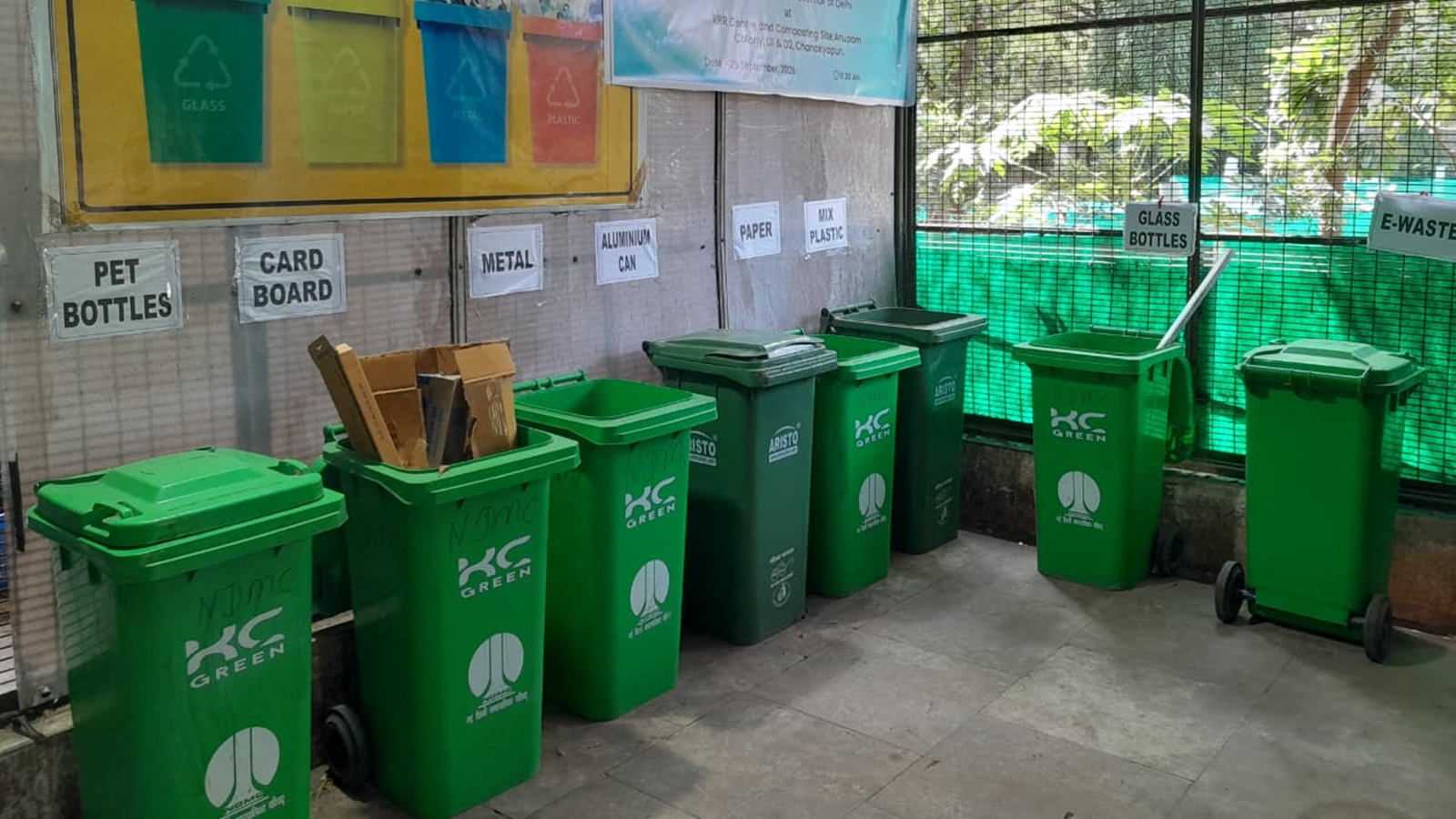
Over 300 homes in Chanakyapuri now follow a zero waste model. Every morning, collectors gather garbage from these blocks and take it to a local facility. "We then put it in separate compartments in our bicycle cart," said Arjun. This process helps recycle waste and creates compost for local gardens.
Every morning, as most of Delhi's garbage begins its journey out of homes and towards dumpsites, the waste from over 300 homes in Chanakyapuri takes a different route.
The process begins around 6.30 am.
Arjun, one of three garbage collectors hired by the D1 Block Residents' Welfare Association (RWA), collects waste from the D1 and D2 residential blocks and the Satya Sadan officers' flats.
"We then put it in separate compartments in our bicycle cart," says the 30-year-old.
After finishing his round around 11 am, he says he takes the waste to the New Delhi Municipal Council's Material Recovery Facility (MRF) at Madhu Limaye Marg, 1.5 km away from the neighbourhood.
There, he hands over the wet waste for processing. He further segregates the dry waste into several variously labelled bins: PET bottles, cardboard, metal, aluminium can, paper and mixed plastic.
These homes are part of a model 'zero waste colony'.
For a little over a year, garbage from these homes -- 800 kg to 1,200 kg wet waste and 250 kg of dry waste a day -- has been collected, processed and recycled in and around the neighbourhood, a process that's mandated under the Solid Waste Management (SWM) Rules, 2026.
According to RWA member Shefali Chaturvedi, households segregate their waste into wet and dry before handing it over to Arjun.
From waste to compost and recyclables
At the facility, the waste is processed further.
Amit Kumar, Sanitary Inspector and in-charge of the MRF centre, says their primary focus is on processing wet waste. "The wet waste, a combination of waste from residences and the horticulture waste, is first broken down into finer granules through a crusher," he says.
The horticulture waste -- dry leaves and branches from the colony's parks and lawns -- is collected by the NDMC's auto-tippers during the day.
The wet waste is then transferred to a rounder -- a cylindrical, permeable wire container used for in-situ aerobic composting. There are 10 such rounders present in the facility.
It reduces to half its volume, and the compost is taken out to dry in the sun. A worker then sifts the dried compost through a mesh to filter out unwanted debris and coarse material.
The final compost produced is then given back to the residents to use in their gardens.
Kumar says it can take between two and four months for the waste to be composted, depending on moisture and temperature. "Sometimes, we also add enzymes, such as jaggery water or curd, which speeds up the process," he says.
As for the separated dry waste, Kumar says it is given to scrap dealers who take it to authorised recyclers.
Roadblocks to expansion
In June 2025, these three Chanakyapuri blocks were the first to be declared 'Anupam Colony', a zero waste certification tag by the NDMC as part of its decentralised, zero-waste neighbourhood initiative. A total of nine blocks have received this tag till date.
But can it be scaled up?
According to Rajiv Jain, Advisor of Sanitation and Solid Waste Management for the NDMC, the aim is to implement the initiative in all neighbourhoods under the civic body's jurisdiction but replicating the model is proving to be a challenge -- mainly due to space crunch.
"Space is an essential requirement to set up more MRFS, but this is not readily available," says Jain.
The cost, however, is not an obstacle. He says this model is cheaper than the considerable expenses of processing mass waste.
"The facilities were set up with a cost of around 3.5 lakh. Earlier methods involved expensive dustbins and composting kits with high costs, whereas our model has low operational cost, no chemicals, and simple steel or wire rounders," Jain says.
The waste from these homes is a tiny fraction of the 11,862 tonnes of municipal solid waste dumped each day at Delhi's landfills, but it offers a glimpse of what neighbourhood-level waste processing can achieve.
According to Jain, getting residents to segregate waste at source remains a challenge across Delhi. "They need to be sensitised, told multiple times to segregate the waste."
Room for improvement
Back at the colony, Chaturvedi says more collection vehicles and separate garbage bins for segregation outside each house could make the process even smoother.
She adds that while most households are now segregating wet and dry waste, the NDMC has introduced a third category of 'hazardous waste' which is yet to be implemented completely.
"We are trying to sensitise the residents about it. Most residents are aware that they should keep hazardous waste with themselves until it is collected," sh