
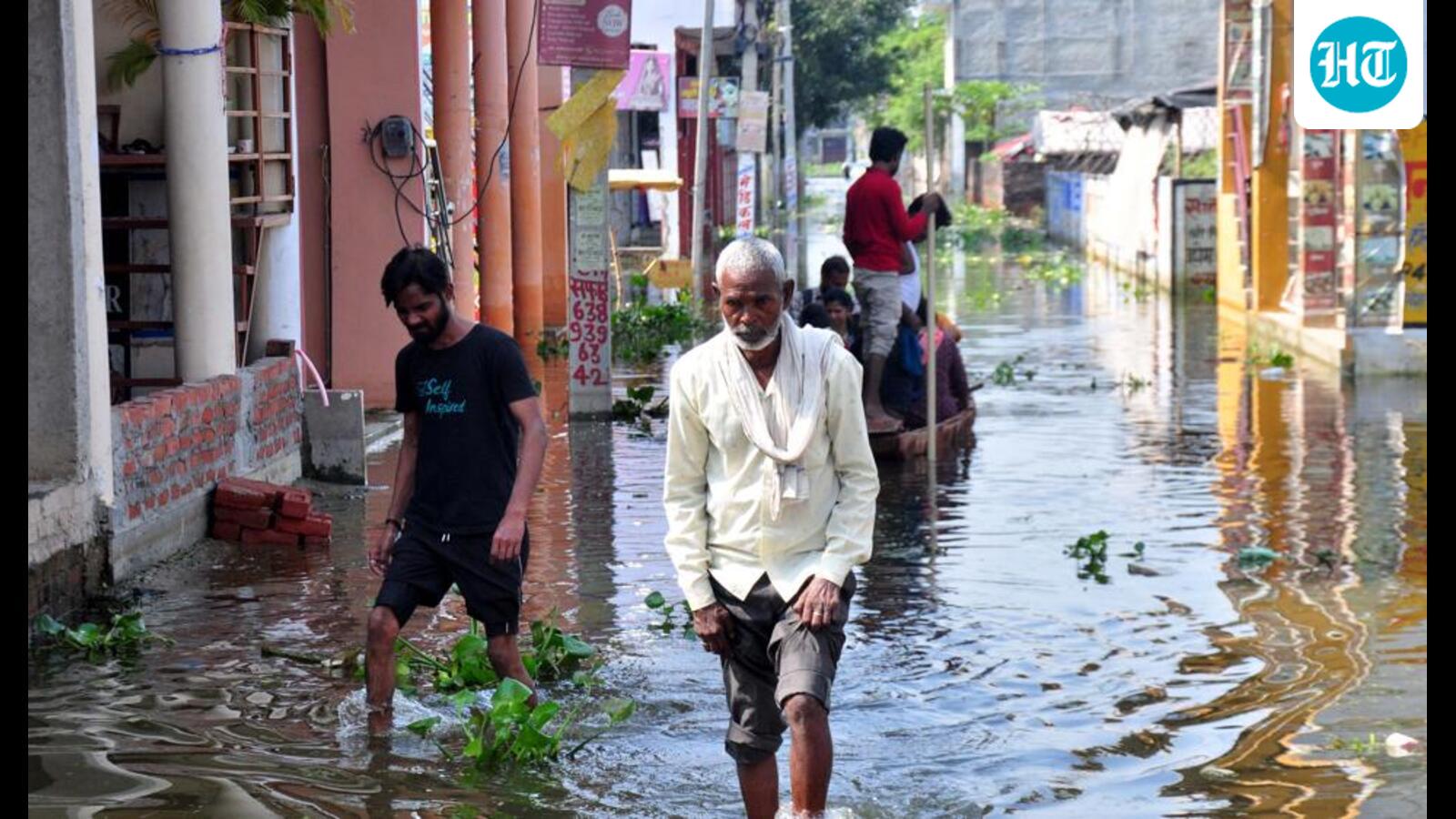
The Gomti river level fell at all four monitoring points in Lucknow on Monday. The Lucknow Municipal Corporation now seeks 500 extra sanitation workers to clear mud and debris from flood-affected areas. Officials started using GIS mapping to guide the cleanup drive and restore normalcy in the city as soon.
With the Gomti river level falling at all four monitoring points in Lucknow, the Lucknow Municipal Corporation (LMC) on Monday stepped up preparations to clear mud, silt and debris from flood-affected localities, estimating a need for 400-500 additional sanitation workers to restore normalcy.
The river level fell by 9 to 16 cm in 24 hours between Sunday and Monday, with Bhatpurva recording the sharpest decline of 16 cm. Gaughat, Hanuman Setu and Gomti Barrage also reported a fall in water levels.
The receding water prompted the civic body to prepare a large-scale cleanup drive in affected areas of Zones 3 and 6, directing officials to begin operations wherever conditions permit.
Gomti level falls at four monitoring points
According to readings recorded at 8 pm, the water level at Bhatpurva fell from 112.64 metres on Sunday to 112.48 metres on Monday. At Gaughat, it dropped from 108.48 metres to 108.39 metres, while at Hanuman Setu, it declined from 107.19 metres to 107.06 metres. At Gomti Barrage, the level fell from 106.96 metres to 106.86 metres.
GIS mapping to guide cleanup drive
Municipal commissioner Gaurav Kumar directed officials to launch the cleanup campaign immediately during a review meeting at the Zone 3 zonal office on Monday. Additional municipal commissioner Arun Kumar Gupta, zonal officer Ajit Rai and other officials attended the meeting.
The LMC has used geographical information system (GIS) mapping to identify flood-affected areas and divide them into sectors. Officials will oversee individual sectors, while supervisors and sanitation workers will be assigned specific streets.
Kumar directed officials to accelerate desilting with mud pumps in areas where floodwaters have receded. Teams will remove accumulated mud, sludge and debris from roads, lanes and drains, alongside drainage and sanitation operations.
400-500 additional workers sought
The civic body estimates that it needs around 400-500 additional sanitation workers for the cleanup. Officials have been directed to mobilise manpower from other municipal zones and arrange personnel through the concerned agencies, including LSA and LSG.
The engineering, health and water works departments will coordinate the operations, with regular monitoring to ensure that teams address the needs of individual localities.
The LMC plans to extend the drive as water levels fall and more affected streets become accessible. Officials have been instructed to deploy available manpower and equipment to clear flood debris, improve drainage and restore hygiene in affected neighbourhoods.