
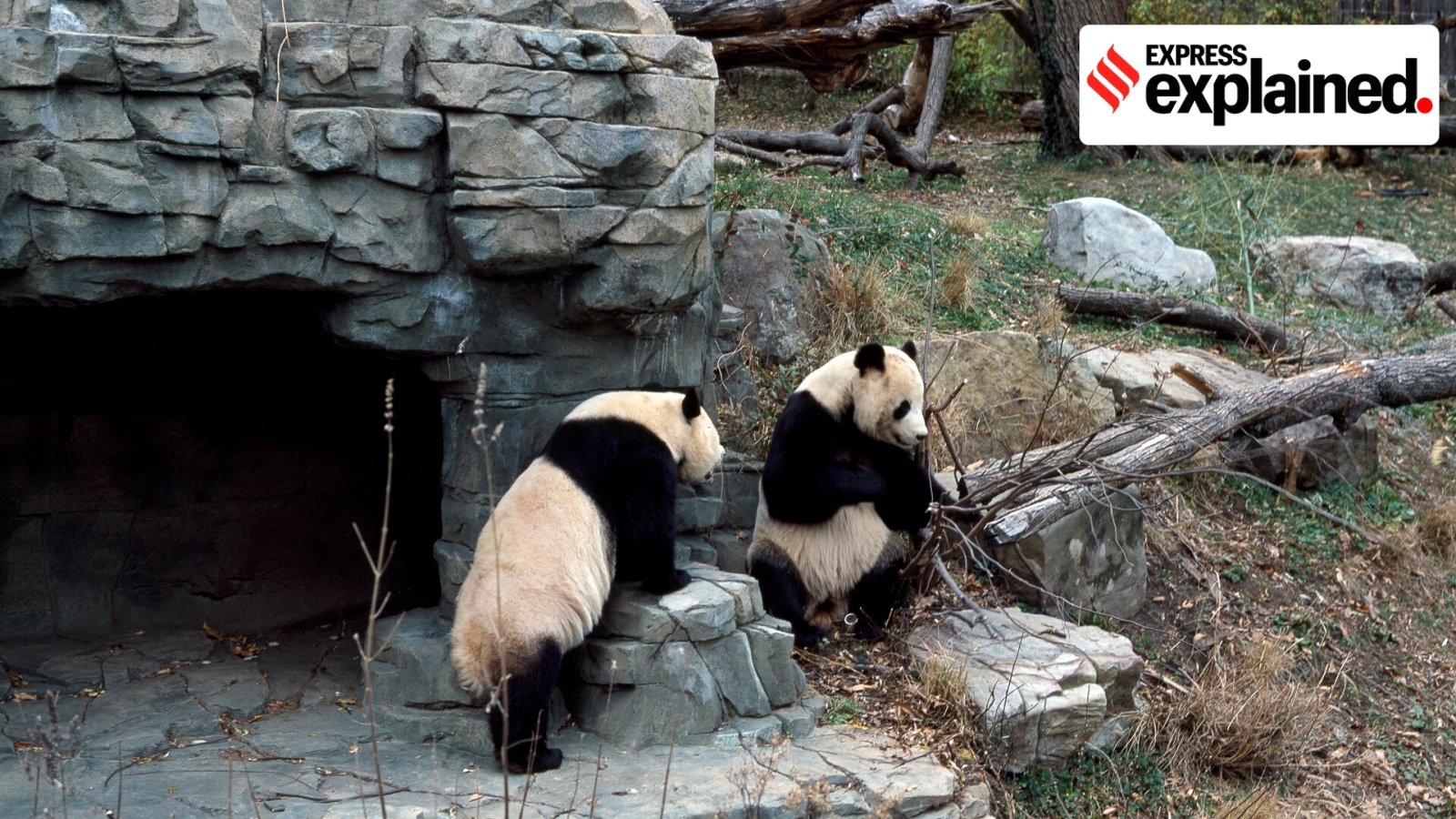
US President Donald Trump and Chinese President Xi Jinping agreed to bring two giant pandas to the Atlanta Zoo. This move follows a long history of animal diplomacy, where nations use rare species to build ties. From ancient Egyptian giraffes to modern panda loans, these gifts show how countries use nature.
For all the spectacle that engulfed last week's meeting between US President Donald Trump and Chinese President Xi Jinping in Washington DC, the outcomes of substance emerged in sets of two: a two-month extension to a trade truce -- and two giant pandas.
"The United States welcomes the arrival of two giant pandas, leased by China to the Atlanta Zoo," noted a fact sheet on the official White House website.
Geopolitical observers drew parallels with US President Richard Nixon's state visit to China in 1972, following which Chinese Premier Zhou Enlai gifted two pandas to the US as a goodwill gesture. Although pandas have long been part of China's diplomatic overtures, the slated arrival of a pair at the Atlanta Zoo, albeit on loan, also puts the spotlight on "animal diplomacy" -- a practice that seems modern but goes back millennia.
We explain the long history of using animals in diplomacy worldwide, the symbolism that lies beneath, and how conservation efforts have exercised influence over time.
History of animal diplomacy
Simply put, animal diplomacy refers to the strategic use of fauna -- both common and rare species -- as gifts, loans, or symbols in international relations. The practice dates back to Egyptian pharaohs sending African animals to ancient rulers in the Mediterranean. The Roman Empire, too, was known to display exotic species to demonstrate the extent of its territorial control.
A notable instance from ancient times mentions Egyptian queen Cleopatra's gift of a "cameleopard" -- a mix of a camel and a leopard -- which was most likely a giraffe.
In 802 CE (current era), Harun al-Rashid, caliph of the Abbasid Caliphate, gifted an elephant named Abul-Abbas to the Roman emperor Charlemagne. Another documented instance, this time from the 1600s, mentions the Russian tsar sending a polar bear to the King of Sweden -- a rare gift that not just involved substantial logistics but also aimed to impress a fellow ruler by signifying one's own status.
Since the turn of the 20th century, the use of animals in diplomacy has combined both public engagement and media spectacle, with China's "panda diplomacy" a prominent example. Even Australia has used its unique fauna such as platypuses and koalas: As a gesture of solidarity during World War II, the country sent a platypus named Winston to the UK as a gift for Prime Minister Winston Churchill in 1943. The platypus died on the journey.
This form of diplomacy also included birds. Past and present rulers, especially in Europe and the Arab world, have exchanged high-prized falcons as signs of goodwill.
India's tryst with animal diplomacy
One of the earliest documented instances of animal diplomacy that passed through India dates to 1414, when envoys from Malindi (in present-day Kenya) met the Chinese naval commander Admiral Zheng He -- a representative of the Ming emperor Yongle -- in Bengal. A 2017 article in Smithsonian Magazine notes that the men from Malindi, who had brought giraffes all the way from East Africa, gave one to the admiral to take it back home as a tribute to Yongle.
Another notable instance occurred over a century later, when Sultan Muzaffar II of Gujarat gifted a rhinoceros to King Manuel I of Portugal; it was transported across continents by sea. Upon its arrival, the one-horned animal created such a flutter across Europe that the renowned German painter Albrecht Dürer immortalised it on canvas (The Rhinoceros, 1515) despite never having seen one himself. According to historians, he accomplished this from descriptions he'd likely read or having seen another artist's drawings.
In the memoir Jahangirnama, there are multiple references to the fascination that Mughal emperor Jahangir (1569-1627 CE) held towards exotic species. The historian Aparna Kapadia, in a 2021 essay, wrote that Jahangir had stationed an official in Goa specifically to conduct business transactions with the Portuguese and "to purchase any rarities he could get hold of". One such acquisition was a North American turkey, "larger in body than a peahen and significantly smaller than a peacock".
In the post-independence era, India's first Prime Minister Jawaharlal Nehru is said to have gifted a baby elephant named Indira to Japan after receiving numerous letters from Japanese children asking to see one. Under Nehru, the Indian government later sent elephants to other countries such as the US, the Soviet Union, China, Turkey and Iran, among others.
Elephants have also come to India as "gifts": This was the case with Shankar and Vimbai, a pair of African elephants which arrived from Zimbabwe in 1996 and were kept at the Delhi Zoo. Although Vimbai, a female, died in 2001, Shankar's years-long solitary existence since then received much media attention. The male elephant finally died in October 2025.
An arguably standout example of animal diplomacy in recent years has been the India-Namibia collaboration in 2022 under "Project Cheetah". In subsequent years, two more batches of African cheetahs arrived from South Africa and Botswana. While the Asian cheetah went extinct in India in the 1950s, history suggests that they occupied a prized place in royal courts and were exchanged as diplomatic gifts.
In August 2026, India gifted five peacocks to the UN, to be housed at its European headquarters in Geneva. UN News termed it "a new twist on panda diplomacy".
Symbolism
Diplomacy has long involved exchanging gifts. What distinguishes this from other gifts is the use of a living being -- albeit a non-human -- as a political and cultural representative: indeed, animals such as giant pandas and koala bears are synonymous with their countries of habitat. The donor country or government can project soft power by bypassing formal channels and directly appealing to the recipient country's general public.
There, perhaps, lies its greatest strategic value. The non-profit Diplo notes that animal diplomacy "simplifies complex international alignments into relatable, emotional narratives" by offering a "tangible, cute face" for a nation's foreign policy, which can sometimes open doors that traditional statecraft cannot.
Such "envoys" can make quite an economic splash: for instance, within the first year of the two giant pandas -- named Ling-Ling and Hsing-Hsing -- arriving from China in 1972, more than one million people visited the National Zoo in Washington, DC, where the duo was kept.
In political and philosophical terms, such an exchange signals that the donor trusts the recipient to prove a responsible host. In cases of rare or endangered species, this places the onus of stewardship on the recipient with the expectation that it will ensure conservation of the animal(s) in an alien habitat. So, the well-being and health of these animals become the barometer of the diplomatic relationship itself.
The conservation debate
Even before the 1972 thaw with the US, China had witnessed the power of pandas as a tool of diplomacy, starting from the 1940s before institutionalising the practice over decades; other countries, too, began to adopt similar practices. Meanwhile, conservationists were raising concerns over placing rare and often vulnerable species in foreign habitats, especially through illegal trade.
Their efforts culminated in a global treaty called the Convention on International Trade in Endangered Species of Wild Fauna and Flora (CITES), which was adopted in 1973 and came into force on July 1, 1975. The treaty regulates international trade in specimens of over 38,000 species -- this ensures that any diplomatic exchanges are governed by strict conditions guaranteeing conservation and humane treatment, imposing safeguards against exploitation or even extinction.
This influenced the use of animals in diplomacy as well: moving on from permanent 'state gifts', countries began to use scientific loans instead. "Panda diplomacy" has been at the forefront of this, wherein the animals are leased to foreign zoos for a decade or so but are owned by China. The annual rent, officially called "conservation fee", can range anywhere between from $500,000 to $1 million per pair -- any cubs born in foreign zoos means additional payments to China. China says that it uses these funds towards conservation, such as building state-of-the-art facilities and establishing protected areas for the pandas.
A more recent instance where conservationists exercised influence was in 2024 when Malaysia announced its plans for "orangutan diplomacy". The country proposed gifting the primates to its trading partners to show that it was a "sustainable palm oil producer" and "committed to protecting forests and environmental sustainability".
The proposal was heavily criticised, with conservation groups pointing out how clearing land for palm oil plantations was a major factor destroying orangutan habitat and causing their numbers to shrink. Following the backlash, Malaysia switched to a sponsorship model whereby foreign countries and corporations were invited to finance in-situ conservation of orangutans instead of receiving them overseas.