
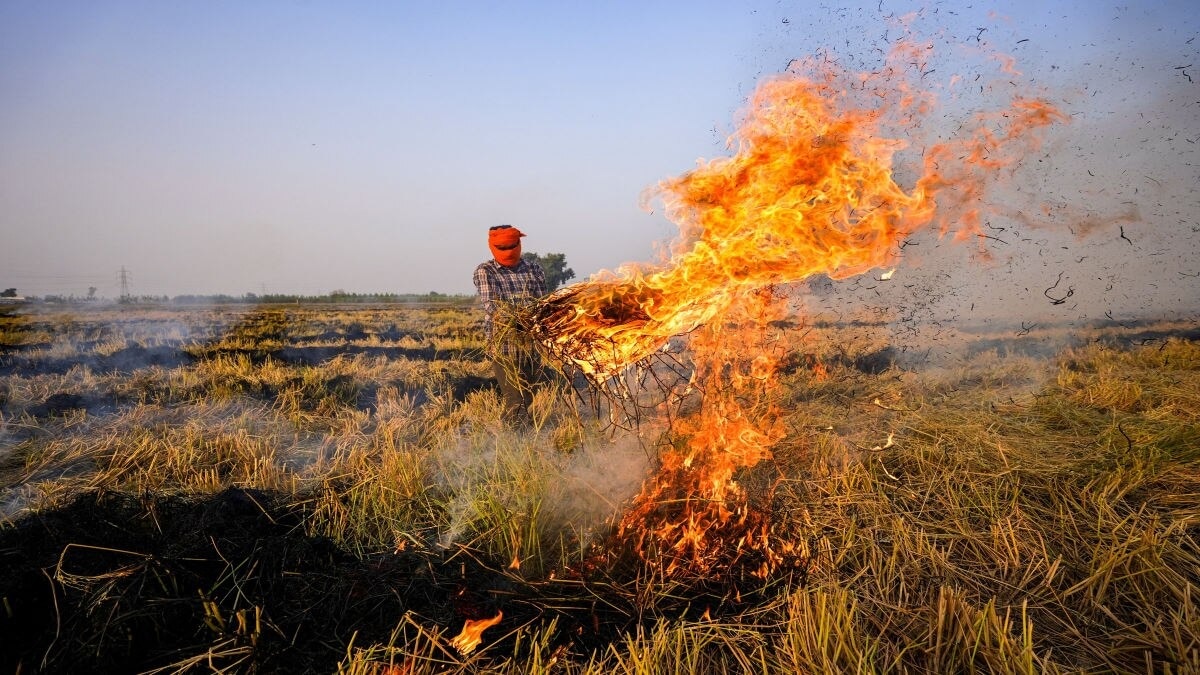
The Commission for Air Quality Management deployed flying squads across 34 districts in Punjab and Haryana to monitor stubble burning. These teams will work until November 30 to prevent pollution in Delhi-NCR. They said the mechanism is intended to allow timely assessment of the situation and prompt action against burning.
The Commission for Air Quality Management (CAQM) has deployed flying squads across 34 districts in Punjab and Haryana to monitor and prevent paddy stubble burning during the ongoing harvesting season, ahead of the winter months when air pollution typically worsens in Delhi-NCR.
The squads will be deployed till November 30, covering 18 districts in Punjab and 16 in Haryana, the CAQM said in a press statement on Monday.
The move comes as paddy harvesting gets underway in the two states, where stubble burning is closely monitored because of its impact on air quality in the National Capital Region.
Daily ground-level monitoring
The flying squads will assess the situation on the ground in their respective districts and coordinate with farmers and local authorities to prevent stubble-burning incidents.
They will work with the Parali Protection Force, district-level authorities, state government nodal officers, state pollution control boards, the CAQM Cell at SAS Nagar and the Commission.
The teams will submit daily reports to the CAQM Cell on the ground situation and measures taken to prevent further incidents.
The deployment will take place in successive phases, with squads assigned to different districts during different periods to ensure monitoring throughout the harvesting season.
34 districts under watch
In Punjab, the districts covered are Sangrur, Tarn Taran, Firozpur, Muktsar, Bathinda, Amritsar, Moga, Mansa, Fazilka, Patiala, Ludhiana, Kapurthala, Faridkot, Barnala, Malerkotla, Gurdaspur, Jalandhar and Fatehgarh Sahib.
In Haryana, the deployment covers Jind, Fatehabad, Hisar, Kaithal, Sonipat, Rohtak, Sirsa, Karnal, Palwal, Jhajjar, Kurukshetra, Ambala, Yamunanagar, Faridabad, Panipat and Hansi.
The CAQM said the strengthened field-level mechanism is intended to allow timely assessment of the situation, closer coordination among enforcement agencies and prompt preventive action against stubble burning.
The daily reports will also help the Commission continuously assess the situation and coordinate follow-up action with the authorities where required.
The Commission said it has been continuously monitoring and reviewing measures with the Punjab and Haryana governments, state pollution control boards and district administrations to prevent paddy stubble burning.