
A writer found a grey pigeon feather while walking along the River Lagan in Belfast. The discovery showed how feathers tell the story of birds through seasons and growth. These creatures use feathers to show beauty and attract mates. The author said, "A deep truth is how beauty grew wings."
River Lagan, Belfast: I glance at the feather in my hand, thoughts drifting to the dinosaurs that were among the first feathered animals
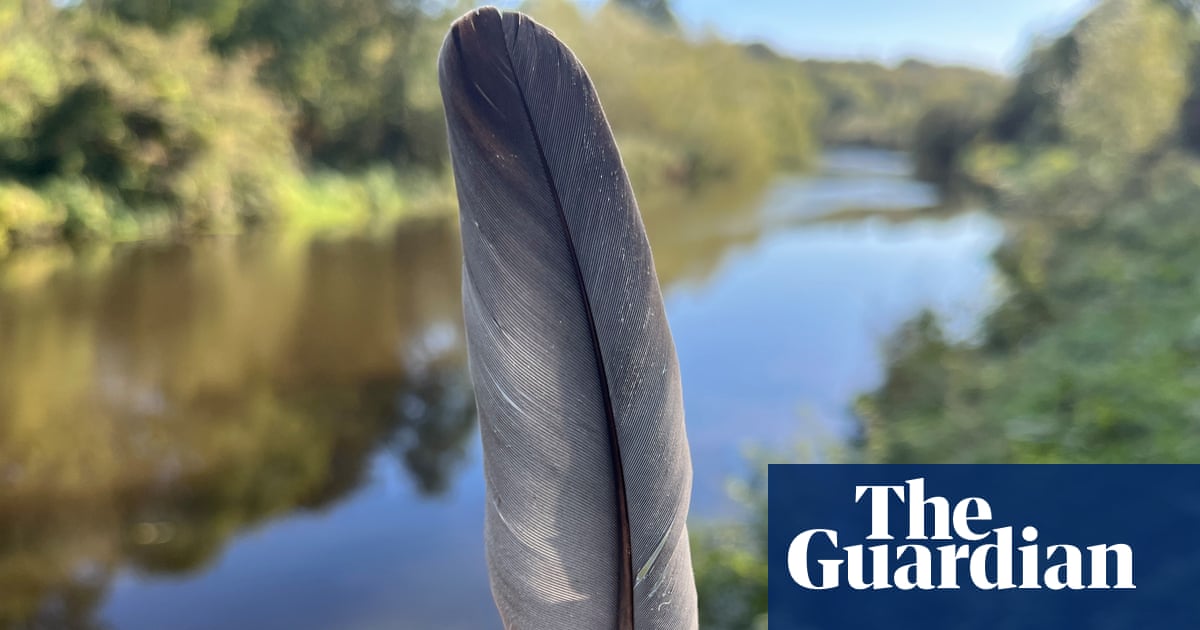
On my walk along the towpath, I pick up a small grey feather. It's a flight feather, probably from the wing of a feral pigeon. I stroke it absently as I watch the birds that are swimming on the river's surface. Steeped in autumn sunshine, the different species are also feathered with other seasons. Summer is in the fuzzy down of a late-hatched moorhen chick. Winter gleams in the white heads of the "black-headed" gulls. And, while a mallard's emerald-green head is, as yet, tatty as old velvet, his crisply curled drake's tails herald the coming spring.
If the story of birds is told in their plumage, then moult - the shedding and regrowth of feathers - is the turn of a page. The moorhen chick reminds me that the first chapter is about keeping warm. I tuck a strand of hair behind my ear, almost tucking the pigeon feather in as well. While our hair and birds' feathers are both made of keratin, they differ in how they grow. In essence, hair extends as a single linear thread, whereas down feathers emerge frothing in all directions. As a fledgling matures, its outer feathers then lengthen, with a central shaft supporting branches that can flatten out and zip together to make a smooth surface.
The evolution of that surface wrote a new chapter in the story of birds.
My thoughts drift to the bird-sized dinosaurs that were among the first feathered animals. Initially, none of those creatures could fly. But their feathers could make a palette for a gaze that appreciated beauty in choosing a mate. A bird's eye still has that gaze, one enthralled by pattern and contrast, colour and shine. An eye for the mallard's gorgeous breeding plumage, and the dark courtship mask of the black-headed gull.
Here's the thing. Because feathers moult, they can be changed. They change many times over a bird's lifetime to convey its sex, maturity and season. And they have changed over millions of years. I pocket my little flight feather. A deep truth of the story of birds, is that it tells of how beauty grew wings.