
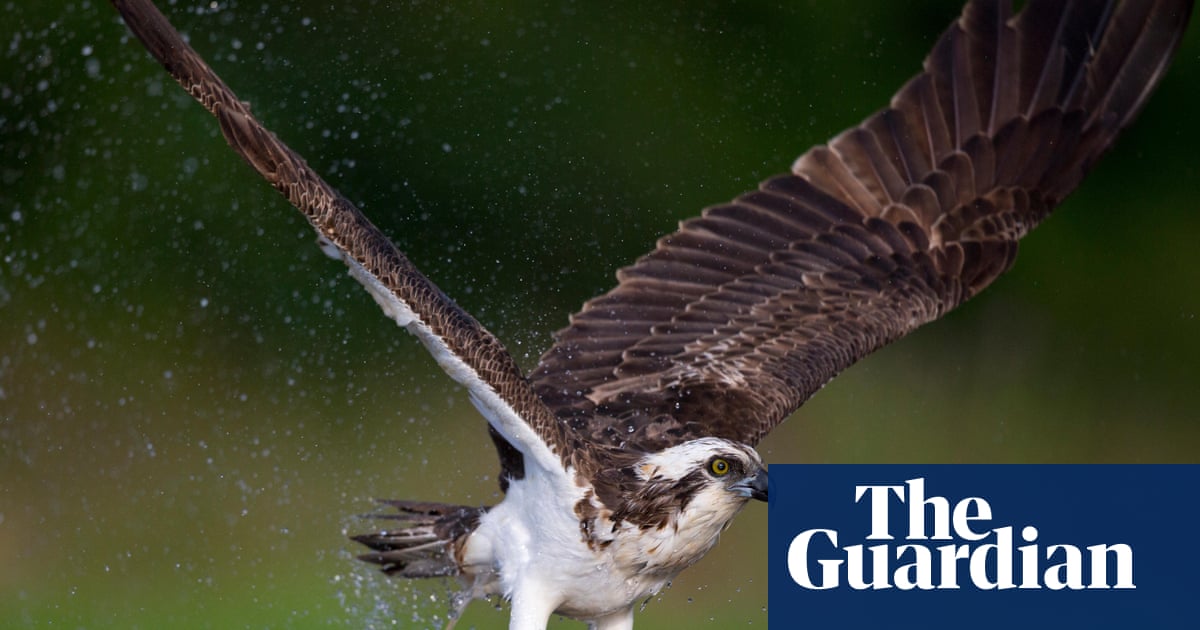
An osprey stopped at Chichester harbour to hunt for sea bass during its migration south. The bird tried to catch fish, but local terns attacked it to protect their territory. The raptor eventually gave up and flew away. The author noted, "The harbour was merely a brief pause."
Chichester harbour, Hampshire: I witness a battle of wills as this magnificent raptor attempts to fuel up on sea bass, before it heads south on migration
The autumnal sunlight gilded the sea as our boat drifted off Fowley Island, a small, uninhabited tidal saltmarsh between Thorney Island and Hayling Island. A colony of grey seals lay sprawled along the intertidal mudflats, their size and prominent, sloping Roman noses making them easily distinguishable from the more lithe, cat-faced common seals that also inhabit the harbour.
Two sub-adults were tumbling and splashing in the shallows, play-fighting with the exuberance of puppies. They mouthed and nipped at each other's heads and necks, lunging and rolling over one another before disappearing beneath the waves, only to pop up again in a spray of water and resume their boisterous tussle. These playful interactions are a form of social bonding, but they also serve as a rehearsal for future dominance contests.
As we passed through the Sweare Deep tidal channel, the boat slowed to let us watch a flock of sandwich terns plunge‑diving for silvery bait fish driven to the surface by predatory sea bass. Glancing over my shoulder, I noticed a much larger bird approaching from the north. At a distance, it might have been mistaken for a black‑backed gull, but its long, crooked wings, bent at the "wrist" into a distinctive M shape, gave it away: an osprey, stopping off to fuel up on its migration.
As I called out to alert my boatmates, the osprey dropped feetfirst towards the water to snatch a fish from the surface. Spotting the intruder, the terns intercepted, banking and diving to disrupt its flight path, and the fish escaped its talons. Their relentless harassment left the osprey little opportunity to hunt. It circled and tried again, but when a tern struck its back with its sharp bill, the raptor gave up, flapping away on slow, shallow wingbeats.
Ospreys have made a remarkable recovery as a breeding species in Britain, but for this individual, the harbour was merely a brief pause on its journey south. As we puttered back to the marina, we passed an artificial nest platform installed in the hope of attracting these beautiful fish eaters to breed. I wondered whether, in some future spring, this osprey might return to establish a new breeding territory.