
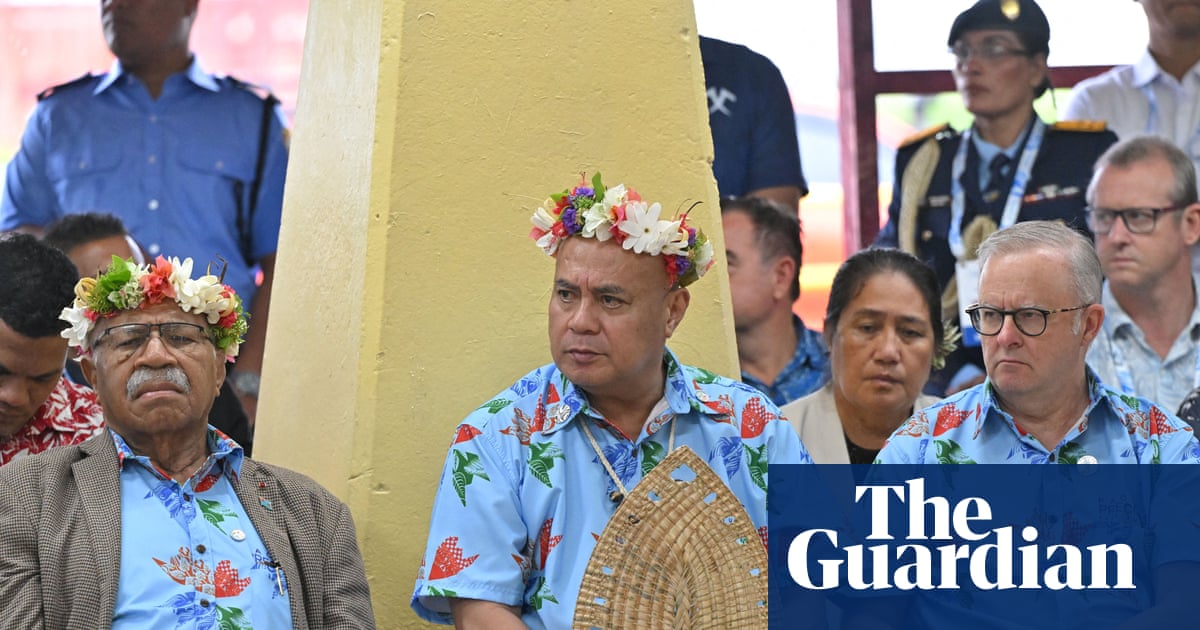
Pacific leaders gathered in Tuvalu to demand that the 2023 global agreement to transition away from fossil fuels remains firm. About 50 dignitaries visited the low-lying nation to highlight climate risks. Local student Melelusi Sokotia said, "We all have one single dream: to grow safely here in Tuvalu."
International leaders visit Tuvalu as part of climate talks co-hosted by Australia ahead of Cop31 conference
Pacific island leaders have urged a promised global transition away from fossil fuels must not be left open to renegotiation as they gather in tiny Tuvalu in a bid to build momentum before a major climate summit.
About 50 dignitaries - 14 national heads including Australia's Anthony Albanese, a list of climate change ministers and the heads of global agencies - flew to the low-lying atoll nation in a bid to bring attention to the plight of the countries most at risk from the climate crisis.
As a showcase for the remote Pacific promised by the Australian prime minister, Anthony Albanese, things could have gone more smoothly. Tuvalu was wet and grey, and the capital of Funafuti - spectacular from the air on a clear day - was visible only in strips between heavy rain clouds during descent.
The visit was promised by the Albanese government last year as part of a compromise deal when it missed out on hosting the Cop31 conference. The event will be in Turkey next month; the Pacific is hosting a preparatory meeting, mostly in Fiji.
Speaking at a "saultalaga" - an exchange of views around a meeting table - at the end of a three hour visit, a string of leaders argued the world must stand behind a 2023 agreement, made at a UN summit in Dubai, to transition away from fossil fuels. More recently it has faced wavering support, with pushback particularly led by oil-producing nations.
Tuvalu is among a handful of countries most at risk from the climate crisis. A collection of three reef islands and six atolls, it is mostly less than 2m above sea level. About half its population of 10,600 live in a corner of Funafuti.
The visitors heard from Melelusi Sokotia, a 13-year-old local student. She said her friends dreamt of "becoming teachers, doctors, builders" but spent their lives wondering if their island would be safe to live on when they were adults. "We all have one single dream: to grow safely here in Tuvalu," she said. "We are not asking for peace. We are asking for help and partnership. Please work together to protect small islands like ours."
Fijian prime minister Sitiveni Rabuka said with the world on the brink of overshooting the goal of limiting global heating to 1.5C - agreed in the 2015 Paris agreement - and facing a super El Nino it must bring forward plans to cut emissions. "That is not radical. It is in line with our agreement, our obligation, and the scientific reality," he said. "The transition away from fossil fuels was agreed to by all of us in Dubai. It is not a new ask, and it is not open for renegotiation."
Tuvalu's prime minister, Feleti Teo, stressed island states needed faster access to global climate to deal with worsening extreme events. "Why should countries like Tuvalu take on more debt to protect ourselves from a climate crisis we need so little to cause? We should not have to borrow our way out of a crisis."
The visit came less than a week after an Australian state regulator approved the latest of more than 30 fossil fuel developments to have been given the greenlight in the country in less than five years.
Albanese, attending his first UN climate conference as prime minister since his election in 2022, said the message from the Tuvalu trip was that "climate change must be understood as being something more than about science or targets".
"It must be understood that effectively it's about people, is what it comes down to," he said. "And the impact on humanity. The perspective of elders reminds us of what must be protected - the knowledge, the identity, the traditions, and the culture pass from one generation to the next."
After being greeted by a cultural ceremony, the leaders were shown a land reclamation project to extend space for homes and infrastructure by about 20 hectares using sand and gravel dredged from the lagoon inside the atoll. Overseen by the UN Development Program and partly funded by the Australian government, the project is a race against time.
Tuvalu's director of climate change, Jamie Ovia, said the flooding risk was worsening, with the likelihood of what was once a 100-year-flood increasing as the sea level rose. Projected sea level rise this century could increase the annual economic damage from flooding and storm surges to US$34m a year by 2050 and $63m - more than Tuvalu's GDP - by 2100.
He said the coastal fishing catch could be cut by 16% and tuna stocks worth $4m a year to the local economy could be lost as the seas warmed and species moved away from the atoll nation.
"We need time to adapt," Ovia said. "Tuvalu is doing our part. Will you act with Tuvalu and will you act in time?"