
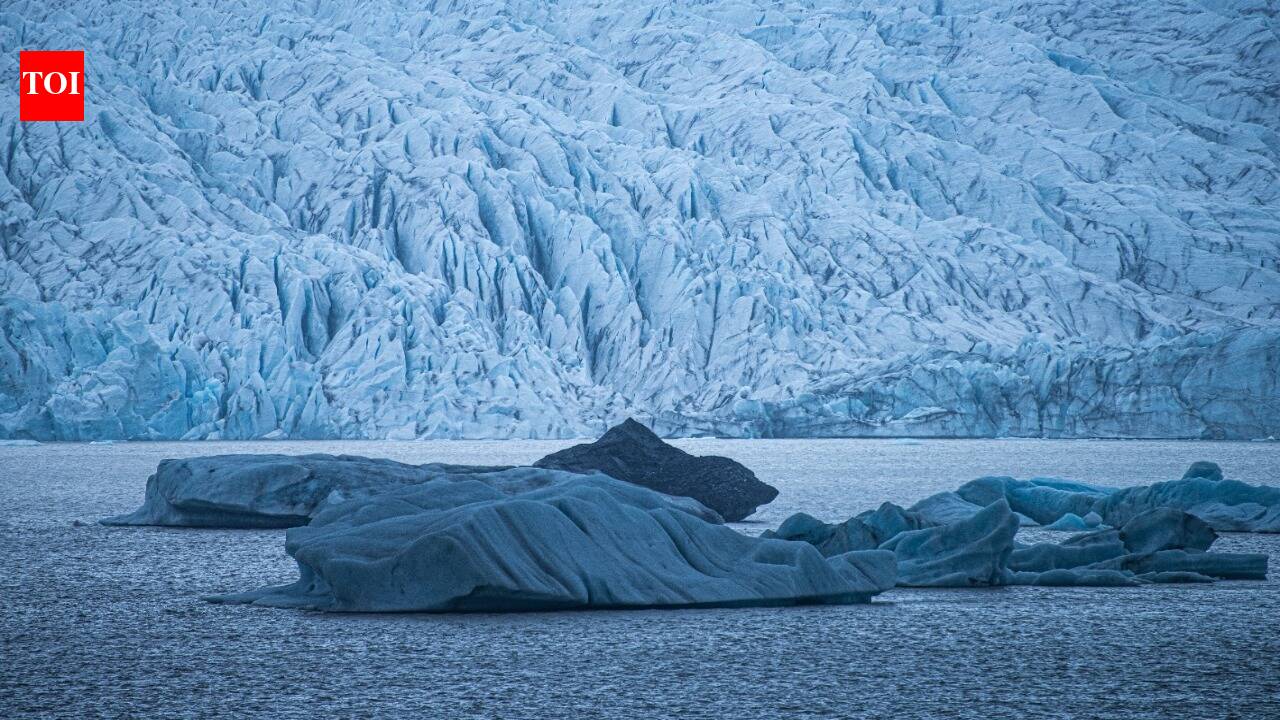
The National Snow and Ice Data Center now holds 1.5 million images of glacier retreat captured over 15 years. Photographer James Balog started the Extreme Ice Survey in 2007 to track climate change. He used solar-powered cameras across the world to show how ice fell away in remote frozen environments.
Representative image of a glacier. (Image Credits: Pexels).
An extensive collection of 1.5 million images in time-lapse chronicling 15 years of global glacier retreat has been officially preserved and archived at the National Snow and Ice Data Center (NSIDC). James Balog, an environmental photographer and mountaineer, founded the Extreme Ice Survey (EIS) in 2007. The project aimed to capture the physical impacts of climate change in real-time across the world's most remote frozen environments. The massive repository was transferred via a physical hard drive to the NSIDC server systems at the University of Colorado Boulder. Now the project is a public domain research resource for glaciologists and climate scientists worldwide. Balog’s massive visual census is an expansion of his earlier works, documenting deforestation and endangered wildlife during his global travels. After hearing from others about weather changes, he discerned that the real story was to be found in the ice. With his background in earth science and master’s degree in geomorphology from the Institute for Arctic and Alpine Research (INSTAAR), he felt equipped to track changes in the cryosphere. Balog drew inspiration from photojournalists Robert Capa and W. Eugene Smith, who exposed societal crises, and hoped to bring the same focus to the natural world.The evolution of continuous time-lapse photography The blueprint for the project was conceived during a 2005 assignment for The New Yorker in Iceland, where Balog was taking pictures of crumbling glacial termini (the locations where glaciers meet land or open water). He realized that static single-frame photography wasn’t enough to capture the continuous structural ice loss, leading him to come up with an automated, long-term monitoring system. In partnership with leading glaciologists Tad Pfeffer and Jason Box, he began building time-lapse systems that were encased in custom boxes and powered by solar arrays and car batteries. The technical construction initially occupied Balog’s residential garage, where his family provided assistance. His wife, Suzanne, and daughters, Simone and Emily, were all supportive, with his six-year-old daughter Emily assisting with pieces of equipment like turnbuckles. While Balog’s initial plan was to place 25 time-lapse cameras near the glaciers, the project expanded into a network of 70 cameras stationed in Alaska, Iceland, Greenland, Nepal, Austria, Antarctica, Canada, South Georgia Island and Glacier National Park in Montana. Each camera was programmed to take pictures of glaciers continuously around the clock for months and even years. This helped in creating an extensive database of physical changes on nearly every observed glacier.
Representative image of a photographer capturing glacier. (Image Credit: Pexels)
The painstaking task of archiving and its challenges When Balog initially approached NSIDC while the project was ongoing, talks fell through because he wanted to put a restriction on access for education and non-profit use. Following the conclusion of field operations in 2022, Balog circled back to the institution and agreed to an open science framework. However, transferring the data proved difficult from the start because Balog’s team lacked the bandwidth to push 1.5 million images to NSIDC’s servers and directories were too large; what they needed was funds. Donna Scott, programs and projects lead, secured endorsements from the science team, and director Mark Serreze and Jennifer Kay, a CIRES associate director, stepped up to contribute funding. The transfer then happened by hand in a parking lot, where Scott was handed a military ammunition box containing Balog’s hard drive of 1.5 million images from the EIS project. Once the drive arrived, a dedicated team spent 60 hours downloading, reconciling and organizing the images, including removing more than 200,000 duplicate files. Reflecting on the data transfer, Balog said he wanted to show future generations that some people were paying attention.