
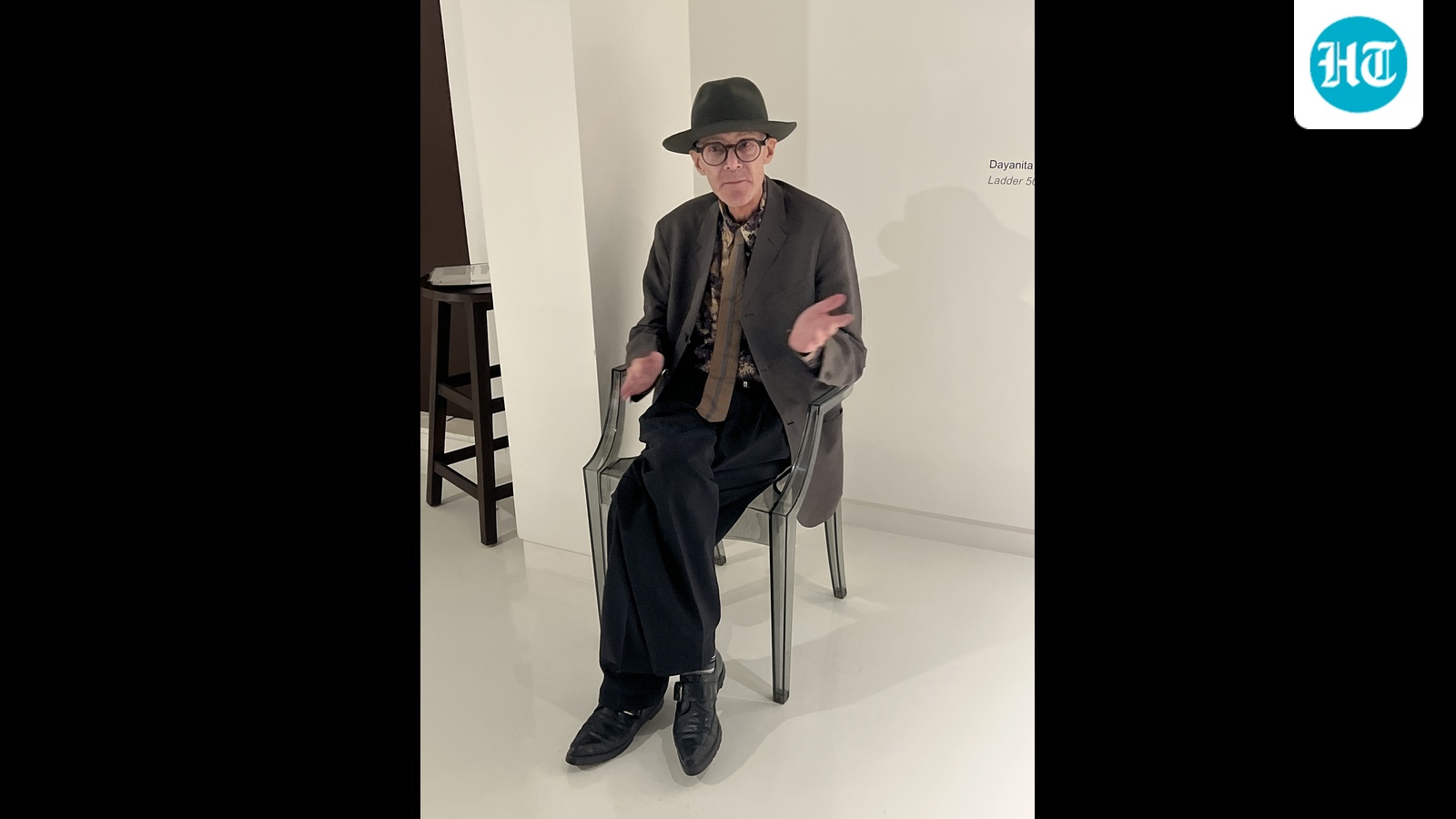
Nature Morte gallery moved to a new permanent home at A9 Gulmohar Park after 30 years. The first show, The Evolution of the Soothsayer, features 35 artists. Peter Nagy said, "The artist is predicting their own future." This exhibition reflects on how contemporary artists work in a world changed by technology.
Instead of making art, Nagy spent much of that year in libraries and meeting artists, teaching himself about Indian modern and contemporary art. He eventually stayed for five years, travelling around the country and meeting artists before deciding to start a gallery. When Nature Morte began in 1997, Delhi was not necessarily the obvious choice. Nagy was advised by people including Geeta Kapur and Vivan Sundaram to start in Bombay (now Mumbai), where the contemporary art scene was already more developed. But he saw an opportunity in Delhi precisely because less was happening there.
30 years after opening in Delhi, one of the city's best-known galleries has moved into a new permanent home at A9 Gulmohar Park, a two-storey building with a rooftop terrace. The first show at the new venue, The Evolution of the Soothsayer, is a two-part exhibition that brings together 35 artists from across the gallery's three-decade history.
Peter Nagy, the founder of Nature Morte, does not see the exhibition simply as an anniversary show. For him, it is a way of looking at where the artists, and the gallery, find themselves now. The title sounds grander than Nagy himself makes it. A soothsayer is a fortune teller, someone who claims to see what is coming. But Nagy is not talking about the gallery trying to predict the future. "I'm not talking about the galleries. I'm talking about the artist," he says. "The artist is predicting their own future." The idea, he explains, is that when an artist finishes one work, they are already thinking about what comes next.
That feels like a useful way into the exhibition. Rather than presenting a history of Nature Morte, the show brings together artists from different generations and practices. There are paintings, sculpture, photography, installation and new media, and some of the works seem to be in conversation. The gallery describes the exhibition as a reflection on the changing position of the contemporary artist in a world transformed by globalisation, identity politics and digital technologies.
Part One, on view until October 10, includes the work of Abir Karmarkar, Alicja Kwade, Ayesha Singh, Basist Kumar, Bharti Kher, Dayanita Singh, Dhruvi Acharya, Manish Nai, Manisha Parekh, Mark Prime, Murari Jha, Pushpamala N, Remen Chopra van der Vaart, Sagarika Sundaram, Srishti Rana Menon, Thukral & Tagra and Vandana Kothari. Part Two, which will open on October 17 and run until December 12, will bring together Aditya Pande, Bharat Sikka, Jitish Kallat, Kamrooz Aram, LN Tallur, Martand Khosla, Mona Rai, Neeraj Patel, Nidhi Agarwal, Olivia Fraser, Parul Gupta, Ramakrishna Behera, RN Palaniappan, Raqs Media Collective, Reena Saini Kallat, Subodh Gupta, Vibha Galhotra and Zimbiri.
Walking through The Evolution of the Soothsayer: Part 1, the viewer notices that the variety is the point. Dayanita Singh's Time Capsule uses fabric-wrapped photographic bundles to think about memory, hidden histories and the passage of time. Sagarika Sundaram's Interference occupies the space in a very different way, while Manisha Parekh's Swing and Float-1 turns material and form into something lighter and more open. Abir Karmarkar's large West wind and Dhruvi Acharya's consume 5: all the signs were there bring painting back into the conversation, but neither feels like a retreat into conventional painting.
That mixture is very much part of Nagy's history with the Indian art scene. He first came to India in 1990 as a tourist, travelling the familiar route through Delhi, Agra, Jaipur, Udaipur and Bombay. At that point, he says, he knew almost nothing about modern or contemporary Indian art. He returned to live in India for a year, spending time at the Faculty of Fine Arts in Baroda and at the Kanoria Centre for Arts in Ahmedabad, after artist Bhupen Khakhar helped arrange residencies for him.
Instead of making art, Nagy spent much of that year in libraries and meeting artists, teaching himself about Indian modern and contemporary art. He eventually stayed for five years, travelling around the country and meeting artists before deciding to start a gallery. When Nature Morte began in 1997, Delhi was not necessarily the obvious choice. Nagy was advised by people including Geeta Kapur and Vivan Sundaram to start in Bombay (now Mumbai), where the contemporary art scene was already more developed. But he saw an opportunity in Delhi precisely because less was happening there.
He remembers meeting Vivan Sundaram, Anita Dube, Dayanita Singh, Bharti Kher and Subodh Gupta in Delhi, and Jitish Kallat and Rummana Hussain among others in Bombay. What interested him was that artists in India were beginning to work with ideas that had become important in New York during the 1980s -- appropriation, reused imagery, photography and the mixing of media -- but in the very different context created by India's economic liberalisation.
This became one of Nature Morte's early contributions: putting photography, video and installation alongside painting at a time when the market was still heavily dominated by painting. Nagy remembers photography as the big surprise. He had already been deeply involved with photography in New York in the 1980s, so seeing artists such as Dayanita Singh and Anita Dube working with photography in India did not seem radical to him. What surprised him was how radical the work was considered here.
The market eventually caught up. Newspapers and magazines began explaining to collectors how photography could be collected -- editions, signed prints and different photographic processes -- and, according to Nagy, that helped create a stronger market for the medium in the early 2000s. But there is an important distinction in how he describes his job. He did not want to show work simply because it could sell. "You show things because you're going to create a context," he says. "And you're going to create a buzz and make people excited at what you're showing. And then you sell what you can sell."
That attitude remains visible in the anniversary exhibition. It is not a parade of guaranteed crowd-pleasers. The point is to show the breadth of the gallery's programme and the different ways its artists have developed over time. Nagy says he and Nature Morte director Aparajita Jain deliberately wanted the exhibition to be as inclusive as possible. They worked through three generations of artists and tried to balance the two chapters across generations and mediums. The result is a conversation between artists who have been with the gallery for decades and artists who joined much more recently.
The change in the Indian collecting scene is another part of that story. Nagy recalls that during the Indian art boom of the early 2000s, many of his collectors were European. That market has moved on, with European attention now strongly focused on African art and American collectors increasingly looking at African American artists. In India, meanwhile, he sees a younger collector class emerging -- people who have studied or worked abroad, returned to India and are more comfortable taking risks. He says Aparajita Jain, daughter of Borosil chairman Pradeep Kheruka, has played an important role in building relationships with this generation, particularly younger business families commissioning large, site-specific works for new corporate and private spaces.
So, what is Nagy looking for now? His answer is almost disarmingly straightforward: good work. He says he would actually have been surprised if Indian contemporary art had not developed to the level it has, given the depth and range of the country's culture. His basic criteria have not changed; he wants artists dealing seriously with ideas, artists who can stay with a subject and investigate it over time. But he also wants craftsmanship. The work has to be well made and be able to survive. "It's two sides of the coin," he tells me. "The artist is still a craftsperson."
That may be the simplest way to understand both Nature Morte's past and this new chapter. The gallery has changed addresses, generations of collectors have changed, mediums have multiplied and the Indian art world has become far more international. But Nagy's basic test remains invariably uncomplicated: is the work serious, well made and worth spending time with? The new Gulmohar Park space is intended as a place to build the next 20 years for the gallery. And perhaps that is why the soothsayer in the title is the artist rather than the gallerist. The gallery can provide the space, the context and the audience. The real prediction still has to come from the artists themselves.
Nawaid Anjum is an independent journalist, translator and poet. He lives in New Delhi.