
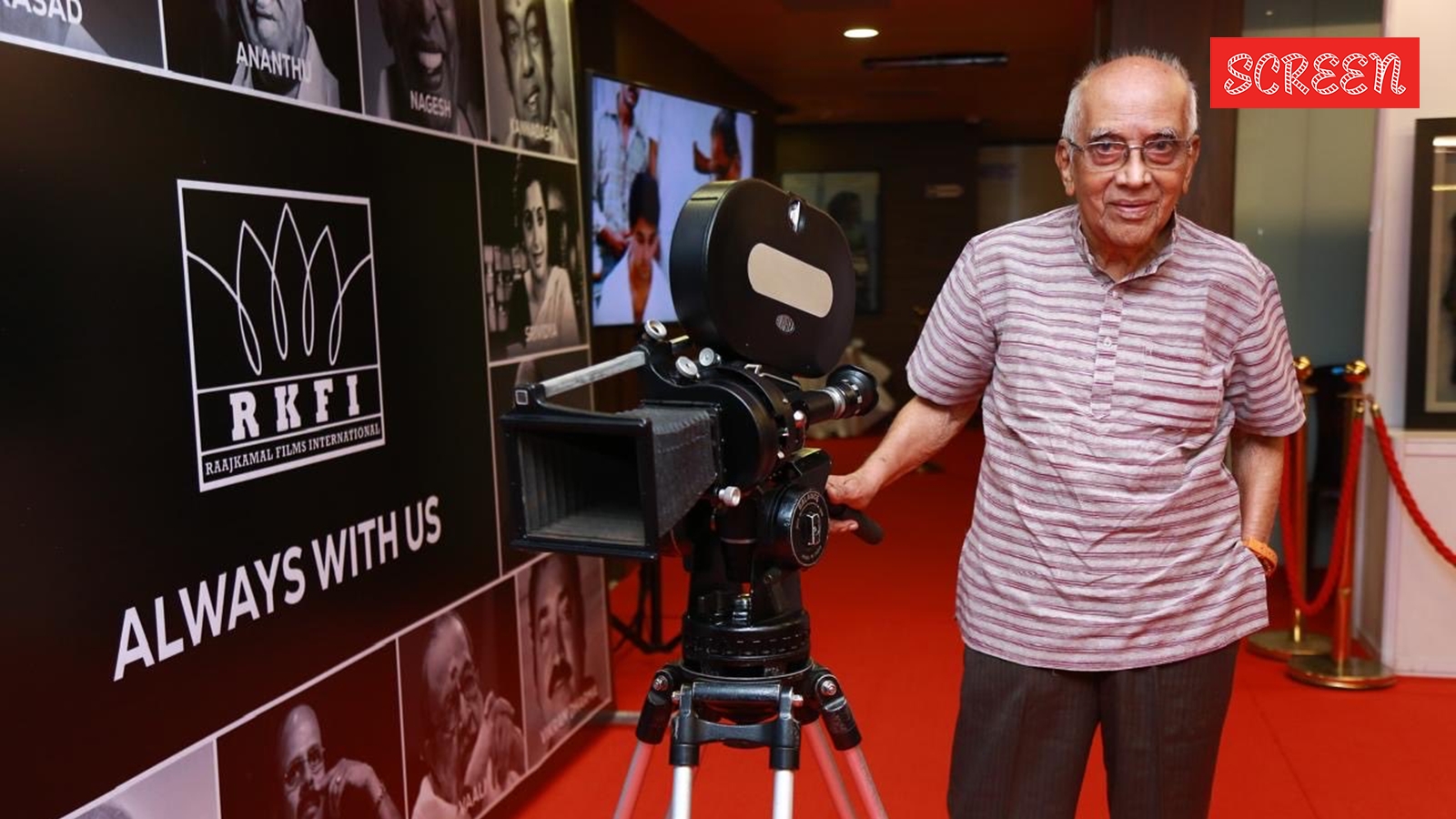
സംഭാഷണങ്ങളില്ലാത്ത ചിത്രം മുതൽ ടൈം മെഷീൻ പ്രമേയമാക്കിയ സിനിമ വരെ ഒരുക്കിയ സിംഗീതം ശ്രീനിവാസ റാവു ഇന്ത്യൻ സിനിമയിലെ പകരം വെക്കാനില്ലാത്ത പ്രതിഭയായിരുന്നു. ആറ് പതിറ്റാണ്ടോളം നീണ്ട കരിയറിൽ അഞ്ച് ഭാഷകളിലായി പരീക്ഷണങ്ങൾ മാത്രം നടത്തിയ അദ്ദേഹം, പുഷ്പക വിമാനം പോലുള്ള വിസ്മയങ്ങളിലൂടെ ഇന്ത്യൻ സിനിമയുടെ ചരിത്രത്തിൽ തന്റേതായ ഒരിടം എന്നെന്നേക്കുമായി അടയാളപ്പെടുത്തി.
The easiest way to understand what Singeetham Srinivasa Rao meant to Indian cinema is to list what he did and then try to find another filmmaker who did the same.
He made a film without dialogue. He made a film with a time machine. He made a film set on a mythical island ruled by a sorcerer. He made a film about a classical dancer who lost her leg and returned to the stage. He made a film where the comedy was entirely physical, entirely visual, entirely dependent on the audience's ability to follow a story through images alone. And then, at 94, he made one more film because he was not done.
Find another Indian filmmaker who did all of this. Not one of these. All of these. Across five languages. Across six decades. Without a single repetition.
You will not find one. Because there is no one else. Singeetham Srinivasa Rao, who died at Kauvery Hospital in Chennai on Saturday night at the age of 94, was not merely an experimental filmmaker. He was the filmmaker against whom every other attempt at innovation in Indian cinema must be measured, and one who, measured against anyone else, invariably comes out ahead.
The experiment nobody believed in
The story of Pushpaka Vimanam is the story of Singeetham Srinivasa Rao in miniature. A filmmaker walks into a room and says: I want to make a film with no dialogue. Not a silent film. A film with sound, music, ambient noise, everything except spoken words. The story will be told entirely through images.
In 1987, this was not a pitch that anyone wanted to hear. Indian cinema, in every language, was built on dialogue. Take away dialogue, and you take away the scaffolding that the entire commercial film industry stood on.
Singeetham Srinivasa Rao could not find a producer. Nobody wanted to fund a film that could not be marketed with a single quotable line. So he produced it himself, partnering with Shringar Nagaraj, a Kannada producer who was willing to take the risk. The idea for the film came to Singeetham while he was in the shower. He wrote the screenplay in two weeks.
The result was a black comedy starring Kamal Haasan, Amala and Tinnu Anand that told a complex, funny and emotionally engaging story without a single word being spoken on screen. Because there was no dialogue, the film did not need dubbing. It was released simultaneously across all Indian languages under different titles: Pushpaka Vimana in Kannada, Pushpaka Vimanam in Telugu, Pushpak in Hindi. Same film. Same audio track. Every audience understood it.
The film won the National Film Award for Best Popular Film Providing Wholesome Entertainment.
The time machine nobody expected
Four years later, Singeetham Srinivasa Rao did it again. This time, the experiment was science fiction.
The film was presented by S.P. Balasubrahmanyam, the legendary playback singer who was also Singeetham Srinivasa Rao's frequent collaborator. The combination of talents was extraordinary, but the concept was the real risk. In 1991, Telugu cinema was defined by family dramas, action films and romantic comedies. Science fiction was not a genre anyone believed the audience would accept. However, they accepted it. The film that proved the audience was willing to go wherever the filmmaker took them, as long as the maker knew where he was going. Singeetham always knew.
Thirty-five years later, time travel is a common device in Telugu cinema. The lineage traces back to Aditya 369 and, by extension, to a filmmaker who read HG Wells in a Madras university library and decided that Telugu cinema deserved a time machine.
The fantasy world nobody had built
Bhairava Dweepam was the third experiment in three consecutive decades, each in a different genre, each doing something Indian cinema had not done before.
The film, starring Balakrishna, was a high-fantasy adventure set on a mystical island ruled by a malevolent sorcerer seeking immortality. It drew from Indian folklore, mythology and adventure storytelling to create a world that was entirely self-contained: its own geography, its own rules, its own visual language. The screenplay was co-written with Raavi Kondala Rao, one of Telugu literature's most respected writers, and produced under the Chandamama Vijaya Pictures banner.
In 1994, Indian cinema did not make high-fantasy films. The genre was considered too expensive, too risky and too unfamiliar for audiences raised on realism-adjacent commercial cinema. Singeetham Srinivasa Rao ignored all of that. He built the island. He populated it with wizards, warriors and magical creatures. He created set pieces that were elaborate by any standard, let alone the standards of a mid-budget Telugu film in the early 1990s.
Bhairava Dweepam completed a 100-day theatrical run in 28 centres. It proved a full two decades, before Baahubali made high fantasy commercially viable on a massive scale, that Telugu audiences were ready for mythology, magic and world-building. They just needed a filmmaker who was willing to try.
The biography that changed lives
Before the dialogue-free comedy, before the time machine, before the fantasy island, there was Mayuri. The film that made Singeetham Srinivasa Rao's name and, in the process, changed a young woman's life.
Mayuri was inspired by the true story of Mumbai-based Bharatanatyam dancer Sudha Chandran, whose right leg had to be amputated after she was injured in a road accident in Tamil Nadu in 1981. Doctors fitted her with a Jaipur foot prosthetic, and Chandran returned to the stage, performing classical dance with an artificial limb. Singeetham saw the story and knew it was a film. Sudha, who had never acted, played herself.
The film was a critical and commercial triumph. It was remade in Hindi as Naache Mayuri with the same cast. It launched Sudha Chandran's career as a film and television actress, a career that continues to this day. And it demonstrated that Singeetham could take a real-life story, handle it with sensitivity and turn it into a mainstream film without compromising either the story's truth or the audience's entertainment.
The Tamil connection
Singeetham Srinivasa Rao's versatility extended beyond genres to languages. While Telugu was his primary language, his Tamil filmography includes some of the most significant films in that industry's history.
Anand, a romantic comedy starring Kamal Haasan and Revathi, was a commercial hit that was later remade in multiple languages. His collaboration with Kamal on Pushpaka Vimanam remains one of the most critically acclaimed actor-director partnerships in South Indian cinema. Magalir Mattum was a Tamil film that addressed women's issues. He also worked in Kannada, Malayalam and Hindi, making him one of the very few Indian filmmakers to direct films in five languages.
The question that lingers after reviewing Singeetham Srinivasa Rao's filmography is: why did nobody else attempt what he did?
The answer is not that other filmmakers lacked talent. It is that they lacked the specific combination of traits that Singeetham Srinivasa Rao possessed: technical knowledge deep enough to execute his ideas, creative ambition wild enough to conceive them, and a stubborn indifference to whether the market was ready for them.
Most filmmakers work within genres. They find what works and refine it. They make action films, or comedies, or romances, and they get better at making those specific things over time. Singeetham never did this. Each one of his films was a fresh start. Each one required learning a new visual language, a new set of production challenges and a new way of engaging with the audience.
The commercial film industry does not reward this behaviour. It rewards consistency, predictability and brand identity. Singeetham Srinivasa Rao offered none of these. He offered surprise. And surprise, while thrilling for the audience, is terrifying for the people who invest money in films. The fact that he continued to find producers willing to back his experiments, decade after decade, is itself a testament to the power of his track record.
The last experiment
In February 2026, at the age of 94, Singeetham Srinivasa Rao announced his return to directing with Sing Geetham, a musical fantasy that marked his first film in over a decade. The project was produced by Nag Ashwin, the director of Kalki 2898 AD.
Sing Geetham was completed. It was released. And it was the work of a man who, at an age when most people have forgotten what ambition feels like, walked onto a set and made one more film. Because he had one more story to tell. Because cinema was not something he did, it was something he was.
The measure of the man
Singeetham Srinivasa Rao's career cannot be reduced to awards, it can only be understood as a body of work that is unlike any other in Indian cinema. Not because every film was a masterpiece, but every film was an attempt to do something that had not been done before.
Indian cinema has produced filmmakers who are more commercially successful. It has produced filmmakers who are more critically acclaimed. It has produced filmmakers who are more consistently brilliant. But it has not produced another filmmaker who spent 54 years refusing to make the same film twice, who treated every project as a first film, who looked at the boundaries of what Indian cinema could do and, every single time, decided to step past them.
Singeetham Srinivasa Rao did not push boundaries. He made the films he wanted to make, in the way he wanted to make them, for 54 years. And then, at 94, he made one more. Because one more was still not enough. That is not experimentation, that is devotion. And Indian cinema will not see its like again.