
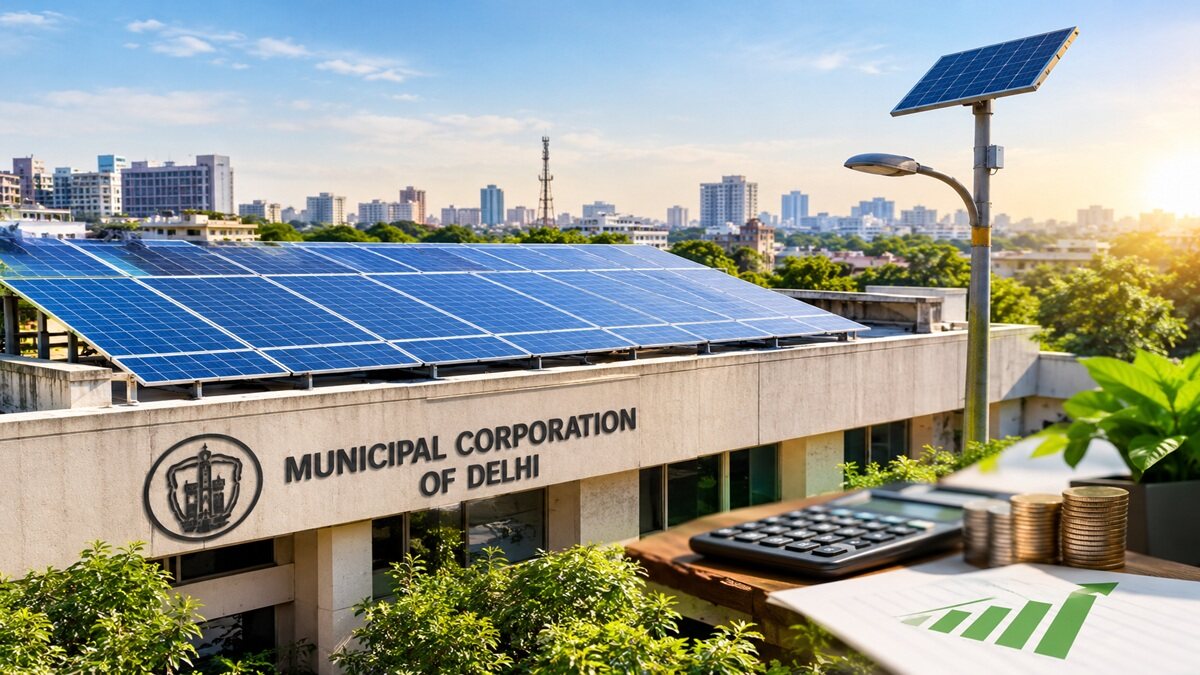
The MCD plans to install solar panels on 1,100 civic buildings under the Delhi Solar Energy Policy, 2023. Officials said the arrangement ensures "no direct capital expenditure" for MCD. IPGCL will manage the systems, while the civic body pays only for the electricity it uses to cut down huge bills.
Under the Delhi Solar Energy Policy, 2023, state power generation company, Indraprastha Power Generation Company Limited (IPGCL), will study feasibility, install the panels and run the systems, while MCD will simply pay for the electricity it uses. The move is designed to cut the civic body's huge electricity bill, shift the financial burden away from MCD, and turn municipal rooftops into a city-wide solar network.
A money-smart model: Who pays, who benefits?
The core of the plan is its financing structure. Officials say the arrangement ensures "no direct capital expenditure" for MCD, as IPGCL and third-party firms will fund and maintain the solar plants.
For smaller systems (up to 25 kW), IPGCL will install under a CAPEX model and provide five years of free maintenance.
For larger systems, the RESCO (Renewable Energy Service Company) model will be used, where a third party sets up, operates and maintains the plant, and MCD buys the power at a pre-agreed tariff.
Under RESCO, "the client does not own the plant. It buys the power at a pre-agreed tariff for a fixed term, typically under a power purchase agreement (PPA) or a lease." This "shifts the burden of financing, installation and upkeep from the consumer to the service provider" and removes heavy upfront costs.
The Delhi government (through IPGCL) bears the capital and long-term operational costs, while MCD avoids large one-time investments and instead pays a predictable rate per unit of solar power consumed.
From 574 plants to 1,100 more: Scaling up existing solar capacity
MCD is not starting from zero. According to official documents, the civic body has already installed 574 rooftop solar photovoltaic plants with a combined capacity of 13.25 MWp across its properties.
The existing installations are distributed as:
* 399 plants on buildings of the erstwhile South Delhi Municipal Corporation.
* 164 plants on school buildings of the former North Delhi Municipal Corporation.
* 10 plants on properties of the erstwhile East Delhi Municipal Corporation.
Now, structural and feasibility assessments have identified another 800 to 900 municipal buildings that could potentially host grid-connected solar systems. IPGCL has already awarded tenders covering nearly 2,600 government buildings, including around 1,100 MCD properties, under the state Department of Power's directive to implement solar projects on all feasible government and civic properties.
Group net metering: Using surplus solar to cut the power bill
A key money-saving feature of the plan is Group Net Metering. This allows surplus power generated at one municipal building to be adjusted against electricity consumption at another MCD building within the same distribution company area.
Officials explain that "any annual surplus electricity will either be carried forward or credited at the average power purchase cost of around Rs 5 per unit, potentially helping reduce the civic body's electricity expenditure."
For ex- If a school or office generates more solar power than it uses, the extra units are fed into the grid. Those surplus units are then credited against MCD's overall electricity bill, effectively lowering what the corporation pays for power from the grid.
This is especially useful for a large consumer like MCD, which runs thousands of facilities with different usage patterns. Some buildings may produce more solar than they consume during the day, while others (like hospitals or night-shift offices) may use more. Group net metering lets MCD balance this internally instead of losing surplus generation.
Dropping a separate tender: Aligning with Delhi's solar policy
The approval also means MCD will drop its earlier plan to float a separate tender for rooftop solar projects and instead adopt the state power department's framework. This avoids duplication, speeds up implementation and plugs MCD into a larger pipeline of government solar projects already being executed by IPGCL.
Under the Delhi Solar Energy Policy, 2023, IPGCL is tasked with implementing solar projects on all feasible government and civic properties. By joining this umbrella programme, MCD benefits from standardized processes, bulk procurement advantages and established contracts, which can help bring down tariffs and execution time.
What MCD will still have to do
While the heavy financial and technical load shifts to IPGCL and third-party RESCO firms, MCD is not completely off the hook.
The civic body will remain responsible for:
* Routine roof repairs and maintenance of its buildings.
* Providing basic access for installation work, including allowing surveys, cable routing and safe access to rooftops.
This division of responsibilities ensures that the solar operator can focus on generation and maintenance of the plant, while MCD continues to manage its civil infrastructure as usual.
For a cash-strapped civic body, electricity is one of the largest recurring expenses. By locking in solar power at a fixed tariff and using group net metering to offset grid purchases, MCD expects a visible reduction in its power expenditure over the long term. At an average credit rate of around Rs 5 per unit for surplus energy, even modest annual surpluses across hundreds of buildings can translate into significant savings.
The plan also supports Delhi's renewable energy and climate goals by adding rooftop solar without extra public spending, reducing the use of fossil-fuel-based power for civic services.