
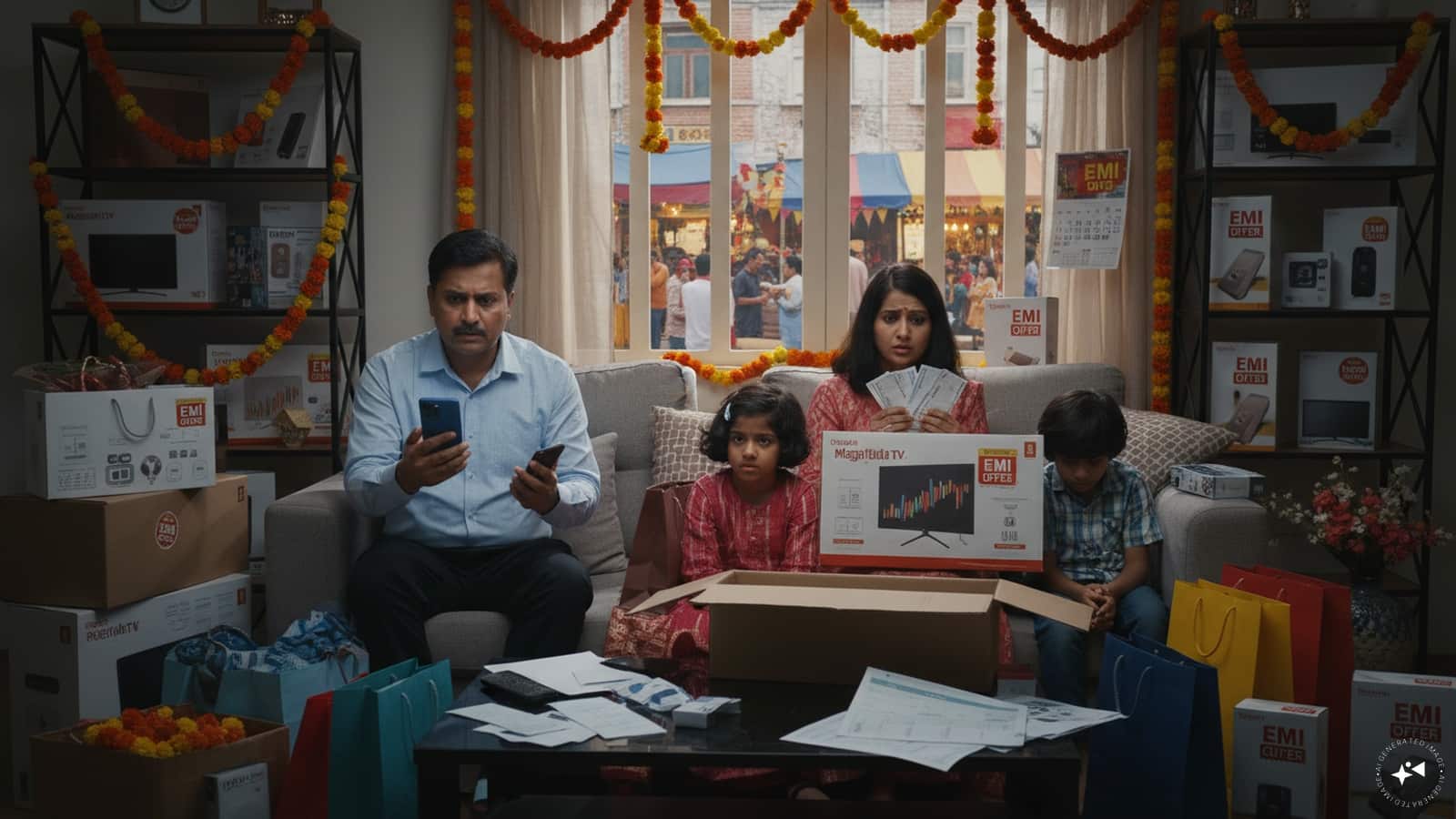
Amazon and Flipkart festive sales offer many easy credit options, but these can lead to a debt trap. Nikhil Singh Gangwar said, "If the total crosses 35-40 percent of monthly take-home pay, the purchase is not affordable." Borrowers should check their total EMI-to-income ratio before taking on new monthly payments.
With Amazon and Flipkart festive sales here, consumers are likely to come across deep discounts, instant-loan offers, credit card deals and no-cost EMI options that can make expensive purchases look affordable. A Rs 1 lakh smartphone, for instance, can be broken into a few thousand rupees a month. But when consumers already have home, car or credit card EMIs, adding more such monthly payments can quickly stretch household budgets and turn easy credit into a debt trap. Before opting for another EMI, consumers need to look beyond the monthly payment and assess whether their existing income can comfortably support the additional financial commitment. Check your EMI-to-income ratio Nikhil Singh Gangwar, smallcase manager and research analyst at Equivision Consulting, said consumers should first calculate their total EMI-to-income ratio. This should include home and car loans, credit card EMIs, pay-later dues and the proposed new EMI. "If the total crosses 35-40 percent of monthly take-home pay, the purchase is not affordable, however attractive the offer looks," Gangwar said. EMI-to-income ratio is not only the check. Consumers should also consider how comfortably they could continue making these payments if their financial circumstances change. Consumers should stress-test their finances before taking a new EMI. They should assess whether they can continue making payments if their income falls by 20 percent or an unexpected medical expense arises, without dipping into an emergency fund. Gangwar recommends maintaining an emergency fund covering at least six months of expenses and EMIs. He also cautioned consumers against budgeting for an EMI based on money that has not yet arrived, such as an expected bonus or salary increment. When multiple small EMIs become risky A debt trap does not necessarily begin with a large loan. Several small EMIs of Rs 2,000-3,000 can collectively become a sizeable monthly obligation. "Watch for signs such as paying only the minimum due on credit cards, taking a personal loan or a new card to service old dues, and using credit for routine expenses such as groceries and rent," Gangwar said. Experts say that cards repeatedly running close to their limits, missed payments, a falling credit score and not knowing the total outstanding debt across lenders are also warning signs. Adhil Shetty, CEO of BankBazaar, said borrowers should look at their overall debt burden rather than evaluating each EMI separately. "If repayments begin affecting essential spending or regular savings, further borrowing deserves careful reconsideration," he said. No-cost EMI is not necessarily free Consumers should also check the actual cost of financing before opting for no-cost EMI, credit card EMI or a personal loan. According to experts' card-based no-cost EMI schemes can involve interest that is offset through a merchant discount, while GST may still apply on the interest component along with processing fees. Consumers should therefore compare the total EMI outflow with the best upfront price, including any cash discount or cashback they may lose by choosing EMI. For personal loans, borrowers should compare the interest rate, processing fees, foreclosure or prepayment charges and repayment tenure. A lower EMI may simply mean a longer repayment period and a higher overall cost. Before buying during a festive sale, consumers should therefore look beyond the discount and ask a simple question: can the monthly payment comfortably fit into the budget even after accounting for existing debt and unexpected expenses? Disclaimer: The views and investment tips expressed by experts on Moneycontrol.com are their own and not those of the website or its management. Moneycontrol.com advises users to check with certified experts before taking any investment decisions.