
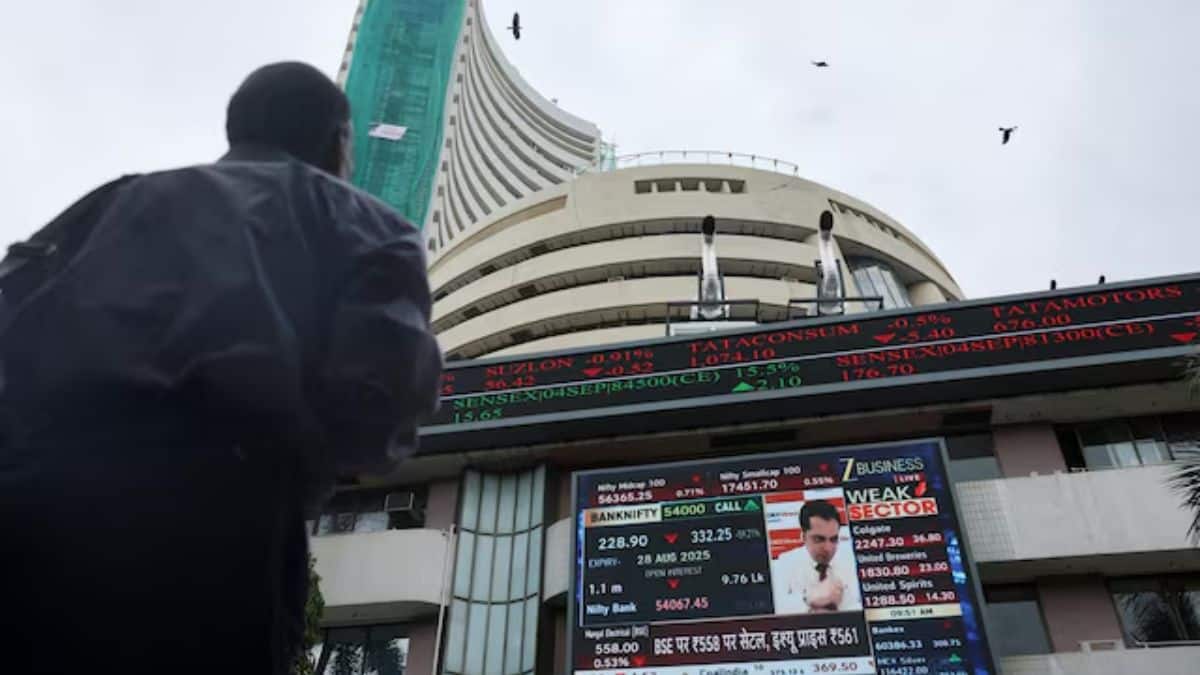
Indian equity markets faced heavy selling pressure on Thursday as the Sensex fell 1,045 points and the Nifty dropped 371 points. Investors reacted to the RBI’s shift toward tighter monetary policy, rising crude oil prices, and continued foreign fund outflows. These factors caused a sharp market rout throughout the trading session.
Indian equity markets witnessed heavy selling pressure on Thursday, with the Sensex plunging 1,045 points and the Nifty falling 371 points as investors reacted to the RBI’s shift towards a tighter monetary policy, a sharp rise in crude oil prices and continued foreign fund outflows.
The sell-off intensified through the trading session after the benchmarks opened mildly lower. The Sensex, which fell around 150 points at the open, eventually declined 1,045 points by the close. The Nifty also extended its losses from around 70 points at the opening to finish 371 points lower.
The sharp decline came a day after the Reserve Bank of India raised the repo rate by 25 basis points to 5.50 per cent and shifted its policy stance from “neutral” to “calibrated tightening”.
Here are five key factors behind Thursday’s market crash:
RBI’s rate hike and tighter policy stance
The biggest trigger for the market was the RBI’s policy decision on Wednesday.
The central bank raised the repo rate by 25 basis points to 5.50 per cent and moved its stance from “neutral” to “calibrated tightening”. While the rate hike was largely expected, the change in stance has raised concerns that monetary tightening could continue if inflationary pressures persist.
Higher interest rates can weigh on equity valuations by increasing borrowing costs and making fixed-income investments relatively more attractive.
The RBI has also flagged risks from elevated crude oil prices and tighter global financial conditions, adding to investor caution.
Crude oil surges above $104
A sharp rise in crude oil prices added to the pressure on Indian equities. Brent crude climbed nearly 4 per cent to around $104.09 a barrel as concerns over West Asia supply disruptions continued to support prices. For India, higher crude prices are particularly negative because the country remains heavily dependent on imports to meet its oil requirements.
Expensive crude can increase the import bill and put pressure on the rupee and fuel inflation. The latest oil surge has consequently strengthened concerns that the RBI may have to maintain a tighter monetary policy for longer.
Foreign investors continue to sell
Persistent selling by foreign institutional investors has emerged as another major drag on Indian equities.
FIIs sold Rs 6,121.37 crore in the cash market on Wednesday, following sales of Rs 2,961.30 crore on Tuesday and Rs 4,699.14 crore on Monday.
They had also sold Rs 9,484.22 crore on October 1, Rs 10,148.41 crore on September 30 and Rs 9,980.22 crore on September 29. Overall, foreign investors have pulled out around Rs 43,395 crore from Indian equities over the six trading sessions.
Rupee remains under pressure
The Indian rupee also remained under pressure amid elevated crude prices, foreign fund outflows and high US bond yields. The rupee was trading around 96.76 against the US dollar, close to its recent record-low levels.
A weaker rupee makes imported commodities such as crude oil more expensive and can add to inflationary pressures. Companies dependent on imported raw materials can also see their costs rise.
The combination of a weak currency, expensive oil and tighter monetary policy has therefore added another layer of uncertainty for investors.
Selling spreads across sectors
Thursday’s decline was broad-based, indicating that the sell-off was not restricted to a handful of stocks. The Nifty Metal index plunged 3.40 per cent, while Oil & Gas fell 2.60 per cent, Realty 2.68 per cent, Auto 2.01 per cent and Pharma 2.26 per cent. FMCG stocks declined around 2.02 per cent, while Healthcare fell 2.31.
GST Council meeting also on investors’ radar
Investors were also closely watching developments from the GST Council meeting, particularly measures that could affect consumption, corporate costs and government revenues.
However, the immediate pressure on Dalal Street remained centred on the RBI’s tighter policy stance, the surge in crude prices and sustained FII selling.