
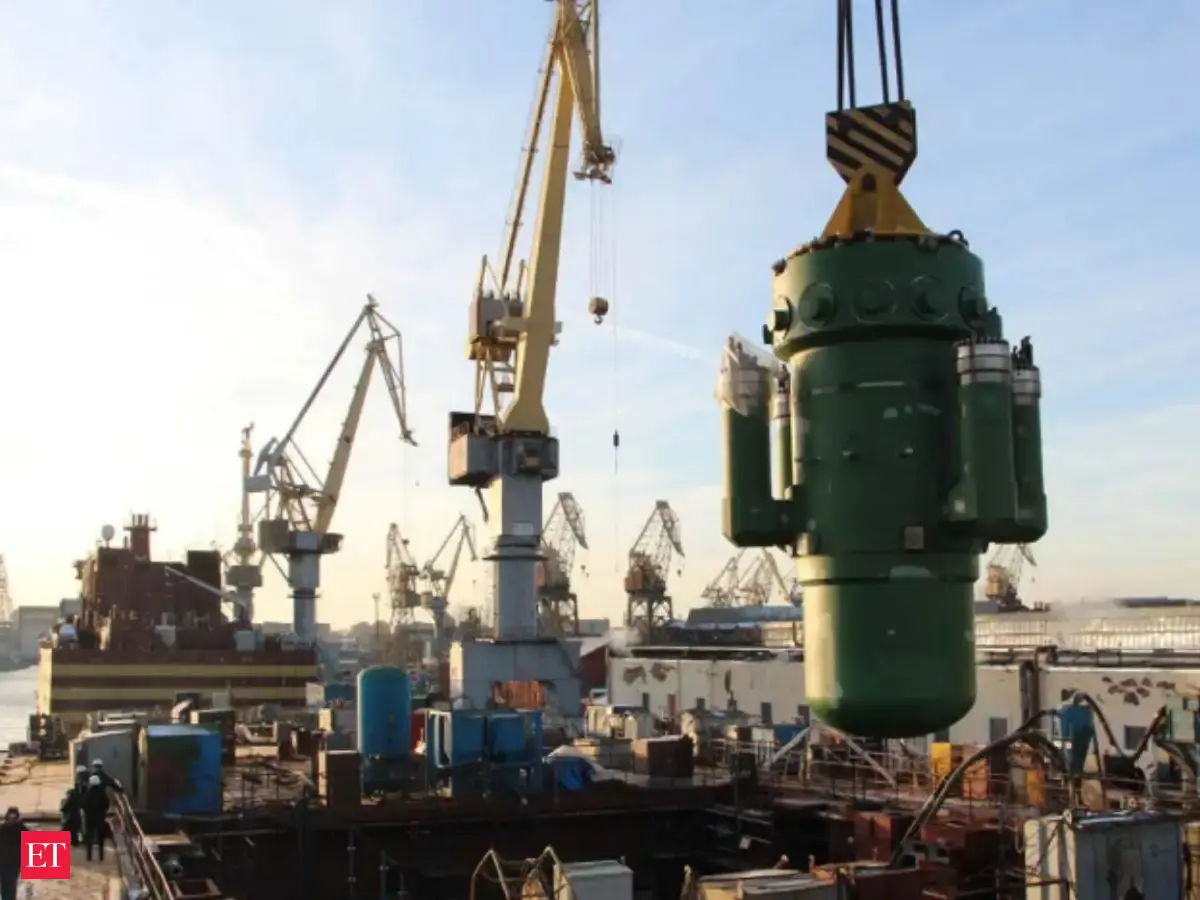
Russia completed 19,000 ton floating nuclear plant reactors to power a copper mine in Chukotka. Rosatom said, "in less than a year, four RITM units have already been manufactured." These reactors will sit on a large barge to provide electricity where no power grid exists in the harsh Arctic region.
In a groundbreaking initiative, Russia is developing four floating nuclear power plants to deliver energy to a copper mining operation located in Chukotka. With no established power grid in the vicinity, each plant will harness RITM-200 reactors to generate 106 megawatts. This project focuses on ensuring a stable energy supply, even amid harsh winter conditions, by strategically mooring the plant to cope with tidal movements and severe weather.
Russia has been building four floating nuclear power plants at the ZiO-Podolsk plant. The firm behind the project, Rosatom, announced in September that it has completed both the 58-megawatt reactors for the lead boat. The company had in May announced that it had finished the first RITM-200S reactor in May.
The floating nuclear power plant will be used to power power mines and a new port in the Chukotka Autonomous Region. The region is the easternmost territory of Russia.
The boat is supposed to be an upgraded version of the Akademik Lomonosav, according to the Global Construction Review. The Akademik Lomonosav began commercial operations in May 2020 and is equipped with two 35-megawatt reactors. It has fed a small Arctic grid since then.
The first reactor has already crossed Russia. The reactor reached the Baltic Shipyard in ST. Petersburg. It is now waiting to be lowered into the hull.
The barge is estimated to weigh about 19,000 tons, will be 140m long and 30m wide. The hull of the nuclear plant is a PEB-106. It will be a 459-foot barge, 98 feet across and has no engine of its own.
Floating power plant to be powered by RITM-200 reactorsThe RITM-200 reactors which will be placed on it will each generate 58 megawatts of electricity. The power plant will hence generate 106 megawatts. The reactors have a new generation pressurized water design.
The RITM-200 reactor, which was completed in May was the eleventh so far manufactured at the ZiO-Podolsk plant. The plant is part of Rosatom's machine-building division.
The director of the Zio-Podolsk plant, Anton Lebedev, in an announcement had said that, "in less than a year, four RITM units have already been manufactured". He added that five more are in production currently.
These particular reactors were not designed for mining camps initially. The reactors were built to power Russia's nuclear-powered icebreakers. Currently eight such icebreakers are operating aboard the Arktika, Ural, Sibir and Yakutia.
An icebreaker reactor does completely different operations than one in a mine. It boosts to full power when the ship smashes into packed ice sheets, and then cools down when there is no need for the push. A mine on the other hand requires the opposite. The reactor needs to produce a flat output all the time. Hence the mine reactors run at 198 thermal megawatts in comparison to the icebreakers, which run at 175.
Power plant is headed to a copper mine The barge is headed for the Baimskaya project in Chukotka. The region lies across the Bering Strait from Alaska. Baimskaya is one of the largest un-touched copper deposits on Earth. The region sees some brutal winters and has no power grid to connect into.
To solve that issue, the barge is headed to the region. It is the lead unit in a series of four identical designs which Rosatom is building for the project. The project will use three barges at once and the fourth as a spare. It will cover whichever unit requires back-up. The barges will be shut down, one at a time for a five-year refueling.
The barges will be moored at Cape Nagloynyn. Each of the ships will be locked to a heavy steel column by mechanical arms. This would allow the hull to ride up and down with the tide and not drift sideways. Around 50 high-voltage cables will run from the barge to the shore grid near the project.