
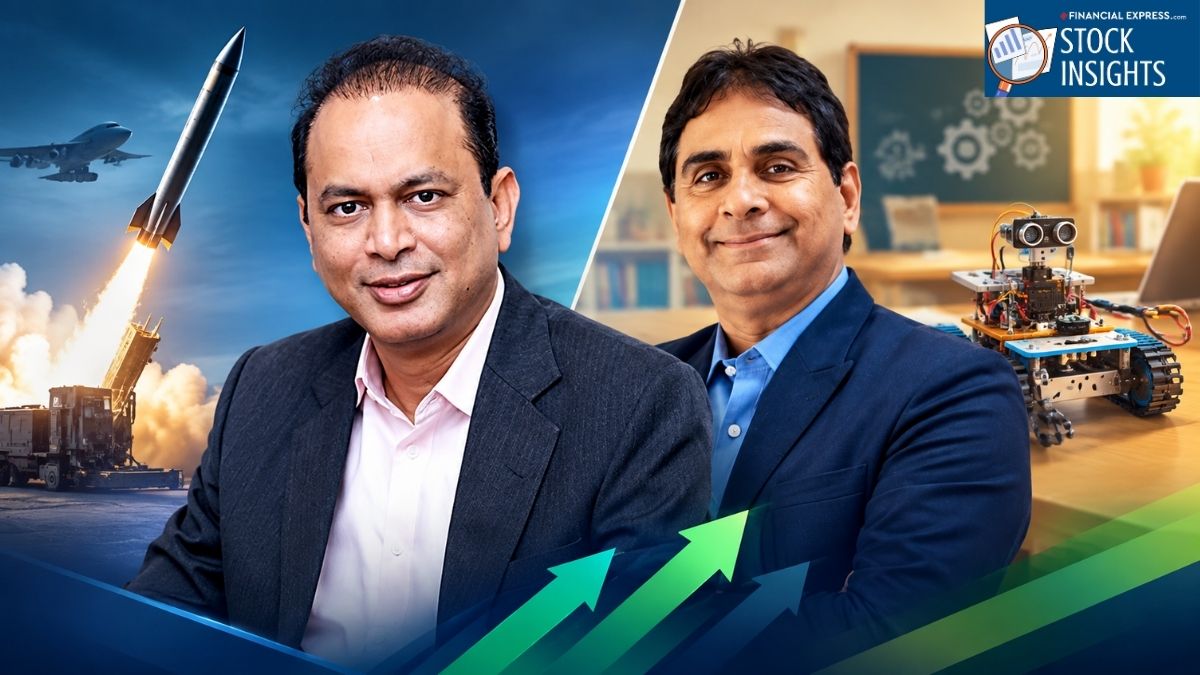
Sunil Singhania’s Abakkus Asset Manager bought 12.88 lakh shares of Axiscades Technologies for Rs 235 cr on 29th September 2026. Meanwhile, Vijay Kedia picked up 5.57 lakh shares of Robokidz Eduventures. Both investors showed interest in these firms as they focus on building new technology in defence and school labs.
Sunil Singhania‘s Abakkus Asset Manager bought 12.88 lakh shares of Axiscades Technologies in a block deal on 29th September 2026. Vijay Kedia, through Kedia Securities, picked up 5.57 lakh shares of Robokidz Eduventures from its promoter ahead of the company’s IPO. Robokidz listed on 28th September.
The two companies could hardly be more different in size. Axiscades is worth close to Rs 8,800 cr. Robokidz is worth about Rs 241 cr. But both sit on the same idea of India building its own technology, one in defence factories, the other in school labs. Let us dive in.
#1 Axiscades Technologies: Navigating the Shift to Missile Manufacturing
Incorporated in 1990, Axiscades Technologies is a Bengaluru-based engineering and manufacturing company serving aerospace and defence customers. Its subsidiary Mistral Solutions builds defence electronics, and the group is setting up manufacturing complexes, including one at Devanahalli near Bengaluru, for aerospace and missile work.
With a market cap of Rs 8,771 cr, the company is promoted by Jupiter Capital, the investment firm founded by Rajeev Chandrasekhar. Per Jupiter’s disclosure to BSE under the takeover rules, it sold 46.2 lakh shares on 28th and 29th September 2026, cutting its stake from 55.68% to 44.82% of the diluted share capital.
Abakkus took 12.88 lakh of those shares at Rs 1,824 apiece, about 3% of the company, for roughly Rs 235 cr. Kotak Mahindra Mutual Fund bought a larger 4.89%. The stock then hit its 10% upper circuit and closed at Rs 2,067, leaving Singhania’s stake worth about Rs 266 cr, a paper gain of 13% on day one.
From Services to Missiles: The Akkodis Deals Behind the Reinvention
The bigger story is what the company is doing to itself. In May 2026, Axiscades agreed to sell its engineering services arm for heavy engineering, energy and automotive clients to Zurich-based Akkodis for about US$ 30.6 million. In June, it agreed to sell its aerospace engineering services business to the same buyer for up to US$ 206.3 million, in two tranches. The first tranche, for 51%, should close by December 2026.
The fine print matters. Only US$ 77.7 million of the larger deal comes at closing. Another US$ 76 million is due 24 months later, and up to US$ 52.6 million depends on performance. Management calls the new direction the Power 930 plan, targeting about Rs 9,000 cr of revenue and Rs 960 cr of profit by FY30. For a company that earned Rs 72 cr in FY26, that is a bold promise.
Unpacking the Axiscades Growth Plan
Source: Screener.in (Consolidated)
EBITDA here refers to operating profit before other income. FY21 was a loss year, so the profit CAGR is marked NM (Not Meaningful). These yearly numbers also include the businesses now being sold.
The restated quarters are sharper. In the June 2026 quarter, revenue from continuing operations nearly doubled to Rs 183 cr from Rs 94 cr. Yet the company posted a net loss of Rs 15 cr, as its young aerospace manufacturing arm earned about Rs 6 cr of revenue against roughly Rs 13 cr of operating costs.
The Real Cost of the Power 930 Transition
The share price of Axiscades Technologies was around Rs 80 in October 2021 and as on 1st October 2026 it was Rs 2,261, which is roughly a 28x jump in 5 years.
As for the valuation, the share is currently trading at a PE of 293x against the current industry median of about 79x. The 10-year median PE for the company is 36x while the industry median for the same period is 50x.
Debt is the other watch point. Borrowings rose to Rs 388 cr in FY26 from Rs 258 cr, and on 24th September 2026 the board allotted another Rs 200 cr of unsecured bonds. Free cash flow was negative Rs 135 cr in FY26, and 23.51 lakh of Jupiter’s remaining shares are still pledged. So Singhania is buying a rebuild, not a finished story.
#2 Robokidz Eduventures: Kedia’s Bet on the Edu-Tech Market
Incorporated in 2014, Robokidz Eduventures is a Pune-based company that sets up robotics, coding, AI and electronics labs in schools. It designs the lab, supplies the kits, writes the curriculum and trains the teachers. It also sells subscription-based learning programmes and runs a handful of activity centres.
Kedia’s well-known SMILE rule favours firms that are small, fairly young, hugely ambitious and chasing a very large market. Robokidz ticks the first box easily. It has just 24 employees and a market cap of about Rs 241 cr.
Here is the key detail. Kedia did not buy in the open market. As per the company’s offer document filed with BSE, Kedia Securities bought 5,56,800 shares from promoter Sagar Sanghvi at Rs 77.50 each in September 2026, an outlay of about Rs 4.3 cr. That was about 27% below the IPO price of Rs 106.
The IPO, a Rs 31.09 cr fresh issue, was subscribed more than 580 times, with the retail portion booked over 800 times. The stock listed at Rs 201.40 and hit its 5% upper circuit on both of its first two days, closing at Rs 222 on 29th September. Kedia’s stake, now about 5.13% after the issue, is worth roughly Rs 12.4 cr, or 186% more than he paid.
Rapid Revenue Expansion vs Working Capital Demands
Source: Screener.in (FY26 Consolidated),Company RHP filed with BSE (FY24 and FY25 Standalone)
A five-year CAGR is not possible here, as the company has disclosed only three years of numbers. FY24 and FY25 are standalone figures and FY26 is consolidated, so the comparison is not perfectly like for like.
The growth however, is striking. Operating margin rose from about 13% to nearly 18% in two years. Subscription revenue jumped from Rs 2 cr to Rs 12 cr. As of 3rd September 2026, the company had about Rs 75 cr of orders still to be executed.
The weak spots are just as clear. Customers took 279 days on average to pay in FY26. Cash from operations was negative in all three years. Borrowings doubled to Rs 30 cr. The top 10 customers made up 78% of revenue, and Maharashtra alone 53%. Little wonder that Rs 23.46 cr of the IPO money is earmarked for working capital.
Of Liquidity and Lock-in Periods
At Rs 222, the share is valued at about 24x earnings against the current industry median of about 25x. The 5-year price history and the 10-year median PE are not available, as the stock has traded for only two days.
Robokidz trades on the BSE SME platform, and that changes the rules. Shares trade only in lots of 1,200, so a single lot costs about Rs 2.66 lakh today. Daily price moves are capped, volumes are thin and exits can be slow. SME companies report results every six months, not every quarter, and several governance rules for main-board firms do not apply. Pre-IPO shares, including Kedia’s, are locked in under SEBI rules for a period after listing. When those locks open, fresh supply can hit a thinly traded stock.
Rockets and Robots: What Singhania and Kedia’s Fresh Picks Tell Us
Both investors bought from the promoter at a negotiated price, and both are already in the money. That is where the likeness ends.
Singhania is backing a company rebuilding itself at 267 times trailing earnings, where nearly everything rides on Power 930. The risks are delayed Akkodis payments, rising debt, pledged promoter shares and a manufacturing arm that still loses money.
Kedia is backing a tiny company early, at a price retail investors could not get. The risks are slow-paying customers, heavy reliance on a few clients and a stock that has nearly tripled from his entry before reporting a single result as a listed firm.
Neither trade is a signal to copy blindly. Both bought at prices that are no longer on offer. The next few months will settle a lot. Axiscades must close the first Akkodis tranche, and Robokidz must deliver its first half-yearly numbers. Until then, it may be wiser to put both names on a watchlist and let the numbers do the talking.
Disclaimer
Note: We have relied on data from www.Screener.in and www.trendlyne.com throughout this article. Only in cases where the data was not available, have we used an alternate, but widely used and accepted source of information, including filings made available on the BSE website.
The purpose of this article is only to share interesting charts, data points and thought-provoking opinions. It is NOT a recommendation. If you wish to consider an investment, you are strongly advised to consult your advisor. This article is strictly for educative purposes only.
Suhel Khan has been a passionate follower of the markets for over a decade. During this period, He was an integral part of a leading Equity Research organisation based in Mumbai as the Head of Sales & Marketing. Presently, he is spending most of his time dissecting the investments and strategies of the Super Investors of India.
Disclosure: The writer and his dependents do not hold the stocks discussed in this article.