
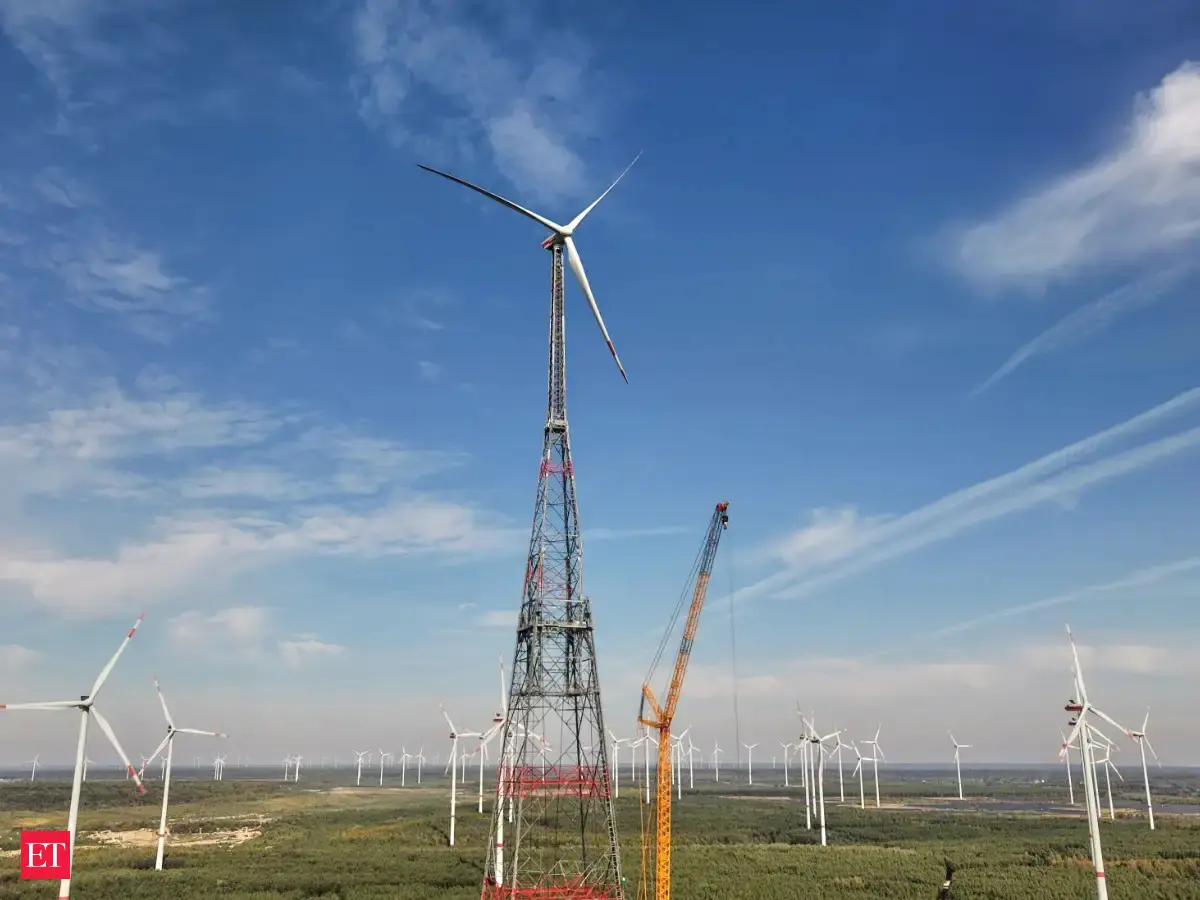
India’s wind industry must move beyond turbines to integrated power solutions, says GWEC. Chief executive Ben Backwell said, “I think we’re beyond the time where we can just sell wind turbines.” Companies should now combine wind, solar, and battery storage to help India reach its 100 GW target by 2030.
Synopsis
India's wind energy companies are encouraged to offer integrated solutions that include wind, solar, and battery storage. This shift is crucial as the country aims to reach its 2030 target of 100 GW of wind capacity. Improved policies and auction designs are helping, but coordination between agencies poses challenges. Grid deployment delays and permit issues are also key constraints facing the industry.
Hamburg: India’s wind energy companies need to move beyond selling turbines and offer integrated power solutions combining wind, solar, battery storage and grid management as the country’s electricity system shifts towards a renewables-based model, Global Wind Energy Council (GWEC) chief executive Ben Backwell told ET.
“We need to sell power solutions,” Backwell said, adding that wind companies need to understand electricity demand, pricing patterns and how different sources of power can work together.
“I think we’re beyond the time where we can just sell wind turbines,” he said.
Companies need to understand adjacent segments such as battery storage and solar, and how these technologies fit together with grid management and industrial demand.
Live Events
Backwell said the industry would increasingly need to develop projects around the requirements of the power system rather than simply respond to capacity targets.
This could involve hybrid renewable projects, partnerships with grids and offtakers, and projects designed around customers’ demand profiles.
“Projects are power projects. They’re not just wind turbines,” he said.
The shift comes as India seeks to increase annual wind installations to around 10 GW to stay on track for its target of 100 GW of wind capacity by 2030. India added 6.3 GW of wind capacity last year and could add 6.5-7 GW this year, according to Backwell.
The changing market dynamics also mean wind companies will need to become more entrepreneurial and partnership-driven, rather than rely primarily on government tenders, he said.
India, he added, provides an important example of how power markets could evolve globally as wind, solar and battery storage become increasingly integrated.
“The system could very easily just incorporate [renewables]” when the sector was small, Backwell said. But as renewables become a much larger part of the power system, companies will need to work out how different technologies fit together commercially and technically.
For India, one of the key challenges remains increasing annual wind additions from the current 6.5-7 GW range to around 10 GW. Backwell said the central government’s policy direction and ambition were supportive, with recent improvements in auction design and the management of wind, solar and batteries helping the sector.
However, coordination between different agencies and between the Centre and states remains a challenge. Grid planning, permitting and market mechanisms need to be aligned for projects to move from auctions to actual development.
For instance, capacity can be auctioned centrally, but projects can get delayed if the states expected to procure the electricity do not sign agreements because they do not find the terms attractive, Backwell said.
He said such coordination challenges were not unique to India and were also visible in markets such as Germany and the UK.
Grid deployment is also a major constraint for the global wind industry, Backwell said. Delays in planning, approvals, paperwork and studies can take longer than the actual construction of wind projects.
The industry therefore needs to work more proactively with governments on permitting, coordination and grid deployment, he said.
Backwell also sees an opportunity for India to emerge as a major global wind supply-chain hub. The country has sufficient supply-chain capacity not only to meet its own requirements but also to supply components to other markets.
Sustained growth in India, he said, would be important for maintaining that supply chain and creating opportunities for Indian companies globally.
(You can now subscribe to our Economic Times WhatsApp channel)
(Catch all the Business News, Breaking News and Latest News Updates on The Economic Times.)
Subscribe to The Economic Times Prime and read the ET ePaper online.
...moreless
(You can now subscribe to our Economic Times WhatsApp channel)
(Catch all the Business News, Breaking News and Latest News Updates on The Economic Times.)
Subscribe to The Economic Times Prime and read the ET ePaper online.