
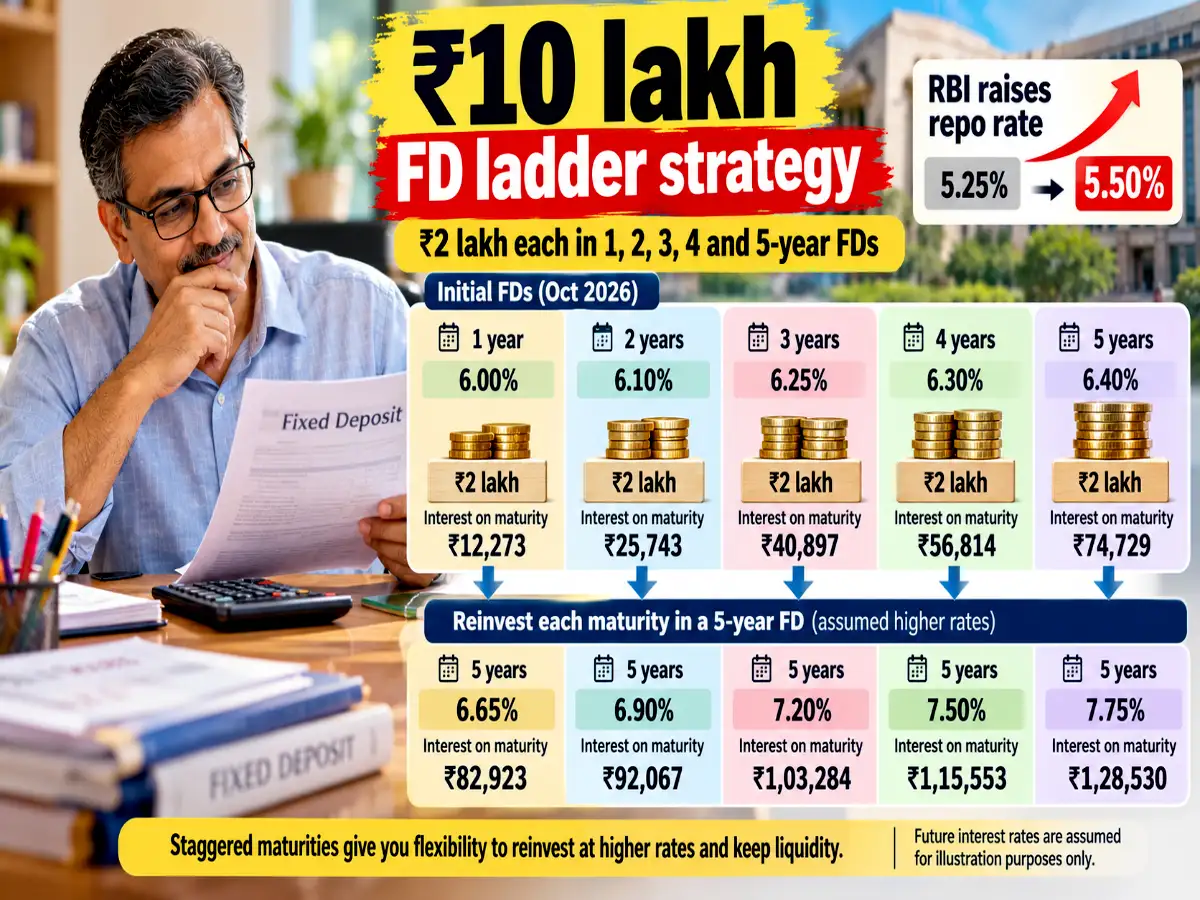
The Reserve Bank of India raised the repo rate from 5.25% to 5.50%. Investors can use FD laddering to manage a Rs 10 lakh investment effectively. “As the shortest deposit ends, the money can be placed again at the rate then on offer,” says Shetty. This strategy helps capture higher rates.
Synopsis
The Reserve Bank of India has raised the repo rate, which positively impacts fixed deposit interest rates. Investors should explore the FD laddering strategy for various tenures, allowing them to reinvest at higher rates as shorter deposits mature. Moreover, diversifying across different banks can boost insurance coverage. It's essential for investors to stay aware of their liquidity requirements and any shifts in interest rates when engaging in this strategy.
Listen to this article in summarized format
The Reserve Bank of India (RBI) has increased the repo rate from 5.25% to 5.50%. Retail inflation in August was 4.84% and has been rising due to global and domestic economic factors. These two factors are creating an atmosphere where banks can increase FD interest rates.
If it happens, it will be a great opportunity to invest for investors who have been going through the low-FD interest rate cycle for a long time and want to invest at higher rates.
But what if they invest a large amount in a single FD and banks increase interest rates further? Won’t they lose money?
For such investors, FD laddering can be a useful strategy where instead of investing in one FD, they can invest in multiple FDs of different tenures.
“As the shortest deposit ends, the money can be placed again at the rate then on offer,” says Shetty.
What is the FD laddering strategy for investors?
In FD laddering, instead of investing money in one FD, you invest it in multiple FDs with staggered maturity dates. When the first FD matures, you reinvest it into a long-tenure FD at a higher interest rate. When the second FD matures, you reinvest that too in a long-tenure FD at a higher rate. The cycle goes on till the last FD is reinvested into a high-interest FD.
E.g., you have Rs 10 lakh to invest in an FD. Instead of investing Rs 10 lakh in a low-interest FD of the 5-year tenure, you split the amount into Rs 2 lakh each and invest each of them in the 1, 2, 3, 4 and 5-year FDs, respectively.
After the first year, when the first FD matures, you reinvest the maturity amount in a 5-year FD providing a higher interest rate. After the second FD matures, you reinvest the maturity in a 5-year FD at a higher rate. The cycle continues till you reinvest the fifth FD. The advantage here is that if it’s a rising FD interest rate scenario, you will reinvest each FD into a high-interest FD, which will give high returns compared to investing Rs 10 lakh in a low-rate single FD. Since one FD will mature each year, you will also have liquidity.
Here is an FD ladder with a Rs 10 lakh investment split into five FDs of Rs 2 lakh each. The investment cycle is for 5 years, where each matured FD is reinvested into a 5-year FD.
FD (Rs 10 lakh) ladder of 5-year tenure at annual intervals
FD serial number / Booking month Tenure (years) Interest rate Interest earned on maturity FD 1 (Oct 2026), Rs 2 lakh 1 6.00% ₹ 12,273 FD 2 (Oct 2026), Rs 2 lakh 2 6.10% ₹ 25,743 FD 3 (Oct 2026), Rs 2 lakh 3 6.25% ₹ 40,897 FD 4 (Oct 2026), Rs 2 lakh 4 6.30% ₹ 56,814 FD 5 (Oct 2026), Rs 2 lakh 5 6.40% ₹ 74,729 Renewal FD 1 (Oct 2027), Rs 2 lakh 5 6.65% ₹ 82,923 Renewal FD 2 (Oct 2028), Rs 2 lakh 5 6.90% ₹ 92,067 Renewal FD 3 (Oct 2029), Rs 2 lakh 5 7.20% ₹ 1,03,284 Renewal FD 4 (Oct 2030), Rs 2 lakh 5 7.50% ₹ 1,15,553 Renewal FD 5 (Oct 2031), Rs 2 lakh 5 7.75% ₹ 1,28,530
Note: Future interest rates are assumed for illustration purposes only.
Should you invest in FDs simultaneously at a single bank?
Shetty says since banks may not pass on a rate hike at once, investors may also open these deposits over a few weeks.
Shetty suggests, “They can also look to spread them across banks, as deposit insurance covers up to Rs 5 lakh per person per bank, including interest.
Shetty is referring to the RBI’s Deposit Insurance and Credit Guarantee Corporation (DICGC) scheme, which insures all deposits with banks such as savings, fixed, current, recurring, etc., up to a maximum limit of Rs 5 lakh per bank.
For example, if you invest Rs 50 lakh in one FD or different FDs at the same bank, only Rs 5 lakh will be insured. But if you invest Rs 5 lakh each in FDs at 10 different banks, all your FDs will be insured.
Key things to consider while following FD laddering strategy
Vedant Gupte, co-founder and CEO, Trackk, suggests investors should consider that gaps between maturities should match when you’ll actually need liquidity, not just be evenly spread for its own sake.
Gupte also recommends treating the ladder strategy as a liquidity and rate-hedging tool, not a return-maximising one.
“If someone’s primary goal is beating inflation meaningfully, FDs alone, laddered or not, are the wrong instrument,” says Gupte.
Gupte says there is reinvestment risk at the tail end of a falling-rate cycle, where maturing tranches get rolled over at lower rates than before.
However, if banks raise FD rates in the next few years, FD laddering strategy can be useful for investors.